
MANITOULIN—Four of the five spring owl survey routes on Manitoulin Island reported above average counts in the spring, with three of the routes having the highest counts on record. “There are five established routes and each of these were surveyed and returned,” said Kathy Jones, Ontario programs volunteer coordinator for Bird Studies Canada. “Considering the snow loads and road access issues throughout Ontario this past April I am absolutely delighted that everyone managed to get their surveys in. We had a great mixture of new and experienced people.”
Ms. Jones thanked The Manitoulin Expositor for helping the organization to fill two empty routes. She noted that both new teams have indicated their interest in surveying again next spring, which helps provide consistent data over time.
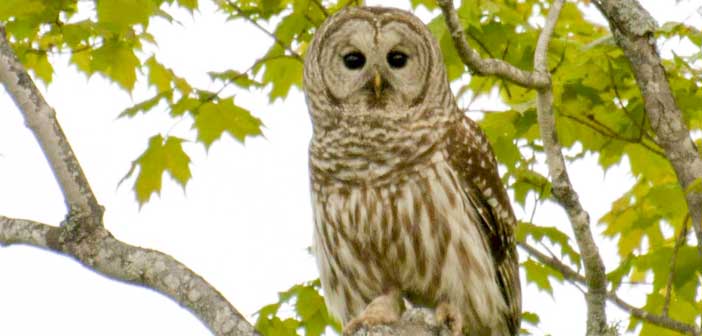
In Sheguiandah a record high 19 owls were counted, including barred owls, great horned owls, and northern saw-whet owls. The participant, who has surveyed this route for 18 years, also recorded sandhill cranes, American woodcocks and frogs, saying, “the owls came to us.”
On Lake Manitou’s northwest shore, four barred owls were recorded, as well as sandhill cranes, Canada geese, an American woodcock and a common snipe. This was an above average count for the participant, who has surveyed this route for 15 years.
In Allan, a record high eight owls were recorded by the participants, a couple who have been surveying this route for eight years. This included great horned, barred and northern saw-whet owls. Other species noted were American woodcock, Canada geese, and spring peepers (frogs).
Two routes had first time surveyors. The Lake Kagawong route recorded a record high count of 14 owls, including northern saw-whet, barred, and great horned owls. In Mindemoya, four owls were counted, an average count for the route. Barred, northern saw-whet owls, and a long-eared owl were recorded. Long-eared owls are unusual but have been recorded on Manitoulin in the past.
When asked how the count on Manitoulin Island compares with other regions, Ms. Jones explained, “The fact that they all managed to survey says a fair bit as the weather prevented a lot of access north of Manitoulin.” While the 2014 analysis has not been completed yet, the simple data as recorded suggests that Manitoulin had an above average population of owls this year. “We know the northern regions had a late and heavy snow load,” she said. “Perhaps many of the birds counted on Manitoulin in 2014 normally breed further north.”
The data is analyzed at a regional level. “How is a species doing in Northern Ontario? How is a species doing in Central Ontario? This is where the data has the most power. Certainly there is data for more regional and local extrapolations if the opportunity or need arises. Scientists and conservation managers can request the data for their own stewardship and research needs as well,” explained Ms. Jones.
None of the species targeted in this survey are species of concern or threatened at this time, Ms. Jones said. “But we want to keep our ‘common bird common.’ Thus, let’s keep an eye on them and ensure they are doing well. Particularly as these species use our northern forests and this is one of the best techniques for monitoring them.”
There are opportunities for all bird lovers to assist with ongoing monitoring. The southern owl migration is at its peak in mid-October and Bird Studies Canada is asking that anybody who hears or sees migrating owls such as boreal, screech, and northern saw-whet owls to report their observations at www.eBird.ca.
Project Feeder Watch is another program that birdwatchers can participate in over the fall and winter months. At regular intervals from November to April, thousands of feeder watchers count the kinds and numbers of birds at their feeders and submit those observations. The information helps scientists study winter bird populations. Find out more at www.birdscanada.org/volunteer/pfw.