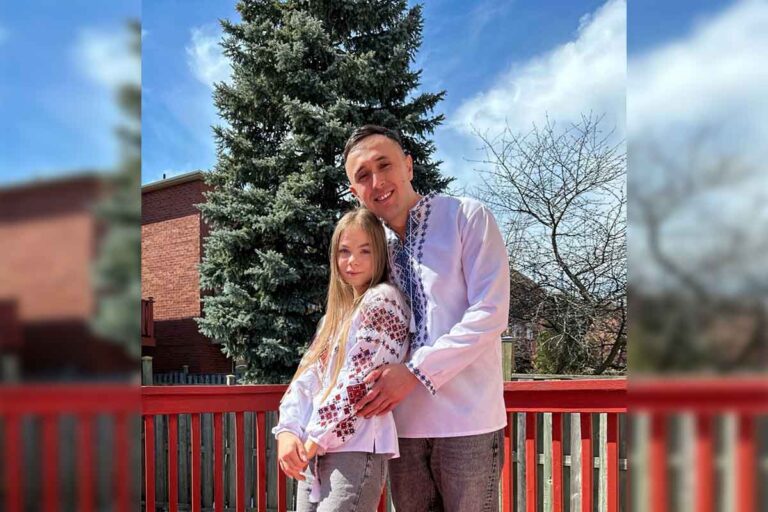
LITTLE CURRENT—The war in Ukraine continues to drag on with little end in sight since Russia launched its full-scale invasion in 2022. Since then, a number of refugees have come to Canada seeking peace and stability. But now, a number of those refugees are sitting on pins and needles as their temporary workers’ permits are reaching their end date—including those who have chosen to settle in Manitoulin communities.
A national petition has been launched by Liberal Party MP Yvan Baker (Etobicoke Centre) calling for a one-time pathway to Permanent Residence (PR) for Ukrainians under the Canada-Ukraine Authorization for Emergency Travel (CUAET) program. CUAET is a Canadian program that offered temporary measures to help Ukrainians and their family members affected by the Russian invasion. The program provided a pathway to come to Canada, stay for up to three years and apply for free open work and study permits.
The petitioners note that thousands of CUAET holders have been living and working legally in Canada for over three years, paying taxes, filling labour shortages and strengthening local communities. They have opened businesses, created jobs and actively contributed to local economies and community life—including Manitoulin.
Many are ineligible for standard immigration programs because of limited quotas, age limits, or “non-priority” occupations. There is a precedent for the request, in 2021, Canada created a similar pathway for Hong Kong residents.
“Supporting this petition means supporting Canada’s humanitarian leadership and helping people who have already proven their commitment to the country,” notes MP Baker. “Ukrainians have played a vital role in building Canada for more than 130 years.” Between 1891 and 1914, about 150,000 Ukrainians immigrated to Canada, mainly settling across the Prairie provinces, where they helped develop agriculture and rural communities. They contributed to the growth of Manitoba, Saskatchewan and Alberta through hard work, farming and community building.
Ukrainian Canadians have since become integral to Canada’s social, cultural and political life by serving as leaders, educators, entrepreneurs, artists and public servants. Today, more than 1.3 million Canadians claim Ukrainian heritage, continuing this legacy of contribution and community spirit and providing a special bond between the newcoming refugees and the established Ukrainian diaspora.
The petitioners note that this is not charity, but rather an investment in Canada’s future and in people who already call it home.
The petition proposes eligibility examples, including having lived in Canada for three of the last four years, being one year in a critical occupation or two years in other legal work or self-employment; ongoing employment or business activity; basic language and education; or at least one integration indicator (children in school, relatives in Canada, study, volunteering, etc.).
One such family are Ruslan Nosirov and his partner Hannah Stepanova. Mr. Nosirov is likely familiar to customers of the former sushi restaurant The Bear in Little Current, and most recently as the welcoming face at the order window of Dockside Social (the former Edgewater).
The Expositor asked Mr. Nosirov what made he and his compatriots decide that they wanted to come to Canada. He noted that after researching countries across the globe, our nation stood out. “Safest place in the world for me,” he said. “Safest place in the world. We looked for everything, like economy, everything, it’s really good for living. We didn’t know anything about Canada before that.”
He also noted the large Ukrainian community that has made Canada their home. That community helps to ease the transition into an unfamiliar land. “They give us tips what we need to do,” he said. “They help with suggestions on how to find work, on how to find accommodation, on how on the differences between here in Ukraine.”
“Now me and my girlfriend, we already applied to continue our work permits,” he said. “But I still wait, and it’s a long time.”
The backlog in immigration services is severe—and delays are causing a great deal of anxiety.
“I applied at the end of January, and they told me two or three months you will have it, but I didn’t,” he said. “Our work permits end in March because it will be three years.”
The situation in Ukraine has not gotten any better, perhaps even worse since the Nosirov family arrived on Manitoulin’s shores.
Mr. Nosirov notes that the Ukrainian government is considering limiting electricity to rotating blackouts. “Probably for everyday four hours without light, two hours with light after that, four hours without two hours,” he said. Mr. Nosirov recalls working for a year in blackout conditions. “My vision was low because we were using only candles in the restaurant.”
His partner’s family in Ukraine have had to take shelter in a train station where there is some hydro available. “It’s super hard to return there. Russians tried to destroy this sector (due to a factory located there).” The houses constantly shake from the explosion of bombs, rockets and drones.
For Mr. Nosirov, his family and the families of other Ukrainians, Canada has become their true home. He and his family have been volunteering, Mr. Nosirov with the Manitoulin Health Centre Auxiliary.
When he first arrived, Mr. Nosirov was suffering from PTSD, a situation that is finally beginning to recede. “It was really hard when I came here,” he said.
“I have some issues with PTSD, including nightmares and loud noises,” he explained. “The sound of snowmachines and helicopters would set it off. It was hard for me. I had couple sessions with a psychologist and after that it’s a little bit better. I’m feeling better.”
Now it is just the waiting that is hard.
The petition requesting a one-time pathway to Permanent Residence for Ukrainians can be accessed at www.ourcommons.ca by searching for e-6866 (Citizenship and immigration). Signing the petition is open to any Canadian citizen or resident.