SHEGUIANDAH—The tiny hamlet of Sheguiandah appears an unlikely candidate for an industrial centre today, but for several thousand years the unusual properties of the quartzite outcroppings, the remains of ancient mountains that poke up through layers of shale and limestone that have accumulated over the millennia, were at the centre of a stone age production.
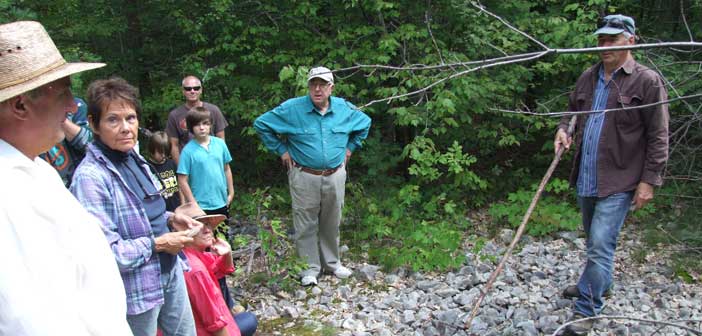
Geo-anthropologist Dr. Patrick Julig of Laurentian University guided two hardy groups of explorers up to one of the famed Sheguiandah archeological sites following unopened road allowances during the Sheguiandah Park Day celebrations.
Before setting out for the site, Professor Julig gave the tour group some background information on the history of the site, including the extensive work conducted by Thomas Lee in the 1950s. Collections of spear points and bioblanks from the site sit in collections at the Royal Ontario Museum and the Canadian Museum of History.
Pointing across Sheguiandah Bay, Dr. Julig explained that the water levels in the past have been much higher than they are today. The ‘steps’ that form various levels rising up to the top of the bluff provide a graphic indication of where the ancient beaches once lay.
Before setting out for the tour, Dr. Julig advised a number of would-be participants in sandals and sockless runners that they might prefer to don socks and perhaps more robust footwear. “There is quite a bit of poison ivy on the trail,” he advised. “The pathway is very rugged and the rocks and moss can be very slippery.”
In the event, his admonition, much like Dr. Julig himself, proved to be a bit of an understatement.
The party set out down a laneway but abruptly halted before ducking, quite literally, into the dense underbrush. Although there was once a well-defined pathway cleared to the site, the intervening years have seen a lot of brush grow up to obscure the route. This is largely a good thing, as the national historical site could be damaged by unrestricted public access as looters seek antiquities. Luckily for the photographs accompanying this story, most of the site and trail is unremarkably different from the rest of Northern Ontario new growth forest.
The first stop is near the bottom of the bluff, a middle period (2,500 years ago) site that is heavily covered with brush and trees. “We believe there was quite a considerable growth in population during this period,” noted Dr. Julig. The site has yielded numerous clues pointing to the wide-ranging trade routes of this period, including flints from Ohio, tobacco seeds and even pipe shards that most likely travelled to the area through trade with southern tribes.
A tour member picked up a small sharp piece of worked quartzite and asked Dr. Julig what it might have been. “It might have been intended as part of a skinning knife,” he conjectured.
Further up the mountain trail, while tripping over the slippery rocks, we enter into the Nippissing region, part of the Barr River formation.
Although the quartzite deposit rises up from the surrounding landscape, artifacts from the site and quarry pits are largely only found on one side of the bluff. “We don’t really know why, but something changed the structure of the quartzite on this side,” he said. “Somehow it was recrystallized to make it glassier.” True to his observation, shards of the rock flaked from stones in the area are incredibly sharp.
“The plants from this region are very different from what you find at other sites,” said Dr. Julig. “That is another feature that is very interesting about these sites.”
Dr. Julig showed how large chunks of raw quartzite would be struck with a hammer stone to flake off rough blanks. Rather than a finishing site, the Sheguiandah site was likely used to create these rough blanks as a raw material that the early hunter-gatherer artisans would take with them on their travels. “Maybe to be worked into more sophisticated tools during the dark days of winter,” he said. “We have found caches of these blanks that were probably intended by their makers to be picked up later in locations on the site.”
The anthropologist explained that each flake struck off of the blank, referred to as a bioface and distinguishable from natural chunks of quartzite by being flaked on both sides, would have a use as a skinning or scraping implement, or even an arrowhead. The blank would eventually be worked down to create a long thin spear point, which would then be lashed to a long stick to create a weapon ideal for bringing down mastodons, giant elk or beaver. These tools were created near to the extinction period for those massive creatures. The last giant beaver disappeared from the archaeological record about 10,000 years ago.
Dr. Julig showed how a pressure tool made from copper (found naturally to the west in the Superior basin) or from a piece of antler can be used to finely hone and shape the raw blank into useful tools.
As we reach the Lake Algonquin period level, about 1,300 to 1,005 radio carbon years, we come across what 1950s archeological explorer Thomas Lee nicknamed “Mystic Ridge.” “He called it that because it is a bit of a mystery,” said Dr. Julig. The mystery centres on how material at this site somehow escaped being scraped off by the glaciers. Tiny fossil teeth from the Ordovician period (about 500 million years ago) abound in the region, almost microscopic in size. Those teeth would normally have been destroyed by the passage of the grinding sheets of ice. “If the glaciers had deposited the material, the teeth would have been destroyed,” he said. “It remains a bit of an archaeological mystery. It is one of the things we have been working on since the 1990s.”
Dr. Julig was part of a team in the 1990s that sought, largely successfully thanks to carbon dating tools that were unavailable to earlier investigators, to reconcile the evidence from the Lee digs with the wider archeological record.
It was near the highest of the sites, dating to around 9,000 to 10,000 years ago, that the controversies surrounding Dr. Lee’s work came about. Lacking carbon dating tools in the 1950s, the dating of artifacts was a less exacting science. “They found mixed deposits that they thought were glacial till,” said Dr. Julig. “Since the last ice age was around 25,000 years ago—that’s where the idea came about.”
But it was Dr. Lee’s work, so meticulous in the recording of where artifacts were found, that eventually helped to solve the dating question.
“When we looked at the collection and started to put the pieces together, it was discovered that some of the pieces found at the bottom of the digs fit with those found on or near the surface,” he said.
Clues as to how that mixing of eras came about were revealed following the microburst that occurred a few years ago. “The soil here is so shallow that when a tornado comes through the trees are knocked over,” said Dr. Julig. The toppled roots drag material from far below the surface up from the deep and over the course of many thousands of years, like a slow motion mix master, the material from earlier and later periods become intermingled.
The tour group skirted a number of small swamps that investigation had determined were actually ancient quarry sites that had filled with water and plant material, eventually turning into peat through periodic drying periods. These peat deposits served as storage sites for food caches. “You can bury butter and meat in these peat deposits and it will keep for a very long time,” said Dr. Julig.
A number of times along the tour Dr. Julig quietly admonished group members to refrain from disturbing worked pieces of stone that might not have looked like much laying on the ground. “Those are ancient artifacts,” he smiled.
The trip up the mountain was certainly not for the faint of heart or infirm of limb.
“I might not have gone up had I known how rough it was,” admitted Little Current author and historian Sandy McGillivray, who was well shod in sturdy hiking boots and carrying a stout walking stick. “I could have used two of them,” he laughed.
Wikwemikong historian and former chief Al Shawana also braved the climb. Chief Shawana was one of the three area First Nations leaders (along with Aundeck Omni Kaning’s Patrick Madahbee and Sheguiandah’s Norman Augonie) who sat on the advisory committee for the dig in which Dr. Julig took part.
“It was all very interesting,” said Chief Shawana, who found himself being called upon by Dr. Julig for details of the earlier explorations.
After cresting the bluffs and looking out across the Sheguiandah valley, the tour group assembled for the trip back down the mountain, which proved even more challenging than the trip up to the sites had been.