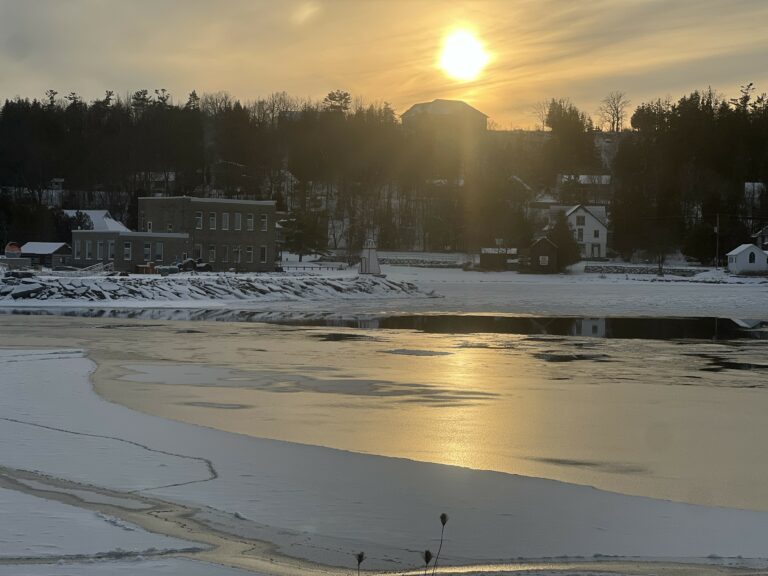
2024 kicks off with 50-year low in ice coverage
GREAT LAKES—On January 2, a meme began circulating online that the Great Lakes had the smallest ice cover on New Year’s Day in 50 years and that we are on track to see less than the seasonal average this year. The diminishing ice comes during a 50-year drop in ice cover that some scientists say is in part due to human activities contributing to climate change.
“It’s an extreme number,” said James Kessler, a physical scientist at the National Oceanic and Atmospheric Administration’s Great Lakes Environmental Research Laboratory (GLERL). “It is early in the season, and there is year-to-year variability. But on average, we are seeing less ice cover and shorter seasons.”
On New Year’s Day, the ice cover on all five Great Lakes saw an average of 0.35 percent, below the nine percent average we typically see this time of year, according to data from GLERG. On New Year’s Day 2023, more than four percent of the Great Lakes was covered in ice, while 2.35 percent was covered in ice on January 1, 2022.
While the low is staggering, climate scientists say that a one-day low is not as significant as consequential as month-long lows and that the most ice coverage generally occurs in February and March. In February 2023, the Great Lakes saw an all-time low of only seven percent, significantly lower than the 35-40 percent that is the general average, according to NOAA’s GLERG.
The Expositor spoke with James Kessler, a physical scientist from NOAA. He told us that while the organization collects and observes data points for each day, they often “collapse the data down” each year to one data point for simplicity.
In December, the North American Ice Service predicted this season’s below-average ice cover across all five of the Great Lakes—Superior, Michigan, Huron, Erie and Ontario. Warmer temperatures prevailed in December, and similar above-normal conditions are anticipated for January.
From 1973 to 2017, NOAA’s analysis revealed a staggering 70 percent drop in the average ice cover of the Great Lakes. However, Mr. Kessler cautioned that this figure might be misleading as it measured the percentage change rather than the actual percentage point difference in ice coverage. Moreover, the Great Lakes collectively experience up to 46 fewer frozen days per season, with at least five percent of the lake’s surface covered in ice. The most significant frozen-day declines are observed in Lakes Ontario and Superior, per the Environmental Protection Agency’s findings.
Mr. Kessler also said that while we might be at risk for another record low again this year if the warm weather persists, “in 2021, we had a record low January, the second lowest on record, and then we had a cold snap, and then the lakes froze 45 percent.”
“You don’t have to go back that far to find years with high ice coverage,” Mr. Kessler said. “But since 1973, when we began collecting data, the trend is a five percent decline in ice coverage per decade.”
Low ice coverage can impact weather events, such as shoreline erosion and lake effect snowstorms. Initially, the lake’s expanse of open, ice-free water diminishes, resulting in shorter fetch distances. Subsequently, as the water temperature approaches freezing, there’s a decrease in the total latent heat energy accessible to generate squalls. A complete freeze isn’t always required to cease the formation of lake-effect precipitation.
Liam Campbell of Manitoulin Streams Improvement Association (MSIA) says that reduced ice cover duration and extent on the Great Lakes could have several consequences for nearshore environments and the plants and animals that utilize them.
“Ice and water reflect light differently and absorb different amounts of radiation from the sun,” he explained. “The amount of light reflected by a surface is called ‘albedo’; ice has much higher albedo than water. This means that water reflects much less light and absorbs much more radiation, leading to warmer water temperatures. It occurs at a much larger scale at the earth’s poles and is known as the ice-albedo feedback loop. As temperatures rise, there is less ice, and for shorter periods, this leads to an increase in water temperatures and a further reduction in ice cover. Hence the name of ice-albedo feedback loop.”
He pointed out some of the immediate impacts that a long-term decline in lake ice coverage could cause for Island residents.
“Ice also protects the shorelines of the Great Lakes from harsh winter storms,” Mr. Campbell continued. “If there is reduced ice cover through the winter, the wave action created from extreme weather events results in increased shoreline erosion. The energy from waves at a time of year when there are not as many plants to act as a buffer further increases the amount of shoreline erosion. This increase in wave action also has implications for some important fish species in the Great Lakes. Whitefish, for example, typically spawn in nearshore shoal environments (1-3 metres) from November to December when ice historically was beginning to form. Reduced ice cover and increased wave action could significantly impact whitefish in the long run as the ice is no longer present to protect the eggs from wave energy and sedimentation caused by increased erosion.”
Another form of erosion that is less known is called lakebed erosion. “Lakebed erosion typically occurs as part of a natural cycle, but it is increased during extended periods of low water, like the early 2000s to mid-2010s,” Mr. Campbell explained. “When water levels are down, the energy from waves breaks further from shore than usual, which leads to erosion beneath the water away from the shoreline. While this isn’t visible to us, its impacts certainly are. When water levels rise again after an extended low-water period, the nearshore environment beneath the waves has eroded away, leading to faster and steeper drop-offs nearshore. In another feedback loop, this leads to increased shoreline erosion as the water has less shallow areas to break and lose energy, meaning it hits the shore with increased energy and erosional force.”
Radiometry data and visible satellite imagery are vital tools for scientists in assessing sea ice extent. Each method has its own set of strengths and limitations, and for further insights, the National Snow and Ice Data Center is an invaluable resource. Certain satellites use gravity measurements to detect subtle ice sheet mass loss, while others use lasers to gauge ice elevation above land.
Mr. Kessler says that one aspect of ice measurement the NOAA still needs to perfect is the thickness of the ice. “It would be very interesting to have access to that data. However, we also do not want to encourage people to go out on thin ice to record it.”
Since December 28, 2023, there have been three fatalities in Ontario involving people falling through thin ice.