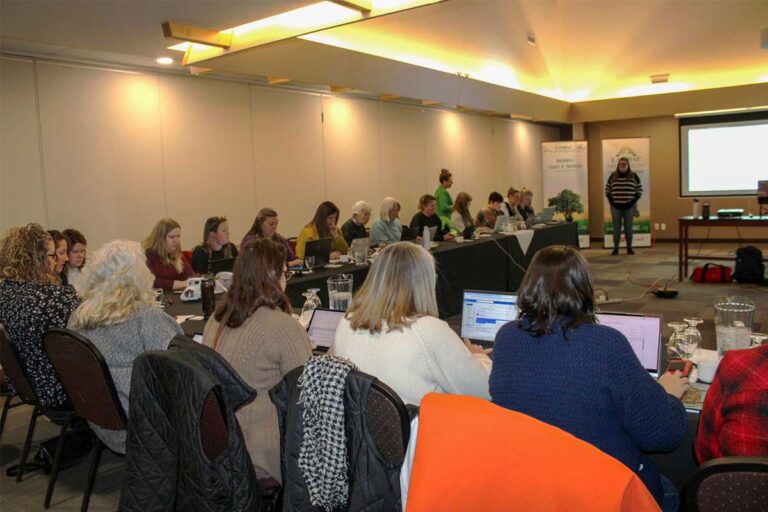
LITTLE CURRENT—On Wednesday evening, December 10 and Thursday afternoon, December 11, at the Manitoulin Hotel and Conference Centre, a very interesting and quite popular interactive workshop was being conducted by Avery Swartz, founder and CEO of Camp Tech. Her workshop was all about ChatGPT and AI. The program was hosted by Susan Whynott of Northern Ontario Women (NOW), and many women, and one gentleman at the Thursday workshop, came out to hear about and learn through their laptops and other devices, how ChatGPT might help their businesses.
Ms. Swartz is a self-declared tech-nerd, and she began her workshop by having everyone state their name, the company they work for (or not, if they were there out of curiosity), “and, fill in the blank with one word. ‘I feel__ about using AI in my business.’ The answers varied, though there were some repeats: confused, was a popular one, as was conflicted. nervous, uncertain, scared. ‘Opposed,’ came from this writer. That got a laugh. “But you’re here,” said Ms. Swartz, “that’s good.” To which Ms. Whynott informed Ms. Swartz she had asked the press to come to cover the story. More laughter.
“This is my job, teaching people about technology,” Ms. Swartz said. “This is what I love to do. I own a company that’s a tech education company; I’ve been doing this for about 14 years” she said. “I’m here to give you practical advice.”
For two hours, Ms. Swartz did exactly that, she gave advice that was helpful, instructive, informative (what not to tell ChatGPT) and useful. She began by saying, “AI is everywhere,” and, on the screen behind her she produced a list: “In the last 24 hours, have you: Unlocked your smartphone with your face? Used auto complete? Scrolled social media? Used Google Maps of Waze for directions? Logged into online banking? Listened to a song that Spotify suggested? Removed something from a photo? Had an email go to your spam folder? Charged your smartphone? AI has actually been in our lives, and we have been using it for a very long time,” she said.
She spoke of Generative AI, how it scans its training data for ‘patterns,’ tries to predict what words come next based on patterns, but does not understand the meaning behind what it generates. She warned of “hallucinations.” AI tools will never say it does not know, instead, it will generate a response that sounds confident but is incorrect. In other words, it lies. Generative AI is best used when you can verify the information given, when there’s more than one right answer. Don’t use GenAI when there’s only one right answer, and you can’t check its accuracy. Ms. Swartz also warned against giving sensitive information to GenAI and because GenAI makes stuff up—always verify the output.
She then took everyone on a tutorial of hands-on activities. Opening ChatGPT was first and foremost, either signing up or signing in, if you already have the app. A few did. She warned, it’s a free app, but with some of the assignments, you may hit a wall and they’ll want you to pay. “You can skip those,” she said.
The first assignment was to have ChatGPT write an email. Then, add context and detail to sound more personal but, she warned, do not give confidential information. Everyone was instructed to have ChatGPT make the email sound more casual, shorten it to two sentences. The assignments continued, all the while Ms. Swartz was instructing, warning and educating about the benefits and the dangers of this technology. She explained how to add tone, voice and style to AI with prompts. Then how to save those prompts in a file on your computer so you don’t have to write them out each time you use AI. The third exercise was to have ChatGPT take a copy of your handwritten notes and turn them into a task list. This was of most interest to those in attendance. It can take a photo of your handwritten notes and turn it into something useful. Ms. Swartz showed everyone how to use voice rather than written instructions. She asked AI to interview her to create standard operating procedure for recurring tasks. Lastly, she had everyone creating images by typing in prompts – a woman in a suburban setting walking a large dog. Impressive.
Many did all the exercises, pleased with the results. Some got lost along the way and others were too skeptical or fearful and did not invite ChatGPT into their laptops.
Ms. Swartz wrapped up her session by covering the pros and cons of AI. It saves time, you can offload mundane tasks, spark new ideas, improve customer service, lower costs and level the playing field. The risks: disinformation, deception, impact on jobs, environmental impact, eroding critical thinking skills, data privacy/security, copywriting and regulatory issues, bias, disclosure and reputational risk. Ms. Swartz concluded by covering the ethical aspects of AI: ‘Is this tool good for this task? Or am I using AI because I’m lazy? What’s the environmental impact of my AI use? Am I taking work away from someone else? It’s important to think about these things and mitigate as much as possible. I want to mitigate ‘hallucinations.’ I want to improve the work; I want to mitigate algorithmic bias. And then there’s accountability. I think about accountability all the time. If I’m not accountable, then I shouldn’t use AI.”
Ms. Swartz showed some technological wizardry at the end of her presentation to demonstrate various ways to enhance one’s business presence on the world wide web. Stressing all the while, the importance of fact checking for accuracy before trusting the AI generated results.
“I attended a workshop of Avery’s down in Parry Sound last fall,” Ms. Whynott said when asked how she came to invite Ms. Swartz to Little Current, “and thought ‘wow, I need to get her up here.’ It took us a while of going back and forth to nail down an opening in her calendar, but I’m very glad we did.” Everyone who attended her workshops was very glad she came. Her presentation was thorough, informative and entertaining. Though better educated about ChatGPT and AI, some who attended are still conflicted, uncertain and scared, but that’s okay. Having listened to Ms. Swartz’s warnings they have an even better understanding of why they’re conflicted, uncertain and scared. Knowledge is power.
by Margery Frisch