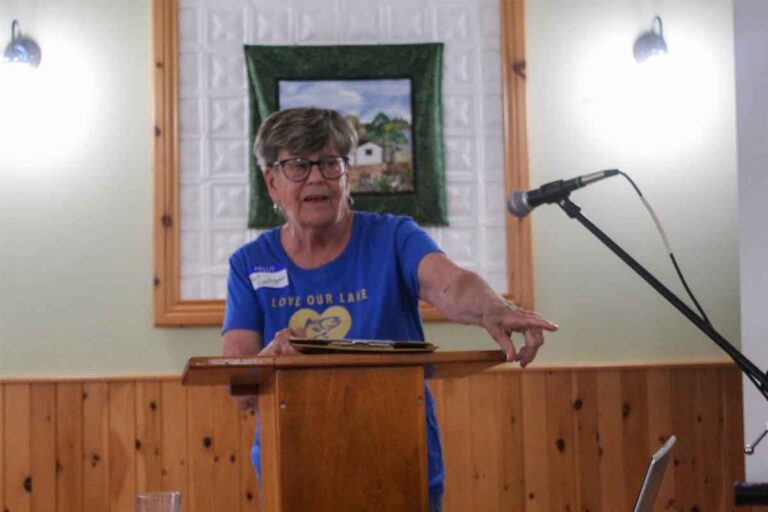
SANDFIELD—Part of a Lake Manitou and area camp/cottage history project being undertaken by the Lake Manitoulin and Area Association (LMAA) at the group’s annual information night was a story read by Pat Costigan of one of the cottages and a first-person account of “the big fire” on Manitoulin that occurred in the late 1880s.
In providing a brief history of the Edward Cottage on Manitou Lane, Ms. Costigan explained, “the first owner of this camp was Alexander Clark Edward who came to Canada from Edinburgh to investigate an oil discovery in southwestern Ontario. He found it to be quite profitable, so he remained in Canada, married a Canadian girl, Jane (Jennie) Dawson, and they raised a family of six children: one girl and five boys: Mary Lee, M.D., Alexander Clark, Fred Hayne, Charles Kemp, Harry Becher and Thomas Dawson. The family was raised in Petrolia in Lambton County.”
In telling the story of the family Ms. Costigan read, “One of their favourite stories that I would like to share is about the “Big Fire” on the Manitoulin. There have been several theories about what actually caused this fire, but this is what Dr. Edward, daughter of the first owner, wrote in her book ‘Reflections of Dr. Mary Lee Edward.’
“One year, it must have been about 1889 or 1890, while we were small children and some of the family were not yet born, a devastating forest fire raged over the whole Island, not long after we had arrived. It was said to drive away evil spirits. We could get very little information about it.”
“We could see the trees across the lake nearly a mile away going up in flames and crashing to the ground,” read Ms. Costigan. “We had no place to escape to, but the fire appeared to be at a distance. In a short time, however, the smoke seemed to be covering the land over most of the far side of the lake and to be advancing and creeping around the end of the lake. All day long it crackled and burned, and trees fell. The sky was yellow and full of smoke and large tree trunks were smouldering on the ground. It was a terrifying sight!”
“Day was advancing, and we could do nothing but watch the fire,” read Ms. Costigan. “As the sun got lower, the red glow in the sky was everywhere. Soon, it was all around us except in front of our camp and a little on one side. We three children were in our night clothes—one a baby, one able to walk a little and myself, nearly four years old.”
“Suddenly, we were told to get into the rowboat. Our mother helped us and the maid got into the punt and pushed off out onto the lake. Not long after, we went back in to get blankets and we children were put to bed in the rowboat and the maids slept in the punt,” Ms. Costigan continued reading. “Luckily, it was a windless night and the lake was quiet.” “We watched the fire a long time. As night advanced, the fire seemed to be burning itself out before reaching our tents. There was a small clearing back of the house which stopped the fire and protected the house and tents. It was a desolate scene in the morning.”
“It was said that 100 years would have to pass before the Island would recover its beauty,” read Ms. Costigan. “The devastation was a sad sight with heavy, charred trunks of trees and brush piles forming the landscape for years. Gradually, raspberry bushes grew up in the bush piles between charred trees and green branches appeared here and there.”
“Isn’t that an interesting story?” stated Ms. Costigan.
Ms. Costigan explained, “20 years ago, in 2006, long-time LMAA member John Harvey suggested we develop an historical map of Lake Manitou and area. Two years later, in 2008, this beautiful map was published. All the places on that map were then researched and in 2011 we produced, ‘Lake Manitou Historical Tidbits.’ These two projects have been so popular that we have had them reprinted. One of the features of the book, that I really like, is that all the places are in alphabetical order, so it is very easy to find what you are looking for.”
“It was at that point that we started to encourage people to write the history of their camps or cottages. Some of these histories have been published in past issues of our newsletter “Windswept,” continued Ms. Costigan.
Ms. Costigan explained that a few years ago Jane Harding, another long-time member of LMAA suggested the group collect the histories of all the camps/cottages around the lake and produce a hard cover book! “So that is now our current exciting project. You would have heard about it in our last newsletters.”
“We hope you will contribute to our book by providing us with the story or history of your camp/cottage. The more camps/cottages included, the more interesting our book will be. To make it easier, we have created a template or format that you can use in writing your history,” said Ms. Costigan. The template includes having the name of the property, camp, cottage including the postal address and location, current owners or residents, the original owners who built the cottage, along with subsequent owners, describing the camp cottage, and camp memories, stories and photos.
Ms. Costigan provided the story of the Edward camp/cottage and on the north shore of Lake Manitou the story of an imposing two-storey structure constructed by local craftsmen for American tourist Robert Wallace in 1907.
“I think one of the most interesting details in your history is to find out what brought you to the Manitoulin and specifically to the Lake Manitou area,” said Ms. Costigan. “Some of us were born on the Manitoulin, so our roots are here, but it will be fascinating to find out why you and your family are here.”
“So far, we have received 12 camp histories/stories. How many of you have started your camp history? How many are going to start it tomorrow?’ asked Ms. Costigan. “We encourage you to join us, documenting the history of our camp/cottage to share with our own family and to share with others in the new book LMAA plans to publish,” noting the book could include cottages of the Lake Manitou area, not just Lake Manitou. “Our goal is to have all histories in by June 2026, with the book hopefully published the next year.”