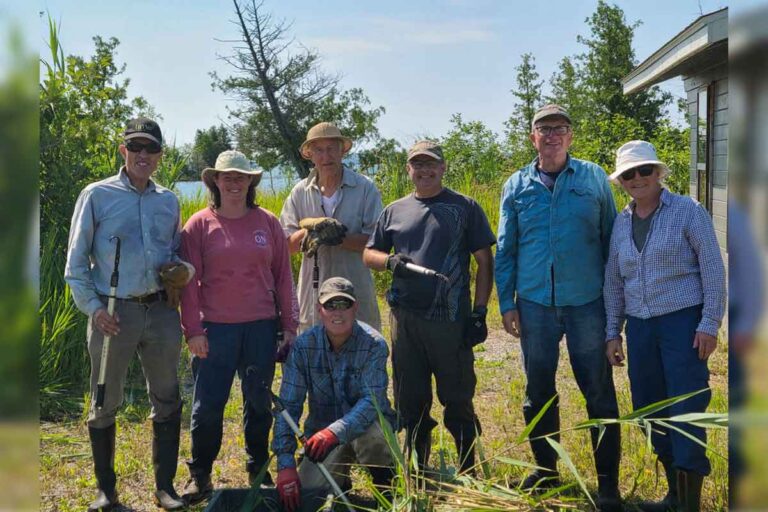
LAKE MANITOU—A hardy group of dedicated volunteers from the Lake Manitou and Area Association (LMAA) and the Manitoulin Phragmites Project gathered on the shores of Gushy Bay, off Bidwell Road, to tackle control of a patch of the invasive reed phragmites.
The effort to challenge Canada’s number one most destructive invasive plant was the first by the LMAA since biologist Judith Jones announced she would soon be stepping back from overseeing the project on Manitoulin—handing off the effort to local groups and municipalities. Ms. Jones was, nonetheless, still part of the LMAA effort.
“Once the grass gains a foothold it can quickly smother the other vegetation,” noted LMAA President Sharon Cooper. “In some cases, it can make access to the water nearly impossible.”
In addition to forcing out native species, the invasive reeds can cluster so close and thick together that turtles and some species of fish cannot reach their spawning areas.
So it was that on the morning of July 23, eight LMAA volunteers lead by Phragmites Project Coordinator Judith Jones, met at Queen’s Lane off the Bidwell Road.
“Our mission was to remove phragmites from a section of the shoreline on Lake Manitou at Gushy Bay,” said Ms. Cooper. “This was the second year for work at this spot.”
Ms. Cooper noted that Ms. Jones did the preparatory work for Gushy Bay, “establishing landowner permission to access the invasive grass, supplied tools, equipment and technical expertise. Volunteers came prepared wearing tall rubber boots, and they did their best to avoid stepping into deep wet holes.”
“The tall thick stems of grass measuring approximately three meters in height are cut off below the water line with raspberry cane cutters,” noted Ms. Cooper. “The cut stems are removed and transported by trailer to a disposal site (a dry place where the material dries out). Once the grass is dry, it can be burned or taken to the dump. It is important to collect all the pieces of stem that were cut so they don’t float away and infect the surrounding area.” Phragmites is so aggressive that even a tiny piece of stem can establish a new patch.
“It was noted that that grass was considerably less thick than the previous year,” said Ms. Cooper, “so the removal project is having a positive effect on reducing phragmites.”
She went on to add that further treatments will be required to, hopefully, eradicate it from Gushy Bay. “The work this summer helps to contain this patch and will stop the grass from spreading and invading other shoreline areas of Lake Manitou,” she said, adding that Ms. Jones “will do follow up work to control any of the grass the LMAA volunteers missed.”
“This is one example of how a community action group is striving to protect and improve our local environment now and for the enjoyment of future generations,” said Ms. Cooper. “This activity helps the LMAA fulfill its mandate and moto, ‘Let’s Keep Our Lake Great,” she added. “Thank you to all the LMAA volunteers and Judith Jones for making this a successful venture. Hope to see you back next year.”
Other groups across the Island were also out during Phrag Week putting their shoulders to the wheel to ensure the reed does not despoil Manitoulin’s shores.