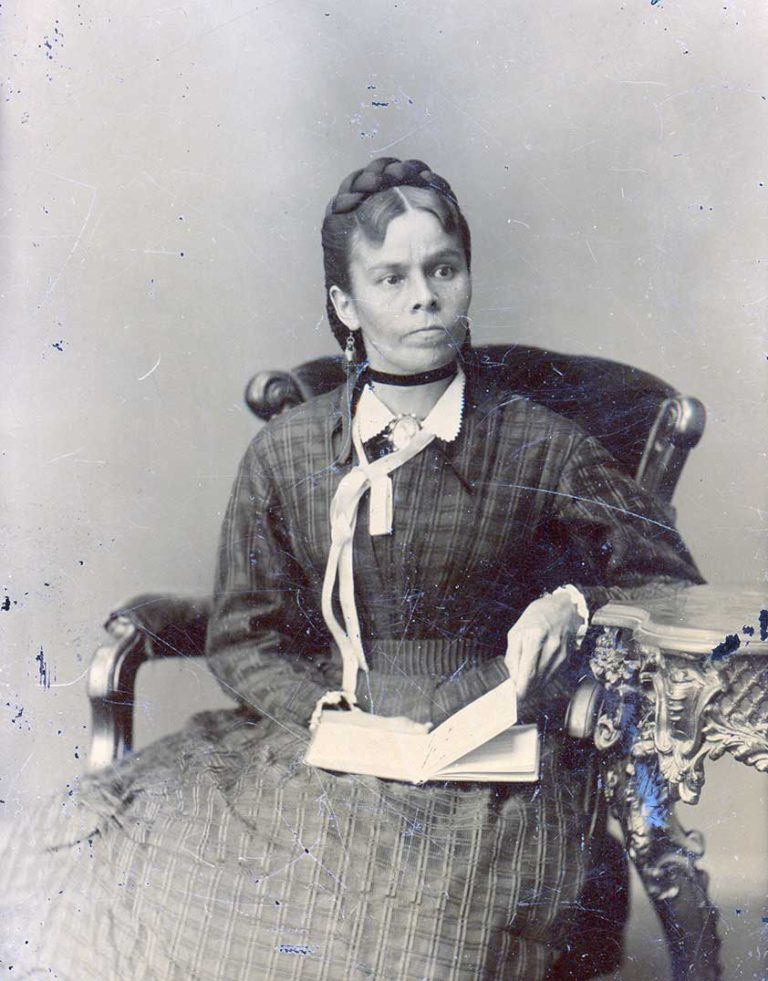
AUTHOR’S NOTE: This is a story of a woman whose faith in God and whose love for her people motivated her to struggle for the just settlement of First Nations land claims well over 100 years ago. I wrote this paper more than 30 years ago for a church history course, and thought that perhaps some people might be interested. Obviously, the issue is still not settled.
by Rev. Martin Garniss
Nahnebahwequay, which means “upright woman,” was a full blood First Nations member of the Mississauga tribe, a sub-group of the Ojibwas. She was born in the fall of 1824 on the flats of the Credit River, now known as Port Credit. Her family had been baptized into the Christian faith not long after her birth. At the age of 12, she herself embraced Christianity. She took the English name Catharine Senegal. Two years later, in 1839 at the age of 14, she married an Englishman, William Sutton.
William was a teacher and a preacher and together they made their home with the River Credit Band for the next few years serving as missionaries to their people. In the late fall of 1845 the Suttons were one of three families that moved from the Credit to Owen Sound. The Newash Band at Owen Sound gave the Suttons about 600 acres of land on Georgian Bay.
A few years later the Suttons were called away from their new home. From 1852 to 1854 they lived at Garden River Reserve near Sault Saint Marie where they oversaw the working of a model farm set up for the benefit of the First Nations people. From 1854 to 1857 they worked on a Methodist mission on a reserve in Michigan. In 1857 they returned to their 600 acres in the Owen Sound area.
However, the situation had changed in the time they had been away. In 1854 a treaty allowed Europeans to take over all of what is known today as the Bruce Peninsula with the exception of the five reservations, one of which was Newash. In 1857 another treaty surrendered the Newash Reservation. When the Suttons returned in 1857 they found that their property had been surveyed and the title to their land was not recognized as valid by the “Indian Department.”
The First Nations lands including that of the Suttons were put up for auction. Mrs. Sutton, as well as some of the others, purchased back their own lands at the auction. But the certification of sale was withheld on the grounds that “Indians” could not buy back their land. Catharine Sutton appealed to the Legislative Assembly of Canada. But no results were heard from this appeal.
A meeting of the First Nation people concerned was held in July of 1859 at Lake Simcoe. It was decided to petition England and Catharine was chosen as deputy. She was appointed as their special envoy to represent the chiefs and the people involved in making known to the British government the peculiar and oppressive circumstances under which the First Nations in British North America were placed.
The local Methodist preacher at Newash persuaded Catharine to wait while he and a deputation of First Nations folks appealed to the government in Quebec, but they were not even received, so, they proceeded to Toronto at a later date in another attempt to change the government’s decision.
Catharine had waited long enough. She set out for England in April of 1860. Since no funds were available for her to make the trip, she had to raise the money herself. She went to New York where the Society of Friends paid her way to England and sent her a letter of introduction to the Quakers there.
With the aid of some people in England she met with the Duke of Newcastle in London and she later met with Queen Victoria, no less, and explained the wrongs committed against her people. There was good coverage in the English press. The Queen promised action. The Duke of Newcastle visited Canada in September of that year where William Sutton was part of a deputation to Toronto to see him. Much had been promised but little was ever done. The Suttons were allowed by special purchase to obtain three lots (about 200 acres).
Catharine had shown great courage in making this trip. While she was in England she gave birth to their seventh child. On her return from England, Catharine continued her struggle for the rights of First Nations. Just because they had been allowed to purchase the land did not stop her efforts for justice. She wrote many letters of protest. Included amongst her many efforts she opposed the extinguishment of First Nation land titles, she objected to her people being referred to as monkeys, and she was critical of First Nations land being bought up by speculators from Toronto. She was also very much aware that the government was anxious to secure Manitoulin Island. In her letters she claimed always that First Nations people have a right to justice, a right to good reservations and a right to be paid fair valuation for any lands which they may agree to surrender.
Unfortunately, Catharine was not well for about the last two and a half years of her life, suffering from asthma, but she continued to be active in her struggles for justice until the very end. Just before her death she had written to the Quakers in New York asking for some bibles in Ojibway for some friends in the north. She died very suddenly on the eve of September 26, 1865 at the age of 41.