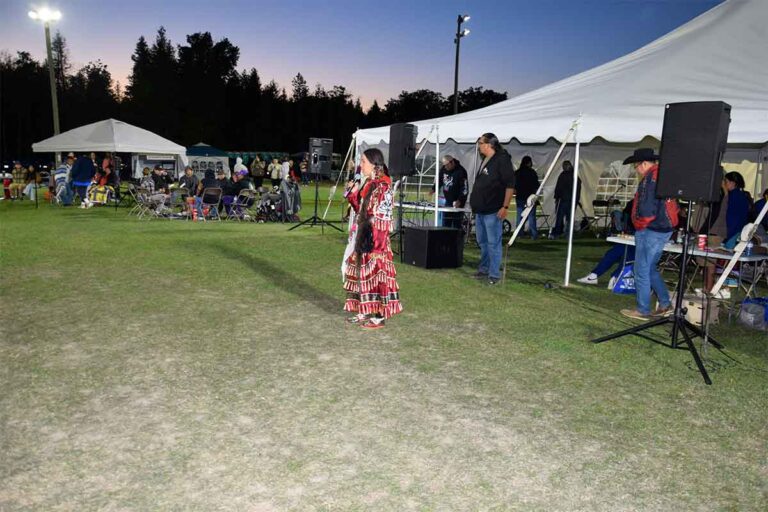
BIRCH ISLAND—The Whitefish River First Nation traditional powwow was held over the past weekend and, on the Saturday evening of the event, a very special gathering took place in the dance arena—the Red Dress Special, hosted by Missing and Murdered Indigenous Women and Girls Two Spirit advocate Nina Toulouse and the WRFN Anishinabe Aadiziwin Program.
Ms. Toulouse, a WRFN band member, has advocated and spread awareness of MMIWG2S through school and boardroom presentations, community walks and she presented a short talk on that tragic issue that is still ongoing.
Ms. Toulouse’s mother, Linda Mae Toulouse, was found murdered in a small room in Sudbury’s Ledo Hotel in 2020. She explained that she was originally going to be putting on a Red Dress Special last February, but circumstances had prevented that taking place. Over the last couple of years, Ms. Toulouse has been holding community walks and other events to bring awareness to the issue.
“We also walk to raise awareness for Missing and Murdered Indigenous Women and Girls, in hopes there is justice for them,” she said. “We also walk for those families who have been impacted by domestic violence, gender-based violence and human trafficking.”
“I wanted to bring this forward also to remind my community, even though I haven’t been here for a little bit, I want to let everybody know that I still hold this community in my in my heart, where I come from,” she said.
Ms. Toulouse explained the evening’s agenda. “I have given some semma (tobacco) to my helpers to help the creation of this Red Dress Special,” she said. “I asked a grandmother to come in to speak on behalf as well as a brother and close friend of mine. There’s going to be four songs, because we want to do things in a good way and honour the four directions. So, the first song will be an honour song. I’m going to dance two push-ups, and then we’ll have our red dress dancers come in.”
Ms. Toulouse instructed the dancers, jingle, women’s traditional and fancy shawl, to gather in a circle in the dance arena.
Out of the dancers taking part, four would receive special prizes, first $1,000, second $800, third $600 and fourth $400. There were also gifts for all of the participants.
Ms. Toulouse said that she wanted to bring the issue to life.
Grandmother Carmen Pitawanakwat told a story of a New Credit First Nation Chief who travelled with his wife and daughter to Toronto. “They were going to meet some officials over there,” she said. “When they went there, they met them, the one that made it back was the chief of that reserve. Those two women never made it back and were never seen again. So, we have a long line of history of this MMIWG2S in Canada for Indigenous women. I, too, have been affected through the loss of the Sonia (Cywink). She and I were friends when we were younger and we spent time together and one of the things I always look forward to with her was her birthday. I was always invited to her party.”
Ms. Pitawanakwat recalled their conversation, the kindness in her heart and the love they had for their people and family.
“When I look at the situations where our young ones or the women are going missing, it hurts,” she said. “Because when that happens to one, it happens to all of us. So, I’m standing here today and acknowledging and I’m going to encourage the younger women who are doing these things to keep going. Only through awareness are they going to be able to bring light to this situation that continues to happen on a daily basis. They can’t stop, because I’m looking at the little ones here in this circle—we need to make sure that they’re going to feel safe where they’re going to go and the things they’re going to do. This is what we need to do as a community: Make sure our children are safe. Our women are safe. Everybody in the community feels safe. And how that’s going to happen is that kindness in your heart you need to continue sharing. Not just here—take it home with you and share it there. Share it everywhere, everywhere you go. Because we all carry that, that’s the medicine Creator gave us. So, we can continue to stand in these places.”
Richard Tabobondung was then called forward to speak on behalf of the men. He explained that he had been asked by his friend Ms. Toulouse.
“I was kind of hesitant to say yes to my friend, to talk about this,” he said, “because I too didn’t understand it that very much when I was younger. But as I grew older, I understood the roles of men as an Anishnaabe man. What it entails. We talk about protection. We think that’s just the physical, but it is also emotional and spiritual.”
“The residential school has really affected our people, both men and women,” he said, “it showed us the weakness that we had inside of ourselves when it came from the drugs and alcohol. And how it affected the men.”
Mr. Tabobondung said that protection of the community is a responsibility. “A responsibility to care for everybody. To protect everybody. In a good way. Using those Seven Grandfather teachings. Holding ourselves accountable for the actions that we do. It might not affect you, it might affect your daughter, your sister, your mother, your grandmother. I’m lucky to have all of them, and I’m lucky to not have had that happen to any of my family.”
He discussed the respect he has for women. “You guys give birth, give life. It’s a true gift,” he said. “It’s our job to make sure that they are protected.” That includes advocating for women when they’re having a hard time, he said. “Mentally, physically, it is our job. The Creator asked of us to do these things. So, I ask all the men here tonight. To reflect on yourselves. What have you done to follow those teachings. And if you haven’t? It’s okay, forgive yourself. Look for those teachings and they will guide you.”
“So, women dance hard,” said Mr. Tabobondung. “Pray for all those women that are missing. Pray they come back.”
Following the words spoken by the presenters, Ms. Toulouse danced her tow push-ups before the rest of the women and girls joined in.