ANISHINABEK NATION—The battle over water is older than Confederation and yet as fresh as the boil water advisories that still haunt the kitchens and classrooms of First Nations across this country.
On July 10, 2025, Alberta and Ontario declared their opposition to C-61 —a federal pledge that every First Nations child should drink safely from their own water, a measure of rights, health and sovereignty — a mere five days after Ontario’s Bill 5, Protect Ontario by Unleashing our Economy Act received Royal Assent, arguing C-61 would “undermine competitiveness and delay project development.” Critics say such reasoning places corporate profits ahead of human health.
For The Chiefs of Ontario and many others, what has unfolded in recent months is nothing less than a legislative sleight-of-hand, where two different governments — Ontario and Canada — are moving in parallel, advancing bills both numbered “5.” On Queen’s Park desks sits Ontario’s Bill 5, an omnibus bill that quietly reshapes land, water and resource governance. In Ottawa, Bill C-5 echoes with its own bureaucratic hum, hiding water rights deep in the folds of legislative text. The pairing has not gone unnoticed by those who live with the daily reality of non-potable water.
Hidden Knives in the 5s; the Hammering Down of Bill C-61
According to the Chiefs of Ontario and other First Nations political organizations, Ontario’s Bill 5 represents far more than “red tape reduction.” They argue it dismantles environmental assessments, weakens wetland protections, and erodes safeguards for watersheds that support entire communities and not only First Nations.
For First Nations communities, this legislation is the reverberation of the early treaty ceremonies: consultation hollowed into ritual, once spoken in trust, then bound in European ink, promises lost to a nation-state whose governance favours semantics over the wellbeing of land and people.
Bill 5 arms corporations with freer rein—projects can surge forward under thinner oversight, muted dialogue and a shrinking duty to secure consent. Its threats arrive alongside another battle: Ontario and Alberta, in concert, oppose the federal reintroduction of Bill C-61, legislation meant to guarantee First Nations safe drinking water, turning basic rights into political contention.
“Ontario and Alberta’s opposition to Bill C-61 is not only disappointing, it is a direct attack on the rights, health and safety of First Nations,” said Chiefs of Ontario Regional Chief Abram Benedict in a statement to APTN News.
The issue is no abstraction for the people of Neskantaga First Nation, who have lived under a boil-water advisory for more than 30 years, a situation Chief Benedict described as “a national failure that must be addressed.” The provincial government of Ontario, the territory with the highest number of long-term water advisories in the country, is alongside Alberta in demanding Ottawa set aside C-61.
Bill C-61, known as the First Nations Clean Water Act, sought to codify what many argue should never have been in question: that Indigenous families deserve reliable access to clean, safe water. The legislation passed Second Reading in the House of Commons and was under study at the Standing Committee on Indigenous and Northern Affairs when it died with the prorogation of Parliament in March.
On World Water Day 2024, Grand Chief Stewart Phillip reminded Canadians of what is too often forgotten: “Water is the lifeblood of Mother Earth. It’s everything to us. Water is sacred, and it’s a symbol of our sovereignty.”
Bill C-61, known as the First Nations Clean Water Act, is meant to put those words into law. At its heart, the bill would establish minimum standards for drinking water and wastewater on First Nation lands, while affirming First Nations’ inherent right to self-government in managing, protecting and governing their own water.
C-61 was crafted as a direct response to decades of failure. The 2013 Safe Drinking Water for First Nations Act was widely condemned for ignoring Aboriginal rights, failing to secure adequate funding, and offering little protection for source water. First Nations called for its repeal, and in 2022 the government agreed. What followed was years of consultation — hundreds of sessions, multiple drafts, and feedback from rights-holders across the country.
Leaders such as Chief Erica Beaudin of Cowessess First Nation have called the introduction of Bill C-61 “historic,” not because the struggle is new, but because it might be the beginning of a future where children are born with the guarantee of safe water written into law.
The bill aligns with the UN Declaration on the Rights of Indigenous Peoples, grounding its provisions in free, prior, and informed consent. It places responsibility on Ottawa to make “best efforts” — in collaboration with First Nations — to ensure safe, reliable water and sustainable funding.
Since 2016, the federal government has invested more than $4.3 billion into water and wastewater projects in First Nation communities, yet long-term boil-water advisories remain. Chiefs have been clear: the status quo is not acceptable.
In June of 2025, Todd McCarthy and Alberta Environment Minister Rebecca Schulz wrote to federal Environment Minister Julie Dabrusin asking her to move away from legislation that they say would “delay project development and undermine competitiveness.”
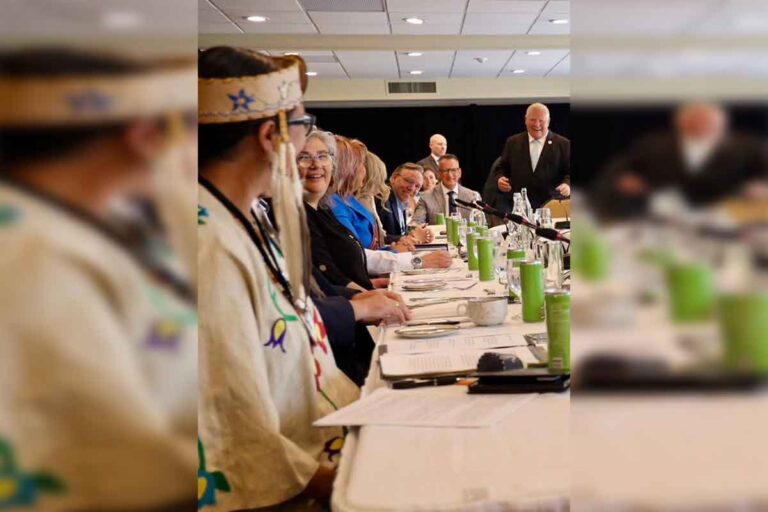
Grand Chief of the Anishinaabek Nation, Linda Debassige, alongside several dozen First Nation chiefs, sat down with Premier Doug Ford back in June to press the concerns surrounding Bill 5. The day before, Premier Ford had dismissed their opposition with a cutting remark—that First Nations should stop coming to him “hat in hand” if they refused to support his legislation.
Behind closed doors, the Premier apologized to the Chiefs. Hours later, he repeated that apology in front of cameras at a televised news conference. At that time, the Chiefs accepted the words and agreed to continue forward with extensive consultations on the proposed law.
Grand Chief Debassige also recounted that Premier Ford pledged his support for clean drinking water for every First Nation in Ontario, saying he would find a way to help. While the issue lies in federal hands, Ford has hinted on radio that Ontario may step in if Ottawa fails to act.
Promises Drowned in Policy
While Bill C-61 would not end the struggle for clean water, but set the stage for a true Nation to Nation relationship between First Peoples and Canada, its revocation — just as the “5s” have been passed — does not inspire confidence for First Nations and their allies.
Federal bill C-61’s scope is simple, though long denied: that no First Nation child should grow up unable to drink from their own tap, their own river, their own land.
The Chiefs of Ontario have called for the bill to be revived without delay. “We fully support the federal government’s commitment to reintroduce Bill C-61, and we urge Prime Minister Mark Carney and Minister Mandy Gull-Masty to move forward without hesitation and reject any attempt to delay or weaken this legislation. Our communities cannot afford to wait any longer,” Chief Benedict stated.
At the same time, Indigenous leaders are warning that Bill C-5 — a federal initiative framed as modernization — poses further risks by centralizing authority over water governance. They see parallels to historic patterns of legislation imposed without meaningful consultation, with echoes of the Indian Act’s unilateral approach.
On July 10, 2025, Alberta and Ontario declared their opposition to C-6 — a mere five days after Ontario’s Bill 5, Protect Ontario by Unleashing our Economy Act received Royal Assent —arguing it would “undermine competitiveness and delay project development.” Critics say such reasoning places corporate profits ahead of human health.
Grand Chief Debassige offered a stark interpretation: “When they say competitiveness, they mean the right of oil and mining companies to dig faster, spill sooner, and pay less. When they say delay project development, they mean the right of children to drink poison while the trucks keep rolling. They are telling us, flat out, that water is expendable, that our lives are expendable.”
The issue of water rights in First Nations communities has unfolded through repeated cycles of pledges and unmet commitments:
2015: Prime Minister Trudeau commits to ending all long-term boil water advisories on reserves within five years.
2018: Federal reports note that several advisories have been lifted, but new advisories continue to appear, leaving overall numbers high.
2021: The five-year deadline passes with over 40 long-term advisories still in place. The federal government extends its timeline.
2021 Auditor General’s Report: Finds that Indigenous Services Canada has not provided sufficient funding or resources to ensure safe drinking water, nor developed a comprehensive long-term plan.
2023: Class-action settlements proceed, with Ottawa agreeing to pay $8 billion to First Nations affected by unsafe water. Financial compensation does not yet correspond to fully functional water systems.
2025: Alberta and Ontario formally oppose Bill C-61, which was intended to guarantee safe drinking water for First Nations communities, highlighting ongoing tensions between provincial and federal approaches to resource management and Indigenous rights.
The Numbers That Tell the Story
According to Indigenous Services Canada, as of mid-2025, more than 30 First Nations across the country remain under long-term boil water advisories. The true number, communities argue, is higher, as short-term advisories — lasting weeks or months — can stretch into years in practice.
In Ontario, Treaty 9 tells its own story: Neskantaga First Nation has endured Canada’s longest continuous boil water advisory, declared in 1995 and still unresolved 30 years later. More than 800 residents rely on bottled shipments flown in at staggering cost. In Eabametoong, Sachigo Lake, and Attawapiskat, advisories stretch like chains across generations. Children have grown up, had children of their own, and never once filled a glass of water from the tap without fear.
Across the prairies, Manitoba and Saskatchewan echo with similar crises. In northern Manitoba, Shamattawa and Tataskweyak face recurring advisories, their water plants aging beyond repair. In Saskatchewan, more than 20 communities have faced repeated boil water warnings in the last decade, with the provincial government often downplaying the scope. In each case, geography is used as an excuse: too remote, too costly, too complicated. Yet oil rigs, hydro dams and mining camps rise overnight in those same landscapes, consuming freshwater to meet their quotas.
The Human Cost
Grand Chief Debassige has spoken often about the spiritual violence of water denial: “To deny water is to deny life. To watch governments argue over competitiveness while mothers mix formula with bottled water, while Elders boil pots for their tea, is to see clearly where we stand in this country’s priorities. They are not failing us by accident. They are failing us by design.”
From the Indian Act to residential schools, Canadian policies have pursued assimilation and dispossession. Today, long-term water advisories trace that same legacy, touching the daily lives, health, and futures of Indigenous families, and laying bare persistent gaps in access to safe drinking water.
The Fight Ahead
Bill C-61 recognizes, on paper, that safe drinking water is a human right for First Nations. But paper rights mean little without political will. As Ontario and Alberta dig in, the fight sharpens, urgent and unyielding. Coupled with Bills 5 and C-5, the stakes rise: a coordinated effort to limit Indigenous sovereignty under the guise of reconciliation.
Indigenous communities are not waiting. In Ontario’s North, First Nations coalitions are demanding authority over water governance, rejecting piecemeal funding and top-down control. Across the country, youth step forward, mobilizing through social media, legal challenges and land defense.
Grand Chief Debassige has said it plainly: “We will not beg for water. We will take back the power to protect it. If that means standing in front of pipelines, mining projects, or government buildings, we will do it. Our children will drink from the rivers again.”
The crisis is tangible. Children with rashes, Elders with stomach sickness, mothers hauling cases of bottled water upstairs—these numbers are flesh and blood. From Manitoulin to Neskantaga, Shamattawa to Attawapiskat, the people resist. The water waits.
