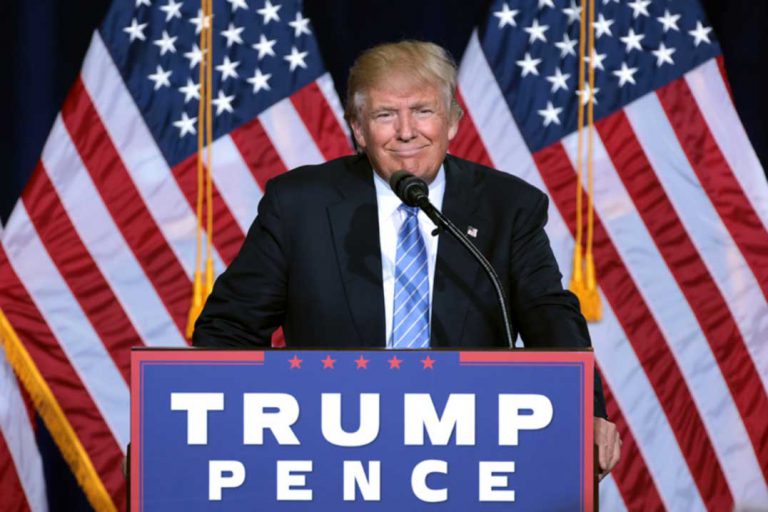
AMERICA—Real estate billionaire and former reality show host Donald Trump stunned the world by upsetting the coronation of media and pollster favourite former Secretary of State, congresswoman and first lady Hillary Clinton to win the job of the most powerful person in the world as the 45th president of the United States of America.
The Island’s longtime political savant and commentator Perry Anglin noted that “Donald Trump won narrowly for the same reason that Britain voted narrowly to leave the EU. Rural and rust belt workers have been left behind as the wealth from free trade has gone to the well educated and the well off.” (See Mr. Anglin’s op-ed piece on Page 4 of this paper.)
While much of the world is now holding its breath until Mr. Trump takes office on Friday, January 20, 2017, policy analysts, trade officials, defence officials and an innumerable host of civil servants and businesses are scrambling to prepare for a very uncertain world.
An unabashed populist, Mr. Trump has made a great many promises and declarations on his way to the White House. While his central theme of “making America great again” resonated well with a large portion of the US electorate, the lack of any firm or delineated stepping stones toward that goal accompanying is making that job a lot more difficult. Mr. Trump made a virtue out of that ambiguity when he proclaimed “No one is going to touch us, because I’m so unpredictable.”
Mr. Trump tapped into a number of deeply held angsts in the American psyche in his march to victory, and now that the dust is beginning to settle, the rest of the world is trying to figure out how the president-elect’s protectionist, anti-immigration and anti-Muslim tirades on the campaign trail will actually play out in the “real” world.
While some of Mr. Trump’s railings undoubtedly are setting off alarm klaxons throughout our national and provincial capitals, particularly in the realm of trade and defence, Mr. Trump’s focus has been aimed at his southern border, Canada was blessed with an absence of mention through most of the campaign. The reality is that the US is Canada’s largest market, and we theirs, so any seismic change in US trade policy can have unintended consequences for that relationship. Canada is a trading nation, and although it has become one of the largest economies in the world, the US is also historically and currently a major trading nation.
To be fair, Mr. Trump has not so much repudiated trade as made the assertion that his experience as a hard nosed wheeler-dealer would allow him to renegotiate trade deals to America’s benefit.
He doesn’t plan to do it on his own. The great delegator has made it known that he would replace “free trade” with “fair trade” and then gather together the “smartest negotiators in the world,” assign each of them a country and renegotiate all foreign trade deals.
Mr. Trump has asserted that he would impose new taxes on many imports into the country and the numbers he has thrown about are indeed alarming, ranging from 32 percent to 35 percent.
A June report from Capital Economics stated, “We would view a Trump win as very bad for Canada’s economy. If he doesn’t push the US economy into recession by slashing public spending, Canada’s exports might end up as collateral damage in his push to increase protectionism.”
But not everyone is running to the economic bunkers just yet. The Globe and Mail reports that TD economists Beata Caranci and Leslie Preston had weighed in saying “but, when it comes time to govern, [presidents] frequently implement much more pragmatic policies that attempt to level the playing field rather than rewrite history.”
On the other hand, Mr. Trump hardly casts himself in the traditional image of a US president. If his policies are constrained by anything, it will likely be the power of the Republican held House of Congress and House of Representatives that will be the author (and if history is to be a judge, blamed for any shortcomings in implementation).
Another worrisome policy plank is his assertion that he would allow corporations a one-time window to transfer profits being held overseas, charging a much-reduced 10 percent tax. Since Canada’s corporate tax rates are significantly less than those of our neighbours to the south, this could result in a large drain on the Canadian economy and a large drop in the value of the Canadian dollar. Estimates of the drain run between $30 billion to $38 billion. While that might not hit our dollar all that badly even in the short run, it could lay the smack down on business investment in the country and that spells trouble for job growth.
A bright spot on the horizon is Mr. Trump’s pledge to rebuild America’s aging infrastructure, focussing heavily on bridges and airports. He asserts that his negotiating skills will ensure that the cost will be one-third of the current cost of such projects.
Another plank of concern is Mr. Trump’s vow to force America’s allies, NATO members in particular, to pony up their fair share of the budget to maintain world peace. Canada is at the bottom of the list of contributors as a percentage of GDP, spending a mere one percent on defence. Prime Minister Justin Trudeau has indicated little appetite for upping the defence budget line item.
While it might seem counterintuitive, The Expositor’s publisher Rick McCutcheon discovered on his fact finding mission to Sault Ste. Marie, Michigan on the eve of the election, that Ms. Clinton was perceived by some as a bit of a war hawk.
“There was a couple in a restaurant, he was originally from White River and his wife was from Sault, Michigan,” recalled Mr. McCutcheon. “He had been an OPP officer before taking theology and becoming a minister.”
The couple told him that they had been following Hillary Clinton for years and, with a son still in the military, flying Black Hawk helicopters in the world’s hotspots, they felt she was the more likely to place him in harm’s way.
In fact where familiarity seems to have insulated Canada’s Justin Trudeau from the character-based attack ads of the Harper Conservatives, that same familiarity played heavily against Ms. Clinton.
In striking up a conversation with a 25ish young woman in a restaurant about her new tattoo, Mr. McCutcheon was told by the woman that she “‘really had no choice, because of all that email stuff with Clinton, it’s pretty sketchy’.” Ms. Clinton had built up a long history in government that her opponents were able to wield against her.
Guns is a big issue in that part of Michigan, with a lot of avid hunters in the region. “We met one woman who said she had never voted, at any level, in her life, and even though she tends to lean Democrat, she was going to be voting for Trump,” said Mr. McCutcheon. When asked why, she replied “it’s the gun thing.” Her husband and family enjoy hunting and she didn’t want to take a chance on “them taking their guns away from them,” because “you can’t be too careful.”
In an odd sidebar, the woman offered up that her ex-husband isn’t allowed to have any guns. “A bit of a mixed message there,” offered Mr. McCutcheon.
Some of Mr. Trump’s policy planks may actually benefit Canada. The aforementioned plan to build infrastructure could positively impact Canadian exports. Although there are many “buy local” or “buy US” provisions in government contracts these days, limiting markets for Canadian steel, it is hard to define a path to rebuilding infrastructure less expensively by utilizing only US products.
Western Canada may be taking hope in the revival of the Keystone pipeline, killed by President Barak Obama, but a project Mr. Trump has vowed to revive.
Much of the rest of the nation may be unsettled by Mr. Trump’s view that climate change is a hoax perpetrated by the Chinese to hobble US industry. As a colliery he has also promised to help make coal king again and to rein in the Environmental Protection Agency—so much for breathing easy.
Mr. Trump has vowed to strengthen the US military so that it’s “so big and so strong and so great” that “nobody’s going to mess with us.” Since the US already ponies up more on its military than the next 10 countries, that promise could be considered to already be a done deal.
Concurrent with that vow is the terrifying retreat from America’s commitment to the NATO alliance. His repudiation of US assurances of defending any NATO member who is attacked is unnerving in the light of a resurgent Russian aggression towards its neighbours. The Baltic States are not resting easy these days, but Canada is a member of NATO and continues to maintain its commitment to friends and allies. The thought of dealing with that eventuality without our closest ally and neigbour is unsettling.
While Mr. Trump’s vow to triple the current number of US immigration and custom enforcement officers might seem at first glance to be unsettling, perhaps if some of those new officers are stationed on the northern border transitioning the border might be quicker. This will probably be a relief to returning US citizens and snowbirds alike.
The temporary ban on most foreign Muslims entering the United States “until our country’s representatives can figure out what is going on” is likely more global warming than much of a major change. Mr. Trump has already said that he would allow exceptions for dignitaries, business people, athletes and others who have proven themselves.
His plan to bar Syrian refugees from entering the country and kick out any who are already living in the US will likely prove challenging, the US is already heavily burdened with the chasing of economic illegals. Mr. Trump claims that wealthy Persian Gulf nations like Saudi Arabia should set up a heavily guarded safe zone in Syria—on their own dime of course.
Kagawong’s Wayne Hunt is a professor of Politics and International Relations at Mount Allison University and has been a Visiting Scholar at Harvard University’s Kennedy School of Government, a Senior Research Associate at St. Antony’s College, Oxford University and Visiting Fellow at the Centre for International Studies at the London School of Economics.
“My view is that the system is working as it should,” said Mr. Hunt. “Trump represents something very old and very new. The very old part of the story is nationalism and restoring pride back to people who serve their country through institutions like the military. The new part of the story is his use of social media to put views out in an unfiltered way. Trump made a name for himself as a reality television star. Mainstream media gave all sorts of coverage to him because he was not part of the story, he WAS the story. He was different; he was not an old-line politician. But as president, his chances of making significant changes are far greater in international affairs than in domestic affairs. His type of right-wing populism is a direct attack on a number international institutions, like the UN, the IMF and even the EU, that have been in place since the end of the Second World War. Trump was in the UK when the Brexit vote came through and he declared himself to be an ardent fan of Brexit (“Brexit, plus, plus”). In that sense, commentators are right to say that he has cleared space for a number of populist politicians around the world who want to change the old rules of the game and gets things done directly. Think of Marine LePen in France, Rodrigo Duherte in the Phillipines, Victor Orban in Hungary and most of all, Putin in Russia. Thus there is talk of an end of liberalism.”
Mr. Hunt notes that “all my students talk about is what his election means, and what it means to them.” What is their consensus? “They are all scared.”
Concerns centre on privacy rights and an unleashed NSA poking their noses into every facet of people’s lives.
So are they right to be afraid? Not so fast.
“I think the system is a lot more resilient than people give it credit,” he said. Mr. Hunt points out that Mr. Trump is a “reality television star who has been able to build himself up by saying all kinds of wild things on which he has never been called to account.”
In fact, Mr. Hunt said that he sees a major silver lining in the election of the populist demagogue that appeals to the white working class, a group that has seen itself more and more marginalized in a world dominated by technocrats and east coast elites while their jobs are moved offshore in ever greater numbers. “They despise the way things are going, their jobs are at risk, divorce rates are climbing, they are far from happy,” he said. “Regan was all about the positive, this guy is all about fear.”
But by playing to that demographic, Mr. Trump has provided white working class America with a place in the American story again. “As LBJ said, ‘better to have them inside the tent pissing out,” he said. “They see a game rigged against them, this election puts them back in the game.”
But for Canada the storm clouds do look ominous.
“Canada could get hit hard on this,” he said. As a commodities-based economy, we have a lot to lose. China being hit with trade sanctions and tariffs means less demand for Canadian raw materials in that country and, as a heavily trade dependant nation, a global system where the intricate weave of commercial interactions and trade agreements is torn asunder is anything but good news.
But on a brighter side, Prime Minister Justin Trudeau is currently meeting with the managers of funds that control more than $21 trillion dollars to convince them that Canada is a stable and dependable place to park their money. In a world where Mr. Trump is trumpeting his unpredictability, good old staid Canada could find new friends. “Right now America isn’t looking like such a safe haven,” noted Mr. Hunt.
The prime minister is also seeking to paint Canada as a player in the new economy, with more about knowledge-based industries and high technology than our traditional role as hewers and drawers.
For the rebels challenging Syria’s Assad, the future does not look bright today. Mr. Trump has said that he would allow Russia to deal with the Islamic State in Syria and/or that he would work with the Russian president to wipe out shared enemies—and their relatives. Since Mr. Putin regards many of the groups fighting ISIL as fair game because they oppose Assad, Canadian troops working closely on the ground with the anti-ISIL rebels who also are challenging Assad (yes it’s a secret that they are there—shhh) may have to watch their backs more closely.
A lot of Mr. Trump’s plans will run full tilt into the wall of a congressional agenda guided by senators and representatives where a lot of his policies run counter to the business interests of the people who fund their very expensive campaigns.
It is easy to say you will “force Nabisco to once again make Oreos in the United States” or that you will bully Apple into making its “damn computers” and other products here, another thing to bully your way through a congress that holds the purse strings.
A large part of the US seems to be taking the stance of a Sault, Michigan bookstore owner, however, and studiously avoiding any political conversations. Although a chatty and voluble fellow, very proud of local history and what Mr. McCutcheon described as a “jolly old bookstore,” the shopkeeper “deflected any questions I had about the election.” The same stance was to be found in conversation with the receptionist at the local community newspaper. Sometimes it seems, in business particularly, discretion is the greater part of valor.