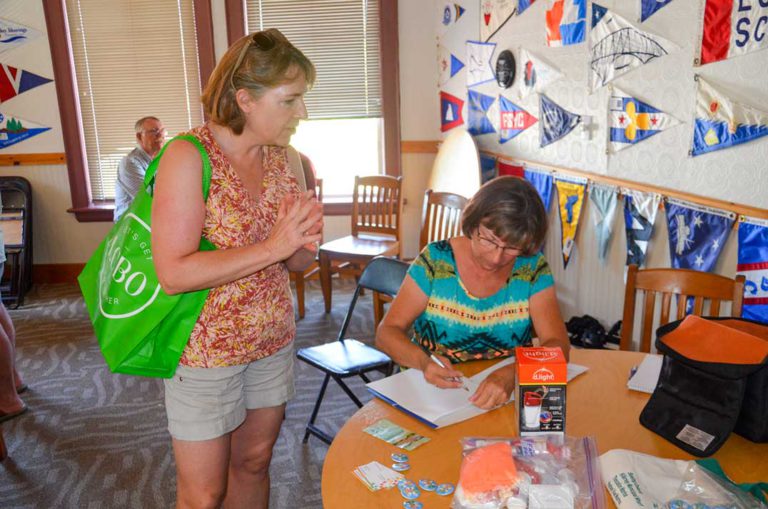
LITTLE CURRENT—Karen Kerr Goodyear, M.S.M. has dedicated a good portion of her life to assisting the devastated country of Haiti and its children, and this summer Ms. Goodyear delivered a seminar on the work of the Children of Hope Foundation she helped found in 2002 as part of the Cruisers’ Net lecture series.
For her work overseas, Ms. Goodyear has been awarded the Meritorious Service Medal-Civil Division (MSM). The award was something Ms. Goodyear downplayed somewhat in giving her presentation, but knowing a bit about the MSM helps put the scale of the work she and her compatriots have accomplished into perspective.
Meritorious Service Decorations (Civil Division) are presented to outstanding Canadians through the office of the Governor General “to recognize remarkable contributions in many different fields of endeavour, from advocacy initiatives and health care services, to research and humanitarian efforts.”
Past recipients have tackled poverty in their community, improved education opportunities for children in Canada and abroad, or raised awareness of important causes and issues. The Civil Division form of the award that has been presented to Ms. Goodyear “recognizes a deed or an activity that has been performed in a highly professional manner, or according to a very high standard: often innovative, this deed or activity sets an example for others to follow, improves the quality of life of a community and brings benefit or honour to Canada.”
“I really have a passion for people in Haiti,” said Ms. Goodyear, who first visited that country in 1998 in order to assist in medical clinics and work in an orphanage. While she was there, Ms. Goodyear was struck by the immense need she saw all around her. Over the past 18 years she has been in a community about 15 miles north of the city of Port Au Prince. “In 2002 I took on the role of Canadian Coordinator of the Children of Hope Haiti (COHH).” Together with her four other committee members, Ms. Goodyear has taken on the challenge of helping to raise the next generation of Haitian leaders. “Children are Haiti’s greatest resource,” she said.
Over the intervening 12 years, COHH has continued to develop, grow and expand to the present day, where the organization is involved in numerous projects including providing goats for rural families, distributing rice and beans and lanterns in tent cities, providing medical assistance in the form of clinics and family medical packs throughout various communities, working with sponsored schools, working in an orphanage, preparing land and assembling of two soccer fields in 2011 and a playground completed in January 2013.
The mission statement of the organization is to meet the essential needs of the impoverished children of Haiti—“our goal is to provide physical, educational and emotional care for every child so that each one will become a responsible and productive citizen of Haiti.”
Ms. Goodyear’s dedication to the people, and especially the children, of Haiti might be best understood when she begins to talk about a typical trip to the village, an arduous journey that involves packing medical supplies and food up a steep mountain pathway through an arid countryside. The group has found that apple boxes (two 50-pound containers) loaded into hockey bags make great reusable packs for carrying the supplies—but they are not insect proof.
“We have to bring our own food, and because there is no refrigeration we bring peanut butter and jelly sandwiches,” she recalled. On the one trip a number of the sandwiches became infested with ants. The clinics start at 7 am in the morning and the team sets out for the clinic at 5:30 in the morning. So great is the need for medical services that there are long lines of patients waiting to be seen.
“Noontime came and there were still people waiting outside,” she recalled. “About half of the sandwiches had ants, but about half didn’t. We asked ourselves ‘what are we going to do with the ones with all the ants’.” One of their local advisors suggested they just leave them outside.
They divided the sandwiches in half and gave them to the people outside. “I gave half a sandwich to a young boy about 21-22 (all things are relative),” she said. “He split it into four and gave three of the pieces to the people around him—I froze. Here was one of the poorest of the poor giving to another poor person.”
This was a theme she saw repeated constantly, everywhere she turned in the country. “The children in the orphanage are fortunate, they receive meals every day,” she said. “As they walked down a pathway separated from the outside by a fence, you could see them passing food to the children outside.” The children inside the orphanage knew that they would get another opportunity to eat, unlike the children outside the walls.
On another occasion she brought shoes for a young child, the shoes turned out to be too large for his small feet. “Do you think my friend could have them?” the child asked. “I said ‘of course,’ who am I to say no?” she said. “He will eventually get shoes, but his friend outside might only get to eat once a day and will remain barefoot.”
Most of the work being done by COHH is focussed on providing education and a better future for the children they work with. “We don’t want them to be dependant on us,” she said. The organization refurbishes laptops for the school and accepts donations of those that are no more than five-years-old.
“Over 98 percent of our funds go to our programs,” she said. “We are all volunteers. There are no paid staff.” In an odd quirk of the system, however, the organization actually has to spend some funding, one dollar out of $34, on administration in order to be able to maintain its charitable status.
It takes about $408 a year to sponsor one child in school, but smaller donations are gratefully accepted. Each donation over $20 receives a tax receipt. For those wishing to learn more about COHH or to make a donation the charity has a website at www.childrenofhopehaiti.com.