
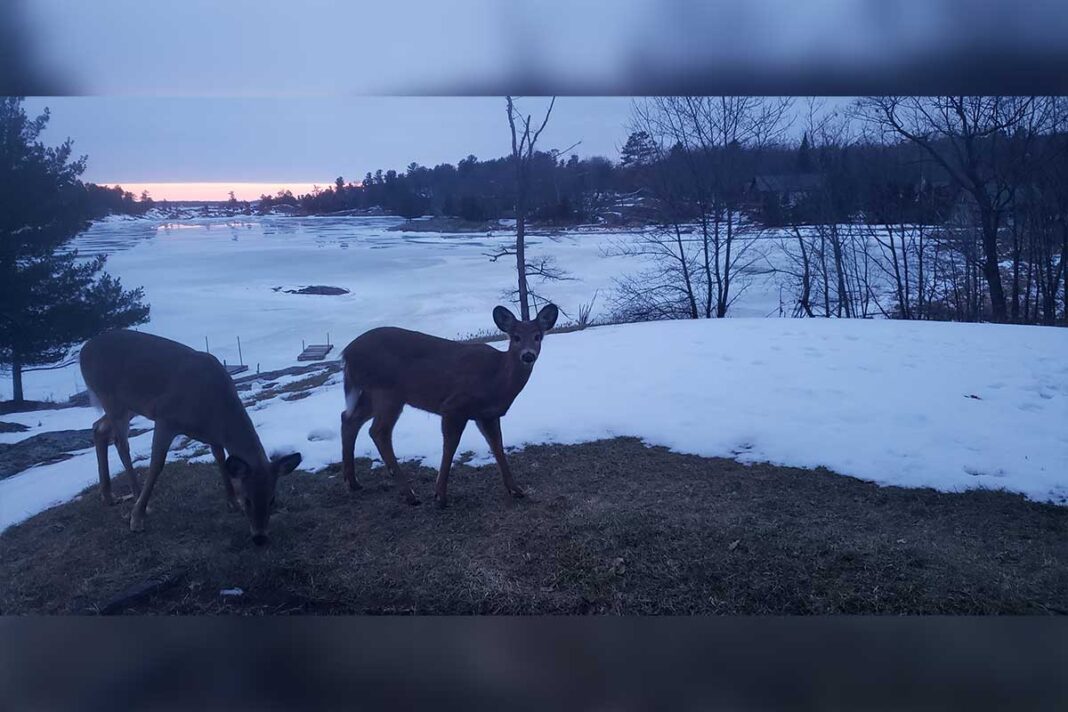
MANITOULIN—While the winter was tough for people on Manitoulin, it appears it wasn’t too hard on Island deer. At the annual Manitoulin deer advisory meeting last week, there was a general consensus among participants that deer fared the winter well, mostly due to the icy crust on top of the snow allowed them to reach cedar browse and the fact that snow depths weren’t bad until well into January.
“It’s interesting, it was one of those winters with a lot of snow, but there was not a lot of noise on feeding or breaking trails for deer,” stated Paul Methner, retired Ministry of Natural Resources (MNR) biologist. “Early on, I thought it would be a winter to remember, but I know myself I didn’t see deer in a lot of hardship, at least the deer I watched in my area (south shore/Tehkummah).”
“How long did the crust last?” asked Denis Gendron, management biologist with the MNR Sudbury and area district, who chaired the meeting.
“About two weeks,” said Mr. Methner. “The deer I saw weren’t struggling, and the deer I’m now seeing in fields look good,” noting he didn’t run across a lot of coyotes over the winter either. “If they were around, they were not going into my traps. I don’t believe there is a significant number of coyotes in the areas that I worked.”
“As Paul did, I spent a lot of time in the bush (trapping),” said Ian Anderson of his time in areas ranging from Central Manitoulin to Robinson. “This year was one of the worst I’ve ever experienced for trapping.”
Mr. Anderson said, “the key for deer and what kills deer is 90 days plus of constant depths of 20 inches of snow on the ground. How we likely escaped a large die-off of deer this winter is that we didn’t see large depths of snow until the third week of January. We also saw four separate freezing rains from Central Manitoulin to Western Manitoulin and crust formed on the snow likely for about three weeks, so they were able to stay on top of the snow,” The crust on the snow “proved to be huge for them because at the end of February, at the deer yard station on Walkhouse Road, there was about 40 inches of snow on the ground. It would have been devastating for the deer if not for their ability to stay on top of the snow.”
Kevin Hutchinson, representing the Little Current District Fish and Game Club said during last fall’s deer gun hunt, in Sandfield, “we had eight guys hunt, and we were tagged out by Wednesday of the rifle hunt.” He said there were many deer seen during the black powder hunt, and he agreed it was a tough winter to trap coyotes.
“The deer I’ve seen are really healthy looking,” said Mr. Hutchinson, noting he drove from Little Current on Monday of last week and would see upwards of 50 deer in fields.
Bryan Barker reported that in the Billings township area there are a substantial number of deer being seen in the fields. “The deer look relatively healthy, considering the winter we had, they are in good condition.”
Denis Goupil, of Central Manitoulin, said the deer population seems to be stable, and he is seeing more fawns, “which is good. We are seeing twins and triplets which are all good signs.” He also indicated the ratio of bucks and does seems to be close to balanced.
Mr. Gendron provided a report from Stephanie Vanthof of the Ontario Federation of Agriculture (OFA) that farms appear to be in good shape, and the increase in deer tag quotas on the Island last year was well received by the agricultural population. She said she would like to see tags increased even further.
Liam Campbell of Manitoulin Streams Improvement Association (MSIA) shared that this winter was the first time a deer save program was discussed in about five years. Instead, local property owners were requested to use snowshoes and break trails for deer. “We didn’t hear many people voicing concerns with the deer this winter. I live in Little Current and I see five deer come by my place every day.”
Megan Bonenfant of Nature Conservancy of Canada (NCC) said there has to be about 150 resident deer in the town of Gore Bay.
Mr. Gendron, in providing a summary of each WMU, said the deer seen per hunter day was slightly down in both WMU 43A and 43B from the previous year and both are now slightly below the ideal range for each unit. Hunter success also decreased slightly in both units with a larger decrease in 43A. The number of bucks harvested decreased in both units with a larger decrease in 43A.
“Manitoulin Island is unique for deer; it is a destination for deer hunters. People buy property to hunt here,” said Mr. Gendron. “Compared to other WMUs in the province, Manitoulin is the marquee, with high populations and hunter success.”
As for last fall’s deer harvest, in WMU 43A, 213 deer were harvested, and for 43B, 2,739 for a total of 2,952. “The harvest was just shy of 3,000 in total,” said Mr. Gendron. After the harsh 2019 winter the overall tag quota was decreased.
As for tag allocations for WMU 43B 6,100 tags were in place, while for WMU 43A the tags remained the same as in 2024 with 400 provided.
Mr. Gendron noted, the key in deer quotas is “finding the balance. Deer are not distributed evenly across the landscape and it is hard to find balance that will please everyone. There are substantial ecological, social and economic benefits. Social acceptance is below carrying capacity. Deer can, however, damage crops, residential properties and ecosystems. There are also public safety concerns,” and he noted severe winters are a major influence on deer population.
“What we have heard today sounds familiar across the board, that there are no real swings one way or the other which is good,” said Mr. Gendron. “In terms of deer tag quotas for this year’s hunt, Kevin and Stephanie have indicated they would like to keep them at the same numbers.”
“I think leaving the tag quotas the same would be fine,” said Mr. Anderson.
“I agree with keeping things stable. The fewer changes the better; everything seems to be working,” said Mr. Methner.
“I am in favour of keeping 100 percent in WMU 43B,” said Mr. Goupil.