Will lead to broadband service
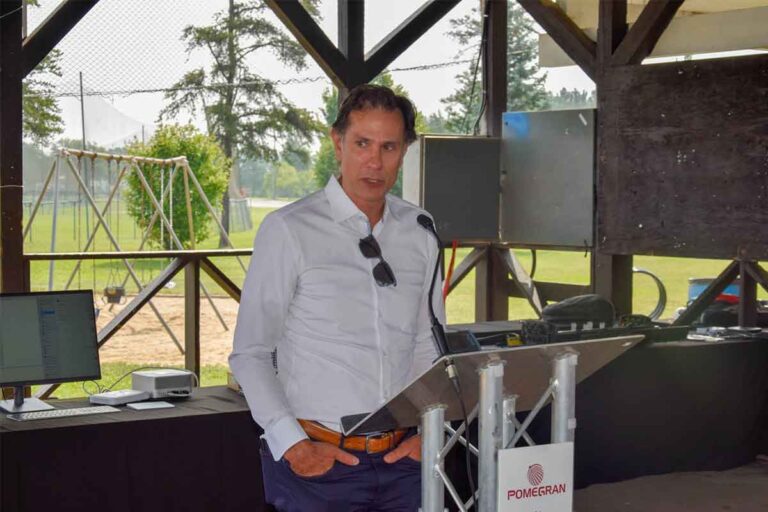
ESPANOLA—Espanola’s Red McCarthy Memorial Ballfield Pavillion was abuzz with excitement on Saturday, July 26 as officials from the companies spearheading the “First Gigabit Connection for the Northern Ontario Fibre Project” delivered a presentation on progress being made to deliver “to the door” fibre connectivity to the internet.
“We’re pleased to share continued progress on our fibre optic project across Manitoulin Island,” said project manager Mahsa Alikhani. “Two of the seven planned OLT cabinets have already been installed—one in the Town of Gore Bay and one in M’Chigeeng—and fibre placement is set to begin in the coming weeks.” Next up in line will be Little Current, Shegiuandah and Assiginack.
“We’re excited to begin connecting the first homes to our network, starting in the Town of Gore Bay and Gordon/Barrie Island” said Mahsa Alikhani, assistant project manager at ROCK. “This marks a key milestone in our mission to expand access to fast, reliable internet across the Island. At the same time, we’re working closely with other authorities to secure the necessary approvals for installation in other areas. While this process can take time, our team remains fully committed and is working hard to accelerate progress and bring high-speed connectivity to more communities as quickly as possible.”
Attending the event were Dr. Kalai Kalaichelvan, CEO of PomeGran; Joe Hickey, president of PomeGran, founder and president of ROCK Networks; Sault Ste. Marie-Algoma MP Terry Sheehan; Marc Bellini, vice president of Enterprise Sales at Nokia Canada; Ashraf Youssef, PomeGran director of fibre projects; and Jean Lamoureux, PomeGran’s chief subscriber officer along with a host of supporting admin staff.
PomeGran Inc. is Canada’s fastest-growing fibre-centric broadband infrastructure provider and is dedicated to enhancing broadband services. As such, PomeGran has emerged as a leader on a mission to empower underserved markets in Quebec and Ontario, notes Dr. Kalai Kalaichelvan, chairman and CEO of PomeGran. “PomeGran is investing in rural Quebec and Northern Ontario as part of their strategic plan. Boasting ownership of broadband networks, underground and aerial fibre assets, and fixed wireless access assets, PomeGran is committed to bridging the digital divide that exists between urban, rural and Indigenous communities. Founded on the fundamental principle of ensuring equitable access to high-speed Internet, PomeGran believes that everyone deserves the opportunity to participate in today’s digital-first economy.”
Nokia, explained Mr. Bellini, no longer makes cellphones and has come a long way from its humble beginnings as a Finnish lumber mill company, growing to become the largest international player in network infrastructure—providing equipment and services for mobile and fixed networks, cloud technologies and the “Internet of Things.”
The event began with short speeches by each of the main proponents of the project. Mr. Hickey noted that the purpose of the barbecue/public meeting is so PomeGran could preview progress on the gigabit fibre service and to introduce the new community-focused ISP brand NIVO.
“We are proud to introduce a sneak peek of NIVO, a new kind of internet service provider designed with smaller communities in mind,” said Mr. Lamoureux. “NIVO is clear, capable, and community focused. You’ll start seeing more of the brand as fibre connections go live across Espanola and beyond.”
Although the group are bringing fibre connectivity to Manitoulin, the broader initiative will deliver fibre broadband to more than 18,600 underserved homes, including 2,580 Indigenous households, across rural and remote parts of Northern Ontario, noted Mr. Hickey.
During the presentation, Dr. Kalaichelvan, highlighted the advanced technology behind the network. “We are building with 25G PON fibre from Nokia, the same world-class infrastructure used in major cities globally,” he said. “Soon, Espanola residents will have access to multi-gigabit internet speeds that are truly future-proof.”
MP Sheehan was introduced as a strong supporter of the project who has attended every meeting about the project. “I can tell you that it’s been an absolute amazing watching this development this journey,” said MP Sheehan. “I supported this from the get-go. What this represents to me is that everybody in Northern Ontario should have a same service and access that anyone else in this country does, places like Toronto, Montreal, Vancouver, because it’s about quality, it’s about equality. It’s equality in health care—being able to do your medical appointments. It’s both equality and education—It is about being able to do business anywhere in Northern Ontario. We made a commitment that we would connect all Canadians by 2030. So, in our Northern Ontario Liberal caucus this was a standing item for many, many years.”
MP Sheehan noted that the project has moved forward with fire hose speed. In the summer of 2024, in June, “We announced $97 million. I’m so happy to see we will connect 18,600 people, including 2,500 First Nations.”
Supporting remarks were also read from a letter by Algoma-Manitoulin MPP Bill Rosenberg. “On behalf of the provincial government, we are very pleased that the progress that has been made on this major milestone of the first fiber to the home connection project in the Town of Espanola. This provincial government infrastructure program will help improve high-speed gigabyte broadband internet opportunities for Algoma-Manitoulin and for remote locations lacking internet services at this time.”
“When you do a project like this, you need lots of partnerships and one of the partners that has been very critical to the success of ROCK networks and PomeGran has been Nokia,” said Mr. Hickey. “Nokia is one of the largest technology companies in the world in terms of Internet infrastructure, and a key part of us delivering 25 gigabit connections in this community.
“We are building the infrastructure to connect 725 homes (in Espanola) that is, an installation and building the cabinet electronics, which is sitting here at 598 Second Avenue,” said Mr. Youssef, “this cabinet can serve more than 4,000 homes—through 97 kilometers of fibre which is being built and almost completed right now.”
“When we build our cabinet, we need to make sure that this cabinet is reliable, providing the maximum availability long-term performance,” he said. “We, we know, in Northern Ontario, we can face some tough weather conditions, especially in winter. Me and my team have driven along Highway 17 and Manitoulin Island during the winter.” He noted how they realize the infrastructure can be “beat up with snowstorm with the power outages. That’s why we have considered that we have ensured all the features to achieve the maximum reliability for our cabinets. We have the battery backup for the batteries, we have AC and DC power for the battery. We have generator plug-in in terms of the power outages. We wanted to make sure there is no disruption in terms of any power outage or any power disruptions. Our cabinets are reliable and keep homes connected with internet.”
The team is currently putting the fibre up on hydro poles across the region, he noted, adding later that the trucks will soon be seen operating across Manitoulin Island.
He assured everyone that the team will soon be connecting homes by dropping the fiber cable from the main cable to each home (after getting consent from each homeowner)—”each individual home will have dedicated fiber to connect them with internet.”
Georges Bilodeau, chairperson/president of H and M COFI and former mayor of Huron Shores was an early proponent of the project and currently operates, along with his wife, the warehouse where equipment for the project is stored. He said he was pleased to see the project moving forward as a vindication of his efforts.
“It cost me my election as mayor because the municipality did not want to get involved,” he said. “But it is getting done and that is what counts.”
Following a demonstration of how fast the download speeds will be with the new fibre connections (spoiler—blazing fast), the group hosted a community barbecue.
It is anticipated that work on Manitoulin will be complete by the end of next year.