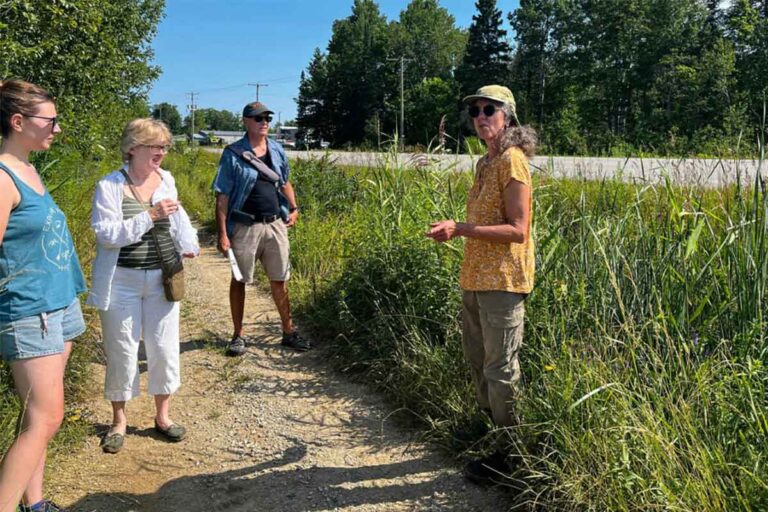
Info sessions to battle invasive reed to be held Island-wide this week
MANITOULIN—It rises like a mirage—tall, swaying, deceptively elegant. Ten feet high, with thick stalks and soft-plumed heads, phragmites might pass for something natural, even lovely, at first glance. But this foreign grass is an uninvited guest. It creeps in dense, choking waves, swallowing shorelines, strangling wetlands and silencing the native species of the land.
This week, July 21 to 25, marks the 9th annual Manitoulin Phragmites Week, a time to look closer, walk the land with intention, and notice what’s changing along the water’s edge.
Known formally as phragmites australis, and pronounced (frag-MITE-eez) this robust invader isn’t from here. It doesn’t know how to share. It spreads fast and thick, leaving little room for turtles to nest or fish to spawn. Where it takes hold, reeds rise like spears, and in the fall, the dead stems remain standing—hard as bamboo, topped with fluffy, wind-snatched seeds.
For the past decade, the Manitoulin Phragmites Project has been pushing back, stem by stem, in defence of the Island’s rich and fragile biodiversity.
“If we lose these beautiful shores, they can’t be replaced,” says project coordinator Judith Jones. “You can’t just go buy another one.” Her work carries both urgency and reverence — for the meadows and marshes, the winding creeks and rocky bays that make Manitoulin what it is.
To raise awareness, short info sessions will take place across the Island on Friday, July 25: 10 am, Providence Bay, by the Discovery Centre; 11 am, Mindemoya, at Up Top Sports Shop; 12:30 pm, Gore Bay, at the Community Centre; 2:30 pm, M’Chigeeng, at the Freshmart parking lot; and 3:30 pm, Little Current, outside The Manitoulin Expositor office.
You can also learn more and follow updates on Facebook and YouTube at @manitoulinphrag.
But this year, hands-on control efforts are limited. The water in Lake Huron has receded, leaving most phragmites stands high and dry — and unfortunately, that means the usual cutting methods won’t work. Without water, the roots keep growing, undeterred. Seed-head removal can do more harm than good, and digging is a gruelling, shovel-by-shovel affair.
Still, there is something everyone can do.
“Don’t drive through phragmites,” warns Ms. Jones. “ATVs, trucks, machinery — they pick up seeds and carry them to new places.” If you’ve been near a patch, wash your tires. A moment of care can mean the difference between containment and colonization.
To report sightings, or request a site visit, contact manitoulinphrag@yahoo.com or leave a message at (705) 859-1027.
So, this week, take a moment. Walk the shore. Listen. Learn the names of what you’re seeing. Not everything that grows tall is meant to be a part of the ecosystem — but every shoreline deserves protection.