Manitoulin’s Doric Lodge opens the doors on Freemasonry
MANITOULIN—Ask most people what comes to mind when they hear the word ‘Masons’ and chances are good many will say a secret society. Fans of Dan Brown novels might even go so far as to suggest the Masons are a cult that practices sinister rites in epic battles of angels and demons – something that draws a hearty laugh from Rick Mauti, who assumed the mantle of Worshipful Master of the Manitoulin’s Doric Lodge, succeeding his predecessor Brent Forsyth, in June 2025.
“People might be surprised to learn that the Patron Saints of the stoneworkers who founded the first Masonic lodge in England during the Age of Enlightenment were Saint John the Baptist and Saint John the Divine. In fact, the Grand Lodge of England was formed on St. John the Baptist Day in 1717,” he explains. “And there are much earlier references in the Bible to stonemasons who built King Solomon’s temple.”
Freemasonry is not a religion but rather a philosophy and way of living that promotes personal moral development and community service through principles such as brotherly love, relief and truth. Members must believe in the existence of a Supreme Being, the ‘Great Architect of the Universe.’ They also must believe in an afterlife and be committed to being a person of good moral character as they seek spiritual truth and knowledge. “Being non-political and non-denominational makes Freemasonry accessible to people from all faiths and all walks of life who want to help, support and protect one another,” adds Rick.

Freemasonry is an international fraternity made up strictly of men who meet in local Masonic lodges or temples, such as Manitoulin Island’s Doric Lodge.
The Mason’s female counterpart is the Order of the Eastern Star. It’s a worldwide sororal (the sisterhood equivalent of a fraternity) non-profit, charitable service organization that also has a Manitoulin chapter.
Masons’ Manitoulin roots
Masons have been on the Island almost as long as settlers have lived here. The first record of a lodge, in Gore Bay, dates to 1885 in the days when forestry and fisheries were major industries. It was one of the few in Northern Ontario, the only one between Mattawa and Thunder Bay at the time. Known as Manitoulin Lodge, it ended operations in 1891.
Roughly a decade later, in 1902, the Doric Lodge in Little Current was created and, shortly after, the Gore Bay Lodge was launched in 1906. Both operated until the Gore Bay Lodge closed its doors during the recent pandemic.
The remaining lodge is currently just shy of 60 members, ranging in age from 21 to 80. Prospective members need to be sponsored by a member of Doric Lodge who is a Master Mason. Many are entrepreneurs and community leaders and all but one are white, the only other member an Indigenous person.
Rick Mauti bristles at the suggestion that Masons are primarily white men interested in supporting and promoting each other’s businesses, a criticism of the organization by some.
“We represent a cross-section of society – from business owners to teachers, principals, doctors, farmers, millworkers and arborists, to carpenters. Most were raised as Protestants, but I was raised as a Catholic, so we are diverse. What we have in common is our goal of providing guidance to men who want to become better individuals, husbands, fathers and members of the community.”
The Masons are not a registered charitable organization, but doing good work is a key part of the group’s activities. Each local lodge determines where to focus its charitable efforts. Perhaps partly explaining what some perceive to be secrecy, Rick says “When it comes to charitable work, we are not out to pound our chests or solicit recognition. We aren’t keeping secrets but being diligent as we develop our own morals. We view it as part of our efforts to support communities. So, we rarely actively fundraise and instead depend on donations from our members to assist a variety of causes. The only annual event we hold is a sausage run and, this past January, we held a Robbie Burns dinner with the proceeds going to a charitable cause.
Last year, the Sudbury-Manitoulin district focused on prostate cancer. We raised $4,900 for Prostate Manitoulin. This year our focus is on Alzheimer and dementia support. In addition, we benefit from the work of the Shriners, an affiliate body of the Masons. Known for generating money for children’s hospitals, Shiners must first be Masons before becoming members of the fundraising group.”
Another annual activity of local Masons is their participation in Remembrance Day ceremonies held in Gore Bay, Kagawong, Mindemoya and Little Current each November. “We attend the ceremonies to honour the military community, support veterans and uphold the shared values of service, sacrifice and the pursuit of peace. This provides an opportunity to remember and respect the heroism of Masons who served.”
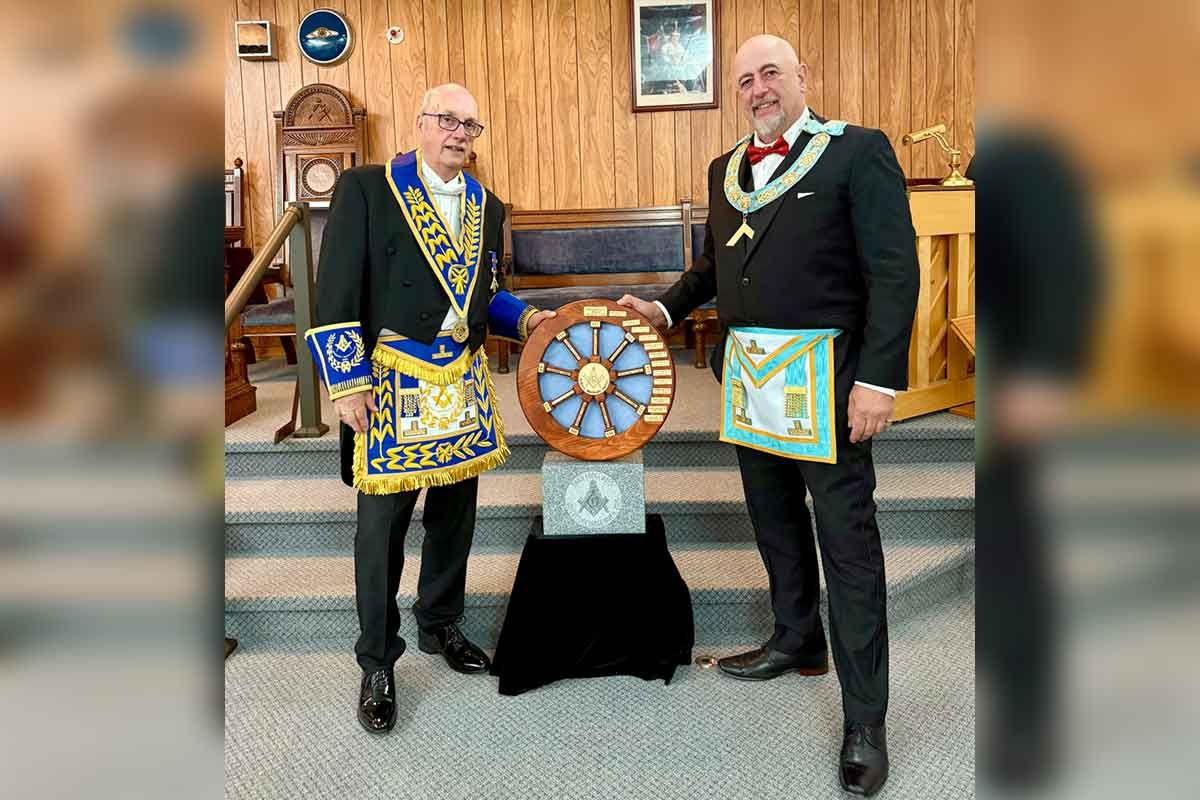
The public also may see the aprons being worn by Masons at the funerals of former members when a special ritual is performed to pay tribute to the deceased. This reflects the ancient tradition associated with the trade, when stonemasons used aprons to protect their clothes, mentioned in the biblical account of the construction of King Solomon’s Temple. Today’s Masonic aprons represent purity and the importance of labor. They are usually the first gift that an initiate receives when joining.
“Most Masonic rituals are held behind closed doors because we respect the privacy of our members. We believe that secrecy helps protect their dignity, allowing them to engage in personal growth and moral education without external judgment. We consider our rituals a sacred thing and there are obligations to not disclose what goes on in lodge to strengthen the bond between one another. This reinforces the connection among members as we all have been through the same process.”
There are an estimated 200,000 Masons across the country, an impressive number given that better known groups like the Rotary and Lions each have national memberships in the +/- 25,000 to 35,000 range. However, with a reputation for secrecy and mystery, it can be difficult to attract new members. Like other community service organizations in Canada many Mason members are seniors, so recruitment is a priority for the local lodge.
Without the infusion of new blood its future may appear to be at risk. But, given its centuries-long presence in communities around the globe, Rick isn’t concerned. As someone who has gone through the process and can bear witness to the positive impact it has had on his own life, he is optimistic that shining a light on the group’s work will encourage potential members interested in its activities to learn more. Anyone wanting to join the organization can only do so by being a 21-year old or older man of faith and good character who is sponsored by two members. (Contact the secretary of Doric Lodge No. 455 by email: doric455@gmail.com for details.)
People are drawn to the organization for a variety of reasons, he sums up. “Freemasonry is many things to many different people. For some, it’s about making lifelong friends and acquaintances, for others it’s a place to engage in introspection or to discuss philosophy and practice charity and goodwill. For most, it’s probably a combination of all of the above.”
Where does the term ‘freemason’ come from?
As early as the Middle Ages, stoneworkers formed guilds to share building skills and techniques. Renowned for building cathedrals and temples, they were known as operative masons. Although the guilds were initially made up of craftsmen, they eventually included merchants and notables. Innkeepers, aristocrats, scientists and others who didn’t belong to the trade were called “freemasons” or “speculative masons” who utilized symbolic masonry tools and applied them to their morals.
The tradition of apprenticeship carries on among speculative masons today. New members must pass through three stages of masonry to become a Master Mason. An initiate starts as an Entered Apprentice Mason. When that level is fulfilled, he moves on to become a Fellow Craft Mason. The final stage is becoming a Master Mason.
Freemasonry is symbolized by building tools. The square represents virtue, while the compass stands for wisdom. The masonry tools are used to draw straight lines and construct correct angles. They exemplify staying upright and dignified, praising rationality to understand the world and improve society in keeping with the Enlightenment Age, and maintaining a moral geometry.
by Heather Marshall