Meanwhile, project to enclose pipeline in tunnel through rock under Straits moving slowly
ONTARIO-MICHIGAN—Representatives of Restore Our Water International (ROWI) in Michigan and Ontario are incredulous that the United States Army Corps of Engineers (USACE) has approved the Canadian-owned company Enbridge’s plans to encase a portion of an aging oil pipeline beneath a Great Lakes channel.
“I don’t understand how (USACE) has approved it without Canada agreeing. It originates in Canada and delivers oil to Sarnia,” said Mary Muter, vice-chair of ROWI. “What can I say, it is a disaster in the making if the line cracks, and it would take a long time before anyone would know of the oil spill, to float to the water surface. Humans have not had a lot of success with supposed ‘fail safe’ proposals like this.”
She noted, “With a strong west wind, this oil would end up on Lake Huron and would reach Manitoulin Island.”
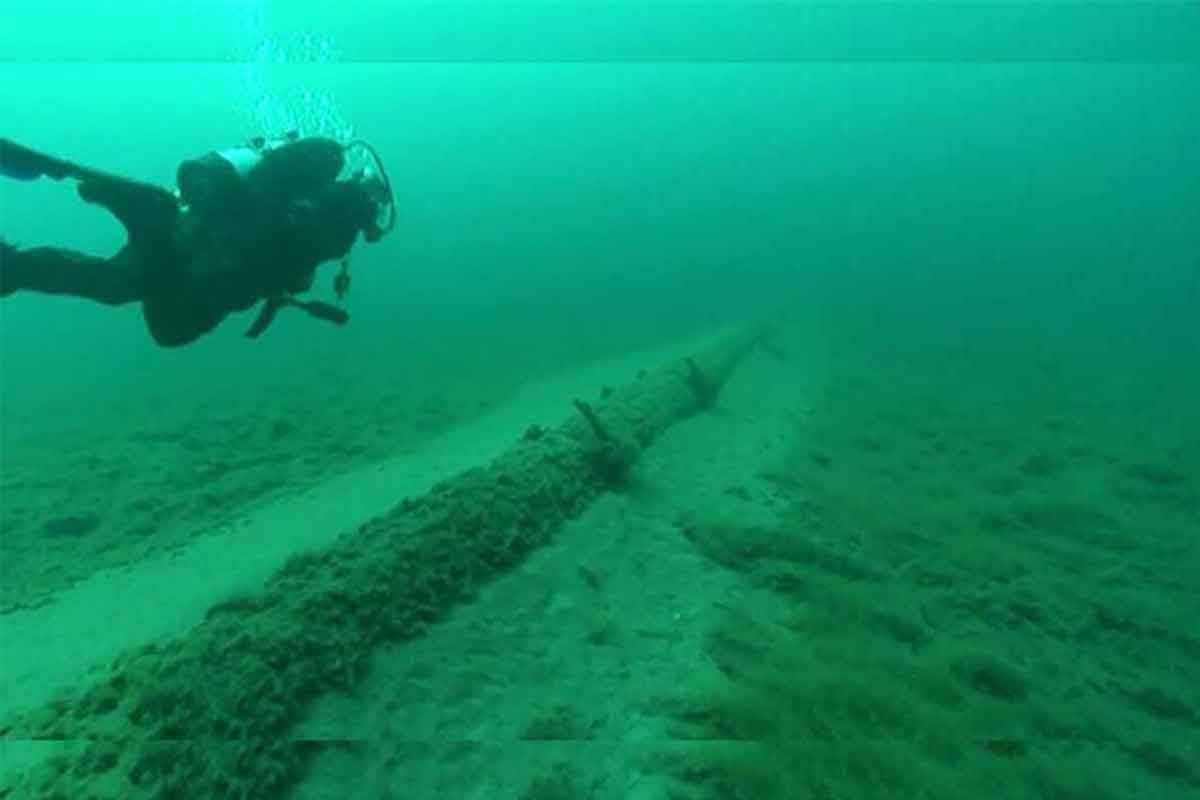
Enbridge has been using the Line 5 pipeline to transport crude oil and natural gas liquids between Superior, Wisconsin and Sarnia, Ontario since 1953. Roughly four miles (six kilometres) of the pipeline runs along the bottom of the Straits of the Mackinac, a channel linking Lake Michigan and Lake Huron.
Roger Gauthier, chair of ROWI told The Expositor last week. “I live in Michigan on the straits of Mackinac and across the horizon, Manitoulin Island is just 40-50 miles away. One of the big problems I’ve had with Line 5 is that Canadian shore property owners on Georgian Bay, including Manitoulin Island have been left out of the entire dialogue since 2011-2012.”
“The USACE permit to approve (encase a portion of an aging oil pipeline beneath a Great Lakes channel) is the latest step in the dialogue,” said Mr. Gauthier. He retired in 2002 as a senior hydrologist for USACE.
“My difficulty with the tunnel discussion is that this is and always has been a red herring,” stated Mr. Gauthier. “It was agreed by Michigan governor Rick Snyder and Enbridge in 2016-2017 to continue pumping oil on a now 73-year-old pipeline and transformed pipeline. It is likely erosion still continues, and they aren’t monitoring the rate of erosion. And while the current discussion has been going on, nothing has been done to replace the current pipeline on the bottom of the straits.”
The approval by USACE is just another step in the process, said Mr. Gauthier. He said the proposed work to encase a segment of the line would take 5-6 years to complete. “Meanwhile, there is a pipeline that is over 70 years old; it was never designed to last more than 50 years,” said Mr. Gauthier.
“The whole thing turned into a red herring, and continues to be,” said Mr. Gauthier. “We don’t believe the engineers’ allegations that the line is fit for service. There is no ongoing active, independent evaluation of the integrity of the pipeline and to provide the answers as to whether the line is still stable and fit for service. We want to see this independent evaluation take place.”
“A spill of oil from the pipeline would pose an extreme danger for Georgian Bay, St. Clair River and all connecting water links including areas like Manitoulin Island,” said Mr. Gauthier. “Enbridge needs to at least do an independent evaluation on the risk of failure of the existing pipeline.”
“The pipeline met standards when it was constructed in 1952-1953 but it was never designed to be supported by 240 supports on the bottom of the channel,” continued Mr. Gauthier. “No one really even knew about the pipeline until the National Wildlife Service raised concerns in 2013-2014.” He said it is unclear if Enbridge even has the funds to have a portion of the line encased. “Enbridge has now approved a plan and initially said they set aside funds to build a tunnel, but this has never been confirmed.”
“The line on the bottom of the channel has never gone through an independent assessment as to whether is if fit for service. So, there is a risk of failure that has never been evaluated or monitored, and we have an aging structure whose risk is increasing year to year,” continued Mr. Gauthier.
The Associated Press reported in part on October 29 that USACE approved the energy company Enbridge’s plans to encase a segment of an aging oil pipeline that runs beneath a Great Lakes channel, pushing past its own findings that construction could ruin the environmentally sensitive area.
USACE issued Enbridge a permit, saying that the application complied with all applicable federal laws and regulations, AP reported. Enbridge did not immediately respond to a request for comment.
Enbridge now needs only a permit from the Michigan Department of Environment, Great Lakes and Energy to begin the $500 million-plus project. Environmentalists have been pressuring the state to deny the application. A boat anchor damaged the line in 2018, further stoking fears.
Conservationists and a number of Native American tribes have balked at the proposal, calling it too risky and demanding Enbridge simply shut down the pipeline, AP reports.
Michigan Attorney General Dana Nessel, sued in 2019 seeking to void the easement that allows Enbridge to operate the pipeline in the straits. The US Supreme Court is currently weighing whether the case belongs in federal or state court, AP reports.
Governor Gretchen Whitmer ordered her regulators in 2020 to evoke the easement allowing the segment to operate in the straits. Enbridge filed a federal lawsuit that same year seeking to invalidate the order.
The Michigan Public Service Commission issued permits, promoting another lawsuit from environmental groups and tribes. A Michigan appeals court upheld the permits this past February.
“I live on a shoreline. My retirement home would be worthless if this pipeline erupts,” stated Mr. Gauthier. “It would affect properties and values in areas around the Georgian Bay and Manitoulin Island. Shoreline owners in all areas that would be affected should be as concerned as anyone.”