
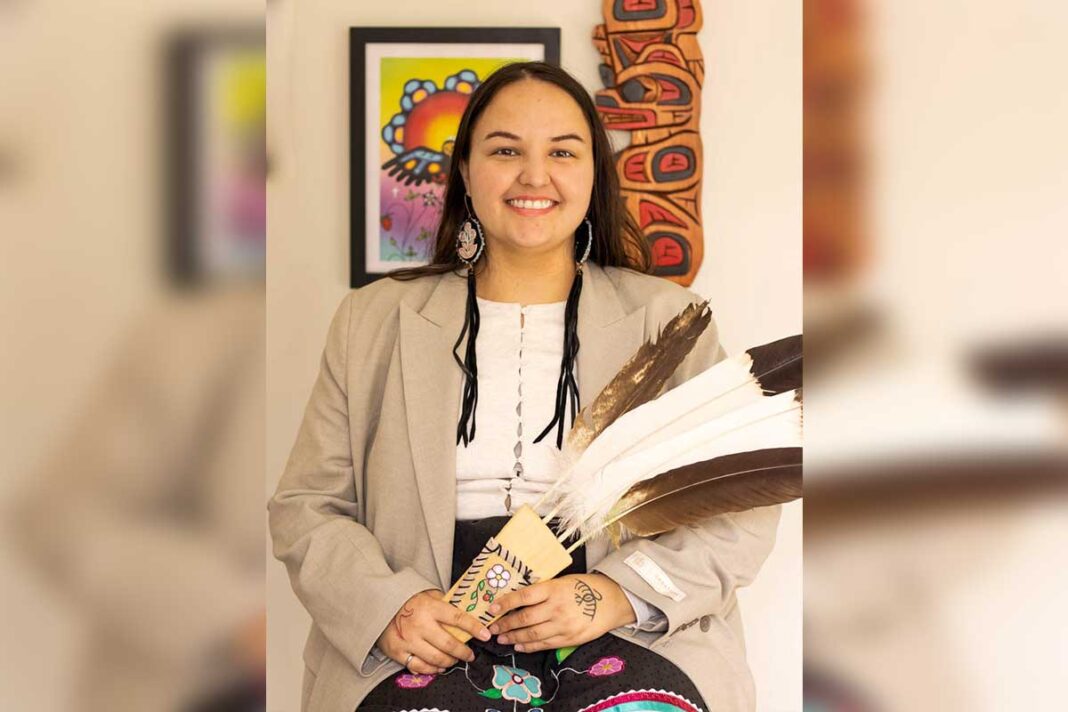
PARIS, FRANCE—Kaella-Marie Earle, a professional engineer and Indigenous governance leader from Wiikwemkoong Unceded Territory and Aroland First Nation (Ontario), was honoured in December with the Inspiring Woman of the Year award. The award was funded by Aubin Gonzalez Lapos, funding chairman of Berkeley Global Society, and presented by Berkeley Global Society in partnership France-Ameriques and Sisley Paris. The ceremony recognized women whose leadership is reshaping global futures in diplomacy, sustainability and justice.
Ms. Earle accepted the award with a powerful address that emphasized Indigenous sovereignty, environmental stewardship and the urgent need for inclusive decision-making in major projects. She also issued a clear call to action: prioritize Canada.
“Buy Canadian. Visit Canada. Invest in Canada,” Ms. Earle stated. “Come meet the Blackfoot in Alberta, the Haida and Coast Salish in British Columbia, the Inuit and Dene in the North, and the Anishinaabe in my home territory. Our safety is tied to the safety of the land, and the strength of our people.”
As Chair of the First Peoples Advisory Committee and member of the Sustainable Jobs Partnership Council at Natural Resources Canada (NRCan), Ms. Earle has been instrumental in advancing Indigenous oversight and sustainable economic development. The Council’s newly released annual report outlines bold recommendations for industrial strategy, skills development, and a people-centred transition to a low-carbon economy, with Indigenous leadership at its core.
“Indigenous Advisory and Monitoring Committees (IAMCs), are a strong beginning,” Ms. Earle said. “But they are not the end of the road. First Nation, Inuit, and Metis people must be decision-makers in the projects that impact their lands and futures. We are building a model of oversight rooted in treaty rights, environmental monitoring and legal plurality, one that can reduce conflict and improve outcomes for all.”
Ms. Earle’s speech also reflected on historical alliances, including the 1725 delegation of American Indians to Versailles, and the enduring relationships between Indigenous Nations and countries like Poland and Ukraine. “Respect for Indigenous governance is not new,” she said. “It is a tradition that still stands, and our future depends on it.”
Kaella-Marie Earle, also known as Waaseyaa (first light and the rising sun) is an Anishinaabe (Ojibwe, Odawa, Potawatomi) citizen of Wiikwemkoong Unceded Territory and Aroland First Nation. She is a certified, experienced board director, a licenced professional engineer and a humanitarian whose work spans energy, governance, safety, healthcare, and cultural revitalization.
Her leadership is grounded in ancestral teachings, humility and a fierce dedication to justice. Kaella-Marie’s impact is felt across local and national spheres, and increasingly, on the global state.
In the energy sector, she led a landmark engineering project that protected Anishinaabe ancestral remains, navigating complex between multiple First Nations. Her approach was peaceful, culturally grounded and deeply respectful, resulting in a resolution that honoured both the spirits of ancestors and the sovereignty of communities.
She also created and leads Enbridge’s methane abatement strategy, including the industrialization of recompression technology, a visionary initiative that blends technical innovation with environmental responsibility.
As an educator, Ms. Earle secured multi-year funding for the Maawanj’we Leadership program, an unprecedented model bringing engineering professionals to residential schools to learn directly from survivors and elders about Indigenous history, cultural repression and reconciliation.
She is also deeply committed to the psychological health of frontline energy workers, leading meditation and cognitive behaviour therapy sessions to address elevated suicide rates.
Ms. Earle is widely recognized as a bold advocate and thoughtful leader and has published in The Globe and Mail, delivered keynotes to thousands of youths, hosted Indigenous oversight leaders at major energy headquarters, and helped shape Canada’s commitment to Indigenous energy regulators through the UNDA Action Plan (Measure 34).
Her governance roles are equally significant, including appointments to the Sustainable Jobs Partnership Council of Canada (governor-in-council) the Waubetek Business Development Corporation), the long-range planning advisory committee at Health Sciences North, and several Indigenous bodies.
Ms. Earle’s work is transformational; she uplifts communities on what justice looks like and bridges ancestral wisdom with modern leadership. She is a systems thinker, a cultural steward, and a leader who influences generations.
At the awards ceremony, Ms. Earle’s speech also reflected on historical alliances, including the 1725 delegation of American Indians to Versailles, and the enduring relationships between Indigenous Nations and countries like Poland and Ukraine. “Respect for Indigenous governance is not new,” she said. “It is a tradition that still stands, and our future depends on it.”