
MANITOWANING—Much has been made of the military use of drones in the ongoing conflict in Ukraine, but a 22-foot vessel built at Henley Boats in Manitowaning has been utilizing cutting-edge civilian underwater drones during the past couple of years on a peaceful mission to discover secrets hidden in the depths of the Great Lakes.
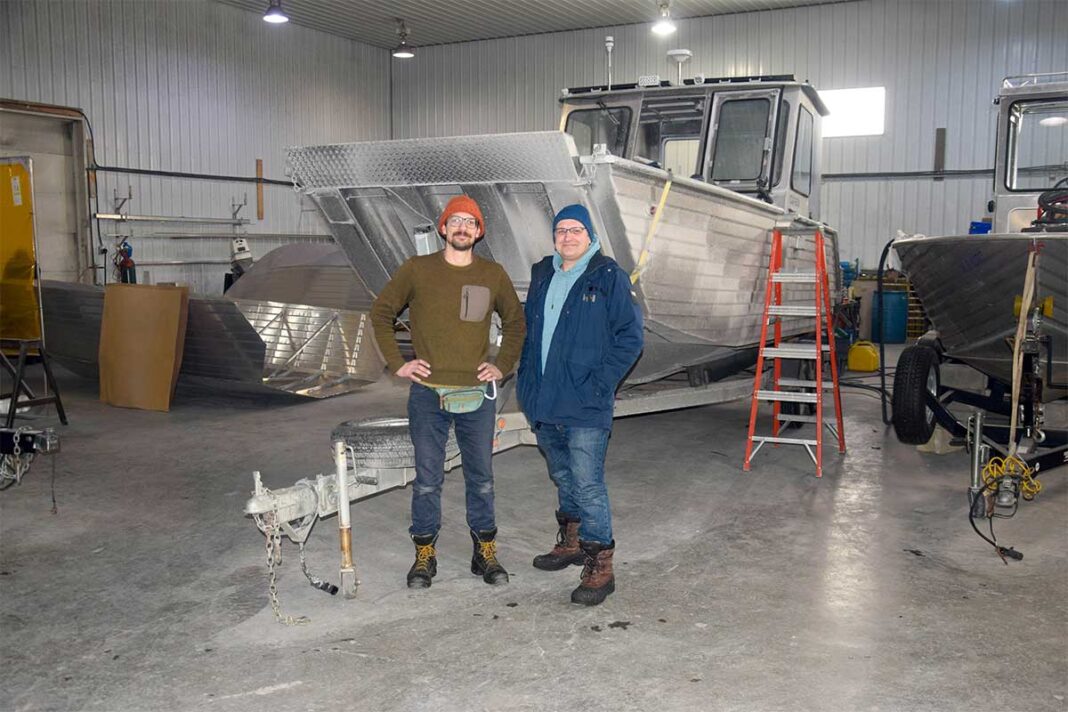
Zach Melnick of the documentary company Inspired Planet Productions was at the Henley Boats factory recently having some modifications made to the vessel in preparation for an important conservation mission on Lake Superior.
“My wife Yvonne and I run Inspired Planet Productions based just outside of the Tobermory area on the Saugeen and Bruce Peninsula, and we are career documentary filmmakers who have recently got into underwater exploration with underwater drones,” said Mr. Melnick, who along with his brother Kyle were going over last minute checks on their vessel before heading back to the Bruce.
“We can take our Henley landing craft out to any part of the Great Lakes and go down as deep as we want and explore with our underwater drone,” he said, explaining that the drone “is just like an aerial drone, but underwater. It’s a very specialized unit built in New Zealand, which has the highest quality underwater camera operating on the Great Lakes today. We can go down to 500 metres and, since Superior is about 405 metres deep, we can explore even the deepest depths.”
Not all of the depths are that deep, however, as the Great Lakes also feature some very impressive shoals—quite literally underwater mountains that reach up hundreds of feet.
“This past September, we went on a mission to what’s called the Superior Shoal,” said Mr. Melnick. “We kind of have nicknamed it the freshwater Everest because it’s the largest underwater mountain in fresh water—we believe in the world.”
Mr. Melnick noted that the underwater mountain has sheer granite cliffs stretching down more than 300 metres, making for some exciting visuals coming up from the drone.
“Just like sea mounts in the ocean concentrate marine life,” he said. “We’re working with a group of scientists on this. Lake mounts in the Great Lakes work in the same way as those in the ocean and, of course, when we go there, we see a lot more life than we do just out in the lake by itself, including some really cool fish.”
“If you Google freshwater Everest, there is a livestream we did from the boat,” said Mr. Melnick. “As we were going down with the underwater drone, we were showing it in real time, just that one dive because we did dives over many days, but that one dive, we kind of brought people along with us from around the world. It’s like a bit of a TV show and we’re really excited about that.”
Mr. Melnick explains that there is an underwater mountain in Lake Huron as well.
“It’s known as the Tobermory Shoals,” he said. “We think that’s actually the second largest underwater mountain in the Great Lakes. Where the Lake Superior Mount is about a thousand feet or so I think, the Lake Huron Mount is about 650 feet. It’s more gradual, but it’s definitely there if you look at it.”
Tobermory Shoals refer to a dangerous, shallow underwater rock formation around Tobermory at the tip of the Bruce Peninsula, which has caused numerous shipwrecks, giving it the nickname as the “shipwreck capital of Canada.” It lies within Fathom Five National Marine Park.
The fish that have drawn the Inspired Planet Productions team to explore Lake Huron during the depths of winter are called redfin lake trout.
“They are a very specialized form of lake trout that have been there forever,” said Mr. Melnick. “They haven’t been stocked like the more familiar lake trout, so they’ve survived in these offshore mountain environments.”
“They look different than that lake trout that we see around the shores,” he explained. “They have these great big fins, and they soar on the currents that flow over these mountains just like birds soar over mountains on the land.”
“We got to spend 10 days out on the on the Superior Shoal itself on the Blue Heron, which is a research vessel out of Duluth, Minnesota,” said Mr. Melnick. “We helped with the science as part of that. We would use our drone to do transects (a transect is a path or line used in science and urban planning to systematically observe and record changes in physical or biological features, like vegetation, land use, or animal populations by taking samples at regular intervals along the route) and help to explore that environment.”
Along with Lakehead University researcher Mike Renning in Thunder Bay, they are doing extensive research on the lake mountains to establish if those areas are as important as sea mounts in the ocean.
“Maybe they should be more protected as these sort of oases of freshwater life,” said Mr. Melnick, “and by what we saw just anecdotally, we don’t have the science in yet, that appears to be the case.”
So that brings us back to the legendary redfin lake trout.
“The reason that we’re filming, we’re working with, scientists in the US try to film this species because they’re trying to restore this little fish to Lake Ontario, but it hasn’t been working,” said Mr. Melnick. “They still have the redfin lake trout in Lake Huron, so we’re trying to figure out what their spawning activity is.”
The redfin lake trout spawn in January and February. “So, we have to try to get out there in January and February,” he said. “We’re working with the Indigenous community, Nawash Unceded Territory. They’re using their traditional knowledge.”
“We’re going out there to try and see if we can film this species spawning,” said Mr. Melnick. “To learn anything about what they’re doing out there that might be able to help the folks in Lake Ontario.”
For the past 15 years now the conservation efforts to restore the redfin to that lake have proven fruitless. “The question is, if we can learn more about their behaviour here in Lake Huron, maybe they can tweak their restoration program in Lake Ontario based on that information.”
Mr. Melnick explains that the Henley boat his company uses is a 22-foot “landing craft style” boat. “It has an electric motor on it so we can stay in position using spot lock, anywhere,” he said. “That’s super key to it all. The boat has a little cabin in the back, so we can make it totally dark, because that’s really important when you’re operating the drone, you want to have a dark environment.”
But it isn’t just all about the redfin.
“We just had a heater installed and the back fully enclosed because we’re going to search for a deep-water fish called the bloater out in Lake Huron and believe it or not, this is one of a number of species which have never been on camera before in the Great Lakes,” said Mr. Melnick. “We’re on the hunt for imagery of that. It’s going to be a big deal because it’s never been photographed alive, and they live only at 300 feet or below, so they’re a deep-water species.”
Mr. Melnick and his wife are originally from Southern Ontario. “But we moved to the greater Tobermory area about nine years ago now. We moved there because we were working on our history series about that region called The Bruce.”
“Our first introduction to Manitoulin was back in 2008,” he said. “We did a documentary called Island of Great Spirit, which was actually when we were fresh out of school. We got to spend a couple of years telling history stories around Georgian Bay, including a project here on Manitoulin. So, we kind of fell in love with it there.”
“When we were looking for the perfect boat to pair with this advanced underwater drone from New Zealand, we’d heard a lot of positive stuff about Henley’s, and we’d seen them around,” said Mr. Melnick. “We knew we wanted a serious work boat that we could take out into the middle of the lake and survive, and so we and we naturally came back to Henley and they built us this custom drone boat that we absolutely love—we take it everywhere.”
“We haven’t announced it yet, but we’re working on a new show called ‘Hidden Below,’ and we’re going to be an underwater wildlife show, but in fresh water all around the Great Lakes, including here around in Manitoulin,” shared Mr. Melnick, “and we’ll be doing live streams where we show people what’s down there live, and we take questions from people.”
“It’s going to be a wildlife show, but as part of that, we are going to visit a bunch of places around Manitoulin and Lake Huron,” he said. “We live in Tobermory, so it’s natural for us to go out here.”
Plans are to explore areas like McGregor Bay, where the company plans to spend a lot of time. “We’re also going to be doing a live stream to the deepest part of Lake Huron, and we show people what’s down there, which believe it or not, we don’t think anyone’s actually visited with cameras. There was a period in the 1980s where they had submarines going around doing exploration in the Great Lakes, but we know from speaking to the people who were running that program that they had intended to explore that deepest spot in Lake Huron, but the weather was too bad, so they ended up looking at Georgian Bay instead, so we actually don’t think that area has ever been explored by cameras.”
“Everyone thinks that the Great Lakes are well explored and well charted and well mapped,” he said, “but there’s a lot yet to explore out there, and that’s what really gets us excited. There is a lot of nothing, but sometimes you see really cool stuff.”
The crew will be keeping an eye out for the famed Griffon, but if they find it, it will not be their first shipwreck. “We actually did find a shipwreck in our in our work, a ship called the Africa that went down in 1895.”
“We were working with folks from the United States Geological Survey who do a lot of fish work in Lake Huron, and they found a bump on their fish sonar, and they said, ‘well, you should probably go check out that bump.’ It turned out to be this steamship called the Africa that went down on 1895. It was built in 1873 and, remarkably, the captain of that ship was a man named Hans Larson and Yvonne, and I live in Larson Cove, named after that captain who went down with that ship. So, it gives us this really cool connection. We actually brought the family of the descendants of Captain Larson from all over Canada. They got to see the ship and the resting place of their ancestor for their first time.”
To learn more about the work that Inspired Planet Productions are doing, you can go to inspiredplanet.ca and follow along.