
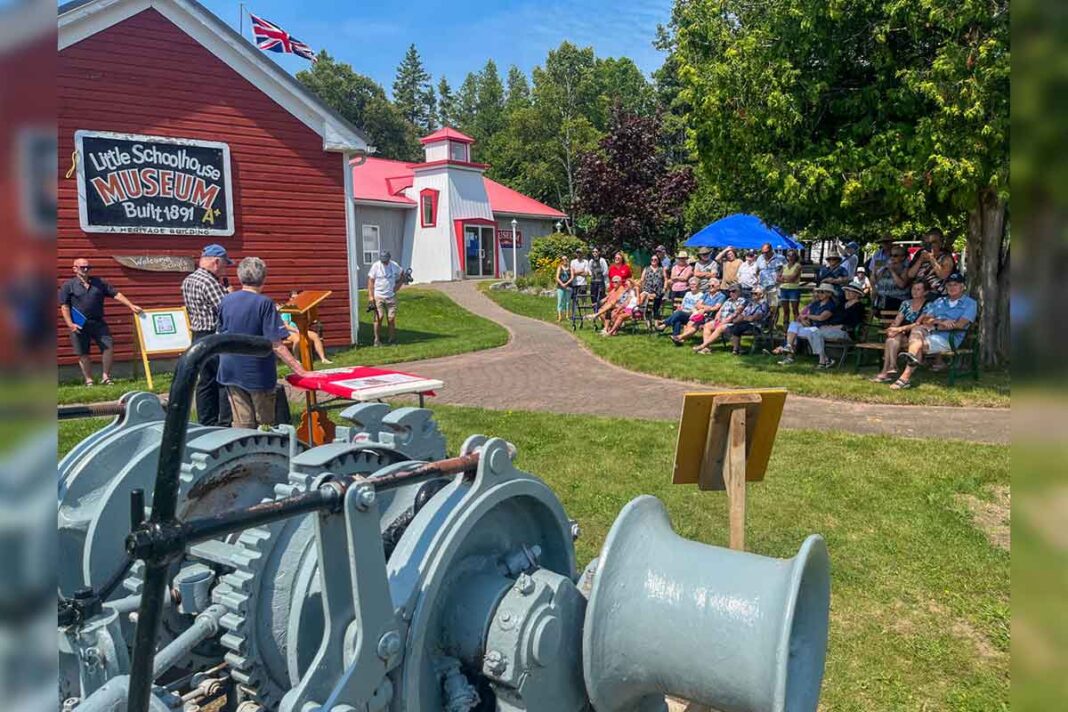
SOUTH BAYMOUTH—The South Baymouth Community Development Association and Little Schoolhouse and Museum hosted an MS Chi-Cheemaun/SS Norisle salute event Saturday in South Baymouth that included a special dedication of several artifacts from the former SS Norisle—the passenger ferry that plied the waters from Tobermory to South Baymouth from 1947 to 1973 when it was replaced by the MS Chi-Cheemaun—back to her home port.
The artifacts, all installed on the museum grounds, include the Norisle’s bow windlass (the machinery that raised and lowered the anchor chain), a lifeboat and a cowl vent.
The dedication was emceed by Gary Brown, museum board chair. He explained to the crowd that the Norisle was built in the Collingwood Shipyard for a cost of $547,000 and launched in 1946.
The name Norisle stands for NOR (Northern region of Lake Huron) and ISLE (representing Manitoulin). She was 215’ in length and had a capacity of 200 passengers and 50 vehicles and replaced the SS Caribou, which could carry 13 vehicles, and supplemented the MS Normac (10 vehicles).
“In her first full season she carried 13,000 vehicles and 40,000 passengers,” Mr. Brown shared. “Multiply this by 26 years of service and you get 340,000 vehicles and over one million passengers.”
Mr. Brown noted that the two outside lanes of the Chi-Cheemaun would hold as many vehicles as the Norisle.
The Norisle was the first commercial vessel built in Canada after WWII and the first new passenger ferry built on the Great Lakes since 1911. It boasted a crew of 47 and included “white linen” dining and overnight berths.
Mr. Brown thanked several people and organizations at the event, beginning with the Township of Assiginack for “extending” the Norisle’s life as a museum ship from 1974 to 2024.
Several plaques of appreciation were given at the event for making the Norisle’s return home a reality. First was John Greenway, representing the South Baymouth Community Development Association, who was instrumental in organizing the return; Marine Recycling of Port Colborne, the ship’s scrapyard which salvaged the pieces; Manitoulin Transport and Chrisanne MacKay for helping to get the artifacts home; Chi-Cheemaun Captain Kerry Adams of the Owen Sound Transportation Company for their help with the artifacts; and Porter Services for helping to unload the equipment once it arrived.
“This museum would not run as it does without the help of provincial and federal funds,” Mr. Brown said, taking the opportunity to welcome MPP Bill Rosenberg to the podium.
Mr. Rosenberg gave kudos to the many hours put in by volunteers to ensure that the history of the area is maintained for future generations. He then presented a certificate to the museum board for the occasion.
Mr. Brown then thanked the municipal staff for their work in installing the artifacts on the museum grounds. Tehkummah mayor John Deforge then offered his congratulations, noting that he knew the Norisle well, having worked for six months on the vessel at the same time his daughter was born.
There were some present for the event who had also spent time working on, or with, the Norisle. Norm Addison said he was a boatswain, coxswain and watchman on the ship while Rick Crouch, a member of the museum board, said he was a teenager in 1970 and worked on the ferry dock, catching lines for the Norisle and Norgoma.
“Things were a lot different then,” he laughed. “We had to let air out of tires, jump on the bumper, hitch and unhitch trailers, all just to make cars fit. The ballast of the ship was field rocks!”
Dave Leeson shared with the audience that his parents owned and operated the Ferry Launch Restaurant and at age 14 he was often tasked with catching the line for the Norisle, which was a heavy cable. Sometimes when he would miss, the cable would fall into the lake and as he wasn’t strong enough to pull it out by himself, tourists would have to come to his rescue.
Mr. Brown concluded by again acknowledging the work of Mr. Greenway, who was not at the event as he was busy barbecuing on the ferry dock as part of the day’s festivities, but had been there the day before, touching the artifacts up with paint for their big reveal.
The audience then headed into the museum for cake and punch.
The day’s events also included a bake sale, barbecue, vendors along the ferry dock, a spaghetti dinner at John Budd Park followed by a family dance.