
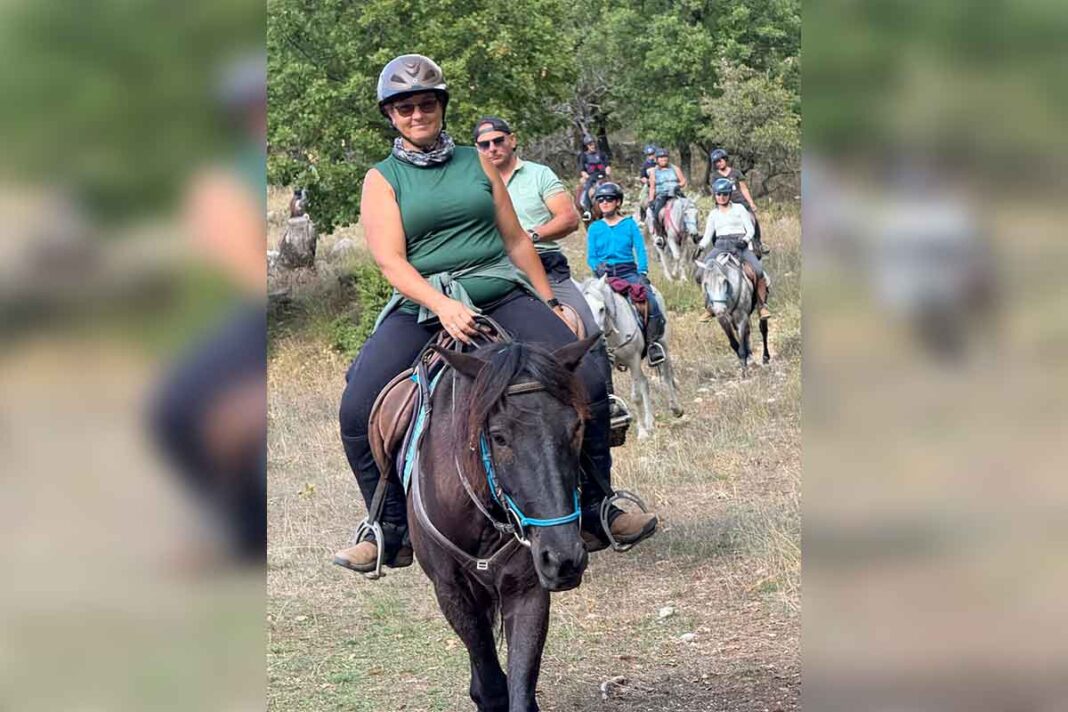
HONORA BAY—For Honora Bay Riding Stable’s Kyla Jansen, a horse riding trip in Albania was the trip of a lifetime.
“The opportunity to take this trip was scattered with many decisions and bumps in the road,” said Ms. Jansen. “I am so very thankful that I persevered and made the opportunity of a lifetime happen. The trip was a blend of current rural Albanian life and the ancientness that exists there.”
There was plenty of both to be had.


“Our guide Kristina pointed out a particular point in our path where an ancient roadway built by the Romans was still intact,” said Ms. Jansen. “Everyone was quiet as we made our way over the road listening to 15 horses’ footsteps and imaging what it was like to be a Roman so many years ago.”
“We visited ancient churches with stone roofs, iron doors and wood carved moulding where the interior walls were covered in fresco murals, some old and faded and others in various stages of restoration.”
The trip members stayed with local families in very small hamlets, she added. “Their gardens were lush with grapes and kiwis and pomegranates. Meals were plentiful and fresh. Every meal included red wine and Raki. “Raki is a national drink of Albania made from fermented fruit” she explains. “Every home has a slightly different variation because its preparation is often a centuries-old family tradition.”
Ms. Jansen explained that etiquette requires a guest to accept Raki. “So, this made our evenings full of high spirits and fun,” she said.
“Albania is a country in transition,” said Ms. Jansen, “but the pride of the Albanian people is palpable. Our guides and our hosts were so eager to share stories, historical facts, traditional dancing, music and food.”
The protection and restoration of some of the ancient buildings has been difficult, she notes, as the government lacks a well-developed cultural sector, at least so far.
“So, the local residents and private tour guides like Kristina from Caravan Horse Tours do their best to protect and to document how they utilize these sites to augment the tourism industry in hopes that formal historical protections can be implemented in the future,” said Ms. Jansen.
“This ride was certainly not for the faint of heart as we did a great deal of galloping across varied terrain, traversing ancient, arched stone bridges with no side rails, climbing near vertical stone slopes on our horses and letting our horses go so we were able to walk/slide down steep slopes of marble-like stones.”
“The horses were small, sinewy, strong and confident and we really had to just trust them,” she said, despite the fact that she is a very experienced rider.
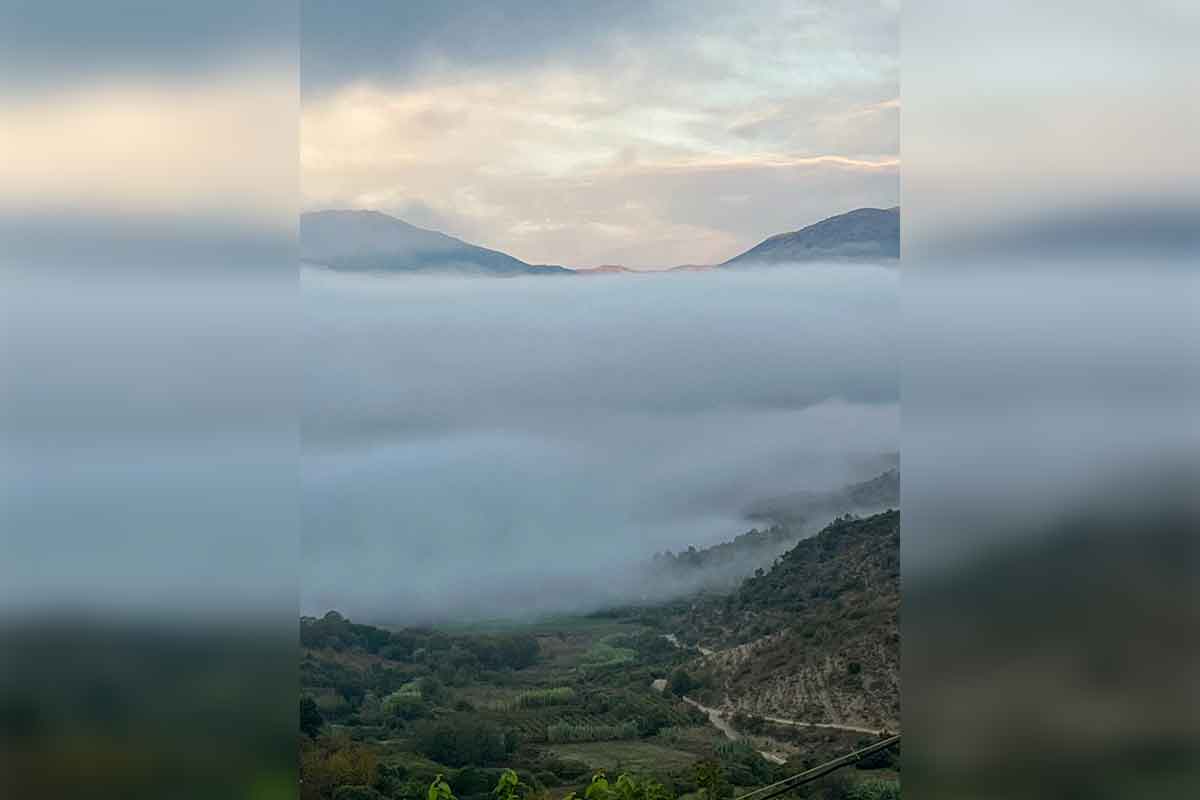
“The first day was like a dream,” she said. “The mountains run laterally to one another and the valley where the town of Gjirokaster is located in between. The valley was full of clouds right up level with the plateau we were on. We galloped for well over a kilometre, as if galloping right on the clouds! The ridge, off to the left above the clouds, was kilometres away and shining with the morning sun reflecting on it.”
“I’ve spent a lifetime on the back of a horse and this trip proved to me that it seems I’ve hardly spent any time there at all,” said Ms. Jansen. “I learned how little we tend to trust our own horses, how much we tend to micromanage them and how much pleasure it is to relax and enjoy as we climbed up rock faces and mountains. The visual beauty cannot be explained. Nor could it be photographed as photos truly could not do the Albanian landscape justice.” She did, however, supply a number of photos from her trip.
“We travelled medieval Zagoria caravan pathways into a land of myths, tales and ballads,” continued Ms. Jansen. “Starting in Gjiroksater, the circular equestrian mountainous route passes through ancient ruins of the Illyrian civilization (early Greek), medieval villages and many remote churches and monasteries. The history behind so many of these churches in monasteries was amazing to me, realizing how old Albanian culture is often pointed out between the 1200s and 1300s in comparison to Canada.”
“We travelled daily on the horse, anywhere between three-and-a-half to seven hours of riding, travelling between 21 to 34 kilometres a day,” said Ms. Jansen. “Part of a ride brought us to a village where we stayed with the host family, which was of minority Greek extraction, living right on the border of the Greek and Albanian lands. We swam in freezing cold turquoise water, had wild horses join our gallop across the mountains, and met friends that will last a lifetime.”
“I will try to explain a little bit of our ride although this will be short of saying the most amazing experience I’ve ever had,” she laughed.
“Our first day we basically got to know the horses had some mad gallops across open fields and began our ascent up into the mountainous areas as we had had to be assigned our horses and begin our journey,” relayed Ms. Jansen. “This was one of our shorter days at three-and-a-half hours of riding. Riding through some open areas, the smell of cocoa surrounded us as there were wild cocoa plants on the mountains from which the local population gather beans to use for croissants.”
“It made us hungry riding along,” she said.
Ms. Jansen explained that Albania is a place of natural beautiful water springs. “Even high in the mountains it is never lacking water for the animals and the locals to use.”
The group began their ascent on the second day under a cover of fog as they climbed.
“Our sure-footed horses were a mixture of Arabian and tarpan and they carried us upwards and through some of the worst sharpest vines,” she said. “While we struggled, they did not. Suddenly we were in the open and galloping along the edge of a mountain with the fog still around our horses’ feet and then looking off to the left was this magnificence of realizing that you were galloping across the top of the mountain above the clouds that were beside you. Breathtaking is all I can say.”
“Our days continued with many mixtures of climbing plateaus and visiting so many churches in monasteries filled with such history in the mountains and small communities some in areas had only 10 people living there.”
“Our third day of riding was our most difficult day, as our ascent up into the mountain put us into some very rugged forest,” she said. “We had to get off our horses tie their reins to their saddles and let them go as they followed the whistle of the main trail guide down the mountain, picking their way, jumping off mini cliffs as they went down. After the herd had made their way down to a level plateau, we riders did our best to scramble, slide and pick our way down a mountainside where the horses seemingly had no issues.”
“Our fourth day, my favourite most exhilarating day of the trail, began with tempestuous rains absolutely pouring rain, however, we all donned our rain gear and began our ride,” said Ms. Jansen. “Luckily for us, the rain did not last terribly long and we began to slowly dry out a little. We crossed a major river between two mountains where one of our riders ended up going for an impromptu bath as his horse decided to go for a swim. While we were still all giggling about his rather damp appearance our guide Kristina informed us it was time to stay out of our horses’ way and ride looking around. I wasn’t able to see the trail anywhere and that’s because there was none! We began to climb straight up the 1,500-foot face of the mountain, trusting our horse here had to be the most important part because the rocks were moving and rolling and they just continued to climb ducking under low trees with us looking over our shoulders and eventually seeing the river below us as just a tiny little stream.”
“The horses carried us with an agility that to this day will forever impress me as they never faltered, although one did almost slip off the mountain,” said Ms. Jansen. “That rider was my friend Ricarda from Germany (if anybody has ridden here at my farm in the last seven years, they will have met her guiding trails). Thankfully, it pulled itself back up and carried on and most of us never even knew what had happened. The horses climbed and climbed steadily without pressure and when we reached the top none of them were even winded. So, we took off at a gallop through the most incredible red ferns I’ve ever seen.”
“Our meals at each stop consisted of fresh fruit and vegetables, including figs,” she said. “When we did have a meal that had meat in it, it was either lamb or chicken.”
“To me this ride was incredibly exhilarating, refreshing and I plan to practice more understanding of horses in the continuation of my riding,” said Ms. Jansen. “I book ended my journey to Albania beginning in Paris and Corfu, Greece finally ending with Switzerland and Germany to visit each of the young ladies who have spent time volunteering here at my stable and seeing and learning so much of the European culture,” concluded Ms. Jansen. “I am so lucky to have had this opportunity.”
Ms. Jansen said that she posted photos on her Facebook page to enable folks to learn more about her journey, “so that my family and friends could follow along as I was travelling.”