
ONTARIO—Nine First Nations in Ontario have filed a joint legal application in Ontario’s Superior Court seeking to strike down two recently passed laws—one federal and one provincial—that they say violate their constitutional rights and threaten the environment.
The nations—Alderville, Apitipi Anicinapek, Aroland, Attawapiskat, Fort Albany, Ginoogaming, Kitchenuhmaykoosib Inninuwug, Oneida Nation of the Thames and Wabauskang—announced their case at a press conference at Queen’s Park on Wednesday.
The legal challenge targets Bill C-5, also known as The One Economy Act, and Bill 5, Ontario’s Special Economic Zones Act. Both laws were passed earlier this year and aim to accelerate the approval of major infrastructure and resource development projects deemed to be in the national or provincial interest.
The First Nations argue that both laws enable governments to bypass existing environmental and consultation processes and were passed without meaningful engagement with Indigenous communities. The application asserts that this violates Section 35 of the Constitution Act, which protects Aboriginal and treaty rights, as well as sections of the Canadian Charter of Rights and Freedoms related to security of the person (Section 7) and equality (Section 15).
“Both of the 5s were introduced to push forward massive economic developments without the necessary information to understand and address what could be serious negative impacts, and without including First Nations—whose lands these projects would be built on—in much if any of the decision-making process,” said Sudbury MPP Jamie West at the press conference.
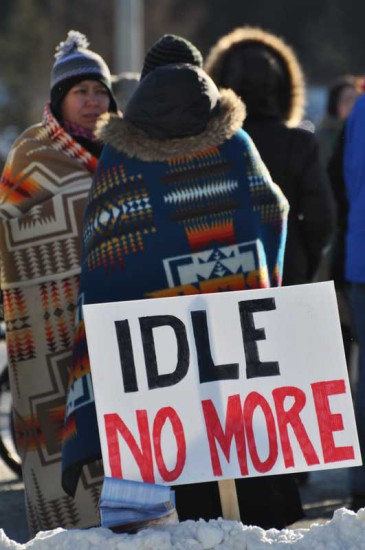
Meanwhile, First Nations leaders in Northern Ontario are vowing an “Idle No More 2.0” if the province passes Bill 5, legislation that would speed up development without clear rules on Indigenous consultation and accommodation.
Grand Chief of the Anishinabek Nation Linda Debassige of M’Chigeeng First Nation has fired a proverbial warning shot saying “we caution the provincial government that should Bill 5 proceed in its current form, we will be idle no more.”
Scope of the Laws
Bill C-5, passed by the federal government, allows cabinet to designate certain projects as being in the “national interest” and fast-track approvals by exempting them from multiple federal laws. These approvals are made through regulation and are not subject to parliamentary debate.
The law was amended during the legislative process to clarify that certain statutes—such as the Indian Act and Impact Assessment Act—remain in force. However, the legal challenge argues that the mechanism still limits public and Indigenous input in decisions that affect lands and communities.
Bill 5, passed by the Ontario government, enables the province to create “special economic zones” where cabinet can override or suspend parts of environmental and planning legislation, including laws protecting endangered species and cultural heritage.
According to the legal filing, both laws include “Henry VIII clauses,” provisions that permit cabinet to amend or repeal sections of legislation without going back to the legislature. The application argues that such clauses further reduce transparency and accountability and contribute to the violation of Indigenous rights.
“These laws authorize the Crown governments to approve on a fast track major projects like Ring of Fire mining and pipelines, by short-circuiting the need to get critical information about human and environmental safety and impacts, and without involving the very peoples whose lands these projects would eat up,” said Alderville First Nation Chief Taynar Simpson in a public statement.
“Our case is not a fight against development,” he added. “It is a fight against dangerous development pushed ahead by factless, thoughtless, and reckless decision-making from government ministers behind closed doors.”
Statements from First Nations Leadership
Chiefs from several of the plaintiff nations spoke at last Wednesday’s press conference. Apitipi Anicinapek Chief June Black described the duty to protect the land as a “sacred responsibility” and said the legislation represented a “clear and present danger” to Indigenous ways of life.
“We have a right to a way of life in our lands, and that way of life includes decision-making and government authorities,” said Chief Black. “Canada and Ontario cannot continue to make unilateral decisions about developments and major projects.”
Oneida Nation of the Thames Chief Todd Cornelius also emphasized that the issue was not a blanket opposition to economic activity.
“We First Nations are not against development per se. This is not about a battle between development and not,” said Chief Cornelius. “It is about doing things recklessly and doing things right.”
In a written statement, Chief Sheri Taylor of Ginoogaming First Nation questioned the rationale provided by government officials, who have cited ongoing trade tensions with the United States and tariff threats from President Donald Trump as reasons to expedite national infrastructure development.
“If Canada and Ontario are so worried about threats to Canada from a bullying U.S. president whose administration has been stripping human rights protections, then why are Canada and Ontario supposedly answering those threats with their own laws that bully First Nations and strip human rights and environmental protections here?” asked Chief Taylor. “Would that not make this country the very thing we are trying to avoid being imposed on us?”
Government Responses
The Office of the Premier of Ontario issued a statement saying it continues to consult with First Nations on shared priorities, including infrastructure and resource development.
“We have begun productive conversations with First Nations who share our vision of unlocking economic opportunity and critical infrastructure in their communities, and will continue these consultations throughout the summer,” said Premier Ford’s spokesperson, Hannah Jensen. “These consultations will shape the regulations and criteria for new special economic zones and Indigenous-led economic zones.”
Prime Minister Mark Carney also hosted a summit with First Nations leadership on July 16 and 17 to discuss the implementation of Bill C-5 and related concerns.
Lawyer Kate Kempton, who is representing the nine nations, said the challenge is aimed at ensuring Indigenous communities are not excluded from decisions with long-term consequences for the land and future generations.
“When we first heard of Bill 5, we were given a mandate by our citizens to stop this bill at any cost,” said Chief Simpson. “And that is what we are doing today.”
The legal action filed by the nine Ontario First Nations came just days before a national summit on Bill C-5, hosted by Prime Minister Mark Carney in Gatineau, Quebec, on July 16 and 17.
The chiefs of Ontario raised concerns about Ottawa’s handling of a July 16 meeting with Prime Minister Mark Carney to discuss Bill C-5, the Building Canada Act. Prime Minister Carney had committed to meeting First Nations after chiefs said their rights were overlooked during the bill’s fast-tracked passage.
Initially, chiefs, legal advisers and technical staff were invited to register. Days later, only regional chiefs’ registrations were confirmed; all others were excluded despite having made travel arrangements.
The chiefs called the decision disappointing and unfair, noting the bill’s potential to reshape the country and the importance of having full support at the table. Prime Minister Carney’s office did not respond to requests for comment.
Leaders arrived at parliament in Ottawa — that sits on Algonquin land which has been petitioned since 1772 and has been under formal negotiation since the 90s — with questions, legal threats and growing frustration over the fast-tracked law and what it could mean for their lands and rights.
More than 600 chiefs from across the country travelled to the Canadian Museum of History, where the federal government invited leaders to discuss the implications of the Building Canada Act.
The summit was framed by the federal government as an opportunity for “engagement,” not formal consultation. This distinction was noted by many attendees, including Chief Don Tom of the Tsartlip First Nation and vice-president of the Union of B.C. Indian Chiefs (UBCIC).
“The prime minister was clear that this was not consultation but rather engagement,” said Chief Tom. “I think the general feeling amongst chiefs is that the government is a day late and a dollar short.”
Chief Tom noted that while many First Nations had expressed concerns about the bill, those given the floor during the summit were largely supportive of industrial development.
“From the opening of the meeting, it was evident that those who were project-friendly were given the platform to speak,” he told CBC News following the summit.
“This is a bad decision by the prime minister to short-circuit the need to protect the land, the earth itself, and to trample on our people’s rights and reduce our rights to consultation,” said Ovide Mercredi, a lawyer and former national chief of the Assembly of First Nations (AFN) in a virtual meeting held to prepare for the summit. Former Chief Mercredi is a Cree leader born on January 30, 1946, in Grand Rapids, Manitoba, Canada. He is a member of the Misipawistik Cree Nation, located in central Manitoba.
“We still own this land.”
“We’re heading to challenges in the court system,” said Chief Teegee, referencing not only Bill C-5 but also B.C.’s related Bills 14 and 15.
In its public statement, BCAFN noted that most of B.C.’s 204 First Nations remain concerned about the lack of transparency around the Building Canada Act and the extent to which it may override Indigenous rights.
Chief Tom acknowledged that Prime Minister Carney remained present for the duration of the summit—something he described as unusual for a sitting prime minister—and that Carney indicated further consultation would take place in the future. However, leaders across the B.C. First Nations Leadership Council have stated that consultation after the passage of legislation cannot be considered meaningful.
As legal action moves forward in Ontario, both provincial and federal governments now face growing national scrutiny over how the laws were developed, passed, and communicated.
“If this Act is to be saved,” said the BCAFN in its release, “and if Canada is to avoid costly legal battles, Prime Minister Carney will need to make substantive and concrete commitments to legislative, regulatory and policy protections to ensure the standards of the UN Declaration are upheld.”