
On the National Day for Truth and Reconciliation, Lt. Governor arrives on naval vessel, lays wreath at M’Chigeeng cenotaph
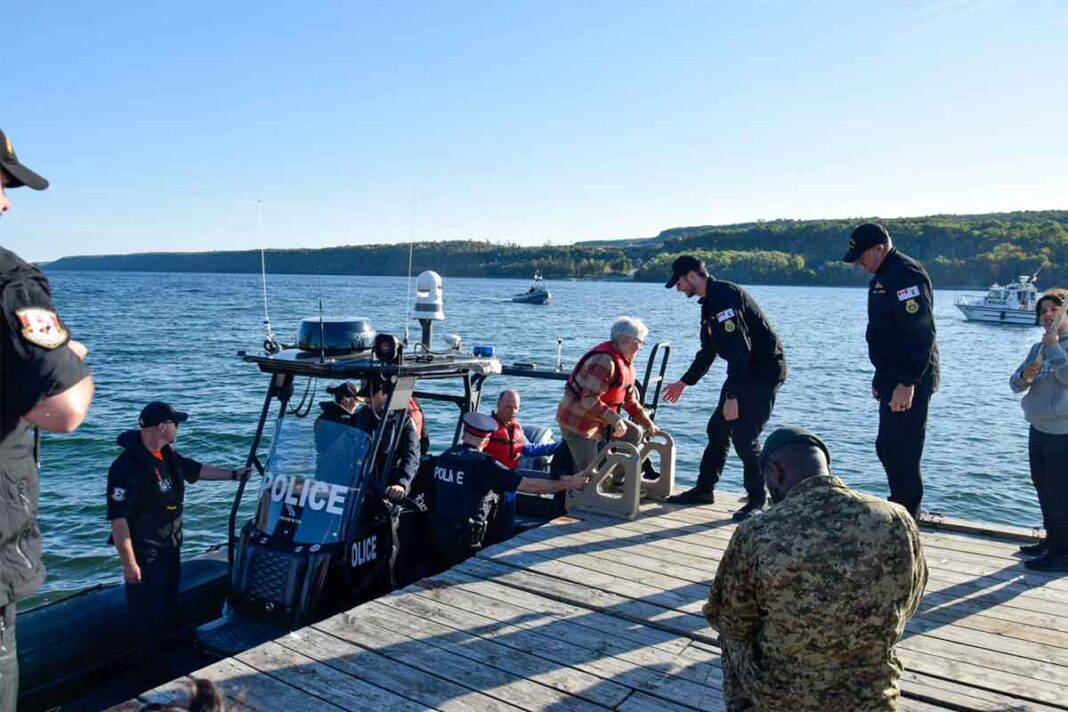
M’CHIGEENG—In an historic event, Ontario Lieutenant Governor, the Honourable Edith Dumont visited M’Chigeeng First Nation for a Truth and Reconciliation event, arriving aboard the Canadian offshore patrol boat HMCS Margaret Brooke. This marks the first time a Canadian warship has dropped anchor at M’Chigeeng.
The Lt. Governor arrived at the dock in M’Chigeeng aboard a smaller vessel as the warship’s draft was too large to come to the dock itself.
Her Honour was met by a reception line consisting of Island First Nations chiefs, councillors and dignitaries, as well as a large contingent of Sea Cadets from Manitoulin and Sudbury who were eager to tour the ship.
photos by Michael Erskine
The official ceremonies took place at the M’Chigeeng Cenotaph, located across from the band office on Highway 551 and in front of the Church of the Immaculate Conception.
Following some brief remarks from master of ceremonies Robert Beaudin and a prayer and opening remarks by Elder Jean Debassige, the Lt. Governor laid a wreath.
Drum group Thunder Earth played a welcoming song, an honour song and a song to which the assembled jingle dancers danced in a circle around them.
Anishinabek Nation Grand Council Chief Linda Debassige was unable to be at the ceremonies, but her son Private Pierre Debassige delivered words to the assembly on her behalf:
“I am honoured to have helped facilitate this visit from the Lt. Governor to our beautiful community of M’Chigeeng. It is a beautiful day to honor our survivors and their families and to honour those children who never returned and their families also. It is a day for us to remember the importance of all of our children and our sacred responsibilities to protect them and raise them to be proud Anishinaabe people. It is a day to uplift the spirits of our communities and our resilience, despite what was attempted on us. We are still here, and we will always be here. Together, and we recognize the trauma we all carry and together. We all help control. Support each other and love each other. When we do this, our trauma will not control us or hurt us any longer. I am sorry that I cannot be there with you all today, but no matter what, where I am, or where I go, I always have the unwavering love for our community, our people, and a special love for all of our survivors and their families. Today, and every day, every child matters.”
“I’m glad to be here today because I got to meet the Lieutenant Governor of Ontario, and that’s a big deal,” said Aundeck Omni Kaning Chief Patsy Corbiere. “And that’s a big deal for me to be coming here today. I also am the Tribal chair of the United Chiefs and Councils of Mnidoo Mnising.”
Chief Corbiere asserted that “You can fix any problem on your First Nation with Truth and Reconciliation. If you have a heart and you want to do that. And started knowing your people. People don’t even know there are people in their communities anymore, so we can fix that problem. It’s not just a chief and council problem—it’s a community problem and we need to work towards fixing what we’ve broken and can’t be all just blamed on other things that happened in the past. We’re the ones that have to fix this generation and we need to start today, not tomorrow today. So, I’m glad you’re here, and I know I just had a great moment to talk to you about what our dialogue might be today, and I’m looking forward to that so much.”
“Chiefs, veterans, dancers, singers, the welcoming party on the cave—thank you for the warm welcoming since we arrived earlier this morning,” said Lt. Gov. Dumont. “I’m a francophone from east of Ontario. So, I’ll be using a little bit of French here and there, so I feel grounded. This is something I learned while visiting First Nation communities, how important it is to preserve our mother tongue. I met recently a teacher, a member of Anishinaabe community, a PhD doctor in Indigenous languages working for Ontario to make sure that indigenous languages are preserved. It’s a member of your community, a doctor at York University.”
The Lt. Governor acknowledged her husband, Tony, who accompanied her on the trip.
“We’ve been traveling along North Channel and Georgian Bay since yesterday morning through waters and along lands stewarded by the Anishinaabe and it is very meaningful for us to be among you. Now, on Orange Shirt Day and the National Day for Truth and Reconciliation. This is a day of reflection about the significant harms caused by residential schools, day schools and industrial schools. And that day, for non-indigenous peoples to show solidarity with indigenous peoples through what we wear, what we say, what we learn, and most importantly, what we do. As the representative of the Crown in Ontario and speaking for myself personally on these treaty lands, I affirm my commitment to pursue of truth, and the journey of reconciliation. This is a commitment that must be made and renewed, not just one day a year, but each and every day. It is also a commitment that cannot remain abstract. Reconciliation is not reconciliation if it’s not embodied through actions through dialogue and by building and sustaining relationships. It is in the everyday practice of respect, listening, learning and partnership that reconciliation becomes real.”
“An important element of reconciliation is remembering the contributions of Indigenous peoples to Canada,” she said. “Today, I am especially grateful to have this chance to recognize all those from M’Chigeeng First Nation, who have served in the Canadian Armed Forces, including those who made the ultimate sacrifice to safeguard our freedom and the freedom of our descendants. To the veterans gathered here. I offer my deep gratitude for your service. And I am grateful to the members of the Royal Canadian Navy, who have brought us here today. Thank you.”
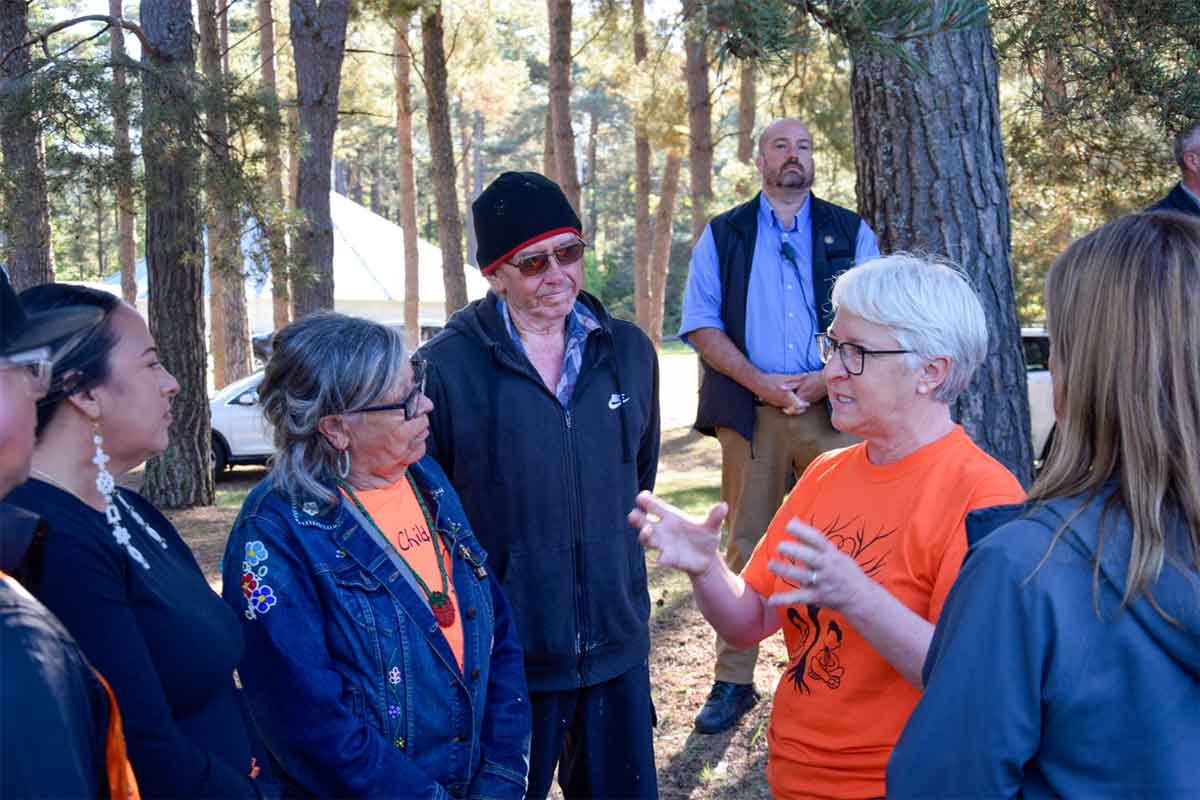
Following the wreath laying and songs from the drum group, the Lt. Governor mingled among the crowd chatting with people about their experiences and lives on Manitoulin Island, before heading into the M’Chigeeng community centre for a feast in her honour.
Following the feast, Lt. Governor Dumont toured the Ojibwe Cultural Foundation (OCF) and met with its executive director Glen Hare and collections manager Naomi Recollect who explained the relevance of the Fort LaCloche artifacts that are temporarily stored at the OCF.
“I’ve been visiting many places in Ontario and in my previous professional life, I was a director of education of a French school board in Ottawa, and for our provincial meetings we would go around Ontario, so not always in Ottawa or Toronto, but you know, going everywhere, Sudbury, North Bay, Sault Ste, Marie,” said Lt. Gov. Dumont in discussion with The Expositor. Asked if she felt it was an historic occasion, the Lt. Governor confirmed that view.
“I think it was a partnership, so we were looking to come and visit Manitoulin at one point,” she said. “The Royal Canadian Navy is part of their contribution to offer Lieutenant Governors across Canada to visit smaller communities that sometimes are hard to reach. So, on their way, they offered me to join them in Sault Ste. Marie, so we left yesterday morning from Sault Ste. Marie and we arrived very, very early this morning. I don’t know if it was five o’clock this morning. Around five o’clock this morning I was still sleeping, and I heard that they were putting the anchor down and we were going to come and visit Manitoulin Island on a very special day, and I’m happy that I am able to recognize and to acknowledge their Truth and Reconciliation here in Manitoulin, because for an non-Indigenous person like me, the most important thing is to learn. So, every occasion I have, not only today, I’ve been to a few Indigenous communities so far, as well as participating in powwows and welcoming chiefs as well as people from indigenous communities at Queen’s Park.”
The Lt. Governor cited her experiences in meeting the Grey Wolves military cadet as a unique experience. She noted that she had met Grand Council Chief Linda Debassige’s son at one of those occasions, before he officially entered the Canadian military.
“The one that was presenting the wreath with me today, I saw him last year, as he was a graduate student from the Canadian Armed Forces doing a special program, the Grey Wolf program.” The Grey Wolf program is an opportunity for Indigenous youth to sample military life and has proven quite popular.
As for the day’s events in M’Chigeeng, “It’s like a special moment that will nurture a sense of community and will also give me the opportunity to learn,” she said. “I will go back to Queen’s Park with things that I learned, with things that I can, maybe, share once in a while with other groups of people. So, I’m just happy. I feel like I’m part of a larger family, even though I’m not Indigenous person, I feel welcome. I feel like it is an amazing opportunity to learn and listen and just be happy.”
“I think the message I want to leave is what I heard from the two elders,” she said. “They talked so well about the importance of being kind with each other, being curious, being a citizen that will care about his neighbor—empathy.”
HMCS Margaret Brooke’s Commander Captain Terry Share spoke with The Expositor on how the day impacts her ship and crew. “Oh, I don’t even know how I can express how important they are to not even just myself, but the entire ships company,” she said. “It’s just one of the very small things we can do to help progress reconciliation, to be better knowledgeable about what happens in the traditions that occur on First Nations communities. We also have a really local and close connection with an Inuit community named Naziabet, and so we do a lot of these types of things, at least on an annual basis, and to really get closer to the community and just better understand their way of life and how we can be better.”