
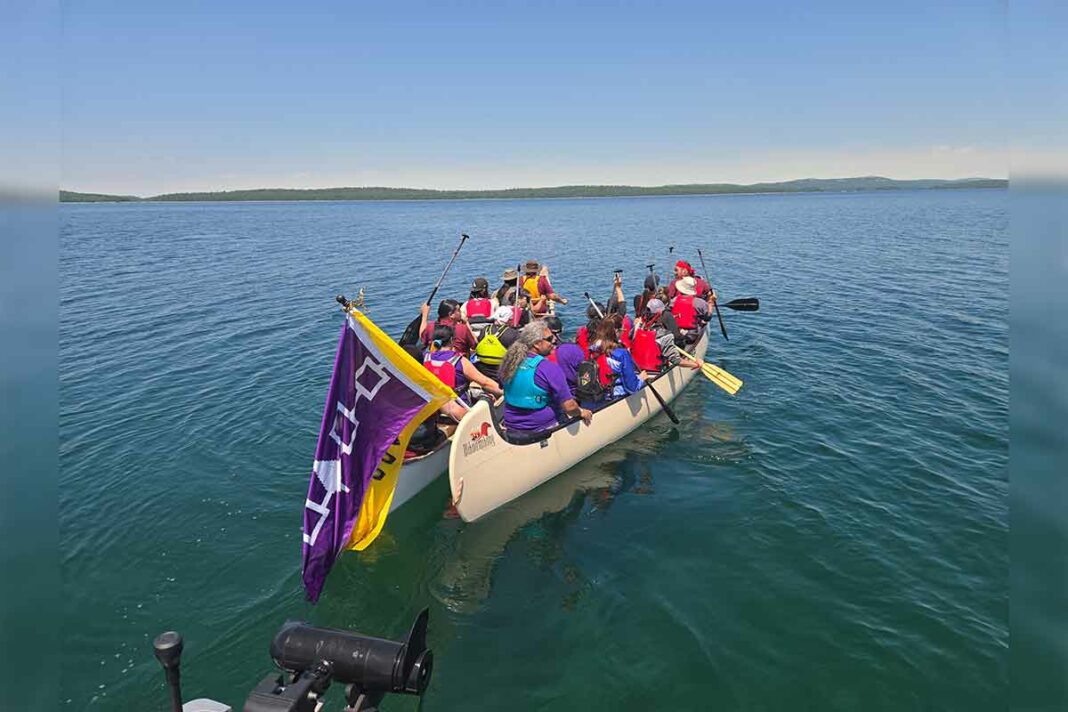
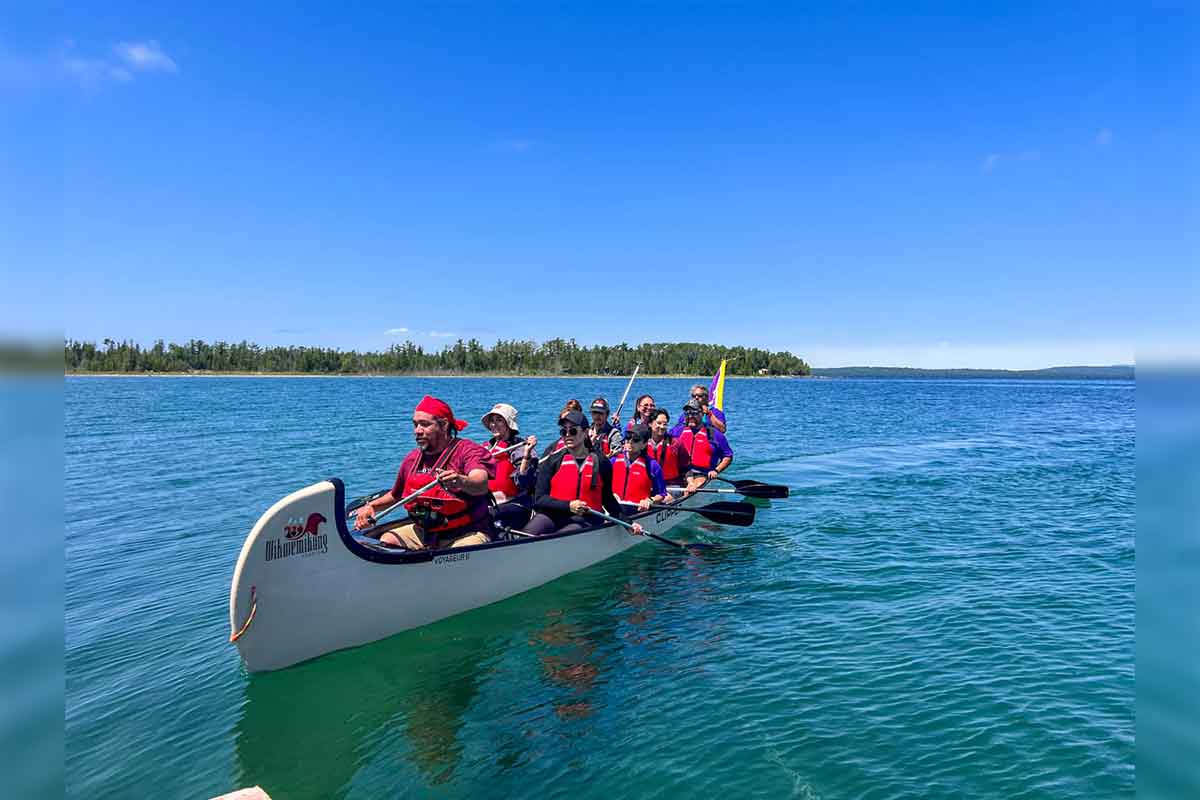
WIIKWEMKOONG—Two canoes moved across the morning water like prayers whispered in two languages. Paddles stirred the shoreline silence, each stroke a syllable in a story long interrupted.
It was day two of the Two Nations Cultural Exchange—an event bringing together the Haudenosaunee of Six Nations of the Grand River and Wiikwemkoong Unceded Territory. Together, they paddled to Skulls Point, a site of layered history on Mnidoo Mnising—sacred ground for both nations, though claimed by neither in recent memory. Until now.
“This hasn’t happened in generations,” said Jackie Jameson, senior manager of tourism and community development for Six Nations Tourism. “Maybe ever. Our nations paddling together, as allies, to this place—it’s powerful. Not just symbolic. Real.”
Before the French, before the Crown, before treaties carved the map into parcels and politics, the Haudenosaunee and Anishinaabek had their own conflicts over the islands of Mnidoo Mnising. Skirmishes. Shifting alliances. What settler historians once called the “Beaver Wars” were, in truth, wars of survival and sovereignty—two sophisticated nations wrestling for control of the fur trade routes that threaded through this territory like veins.
In the end, the Anishinaabek held the land. But no nation walked away unchanged.
Now, centuries later, two of the largest and most politically powerful unceded nations in the province are writing a new chapter—not with weapons or wampum, but with food, ceremony and shared water.
The paddle was not recreation. It was ceremony in motion.
Knowledge carriers from both nations travelled in the canoes. They brought stories in the language, songs that carried teachings and gifts rooted in the land. A chef from Six Nations served a meal that blended both nations’ traditional foods—a dish that quietly honoured the Dish With One Spoon treaty, an old agreement reminding all of us: the land is shared, and so is the responsibility to care for it.
“We gave thanks for the strawberries this morning,” said Ms. Jameson, referencing the strawberry ceremonies currently underway at Six Nations. “And we talked about harvest season coming up. That’s relationship-building. That’s what it looks like—on the land, through language, over food.”
The event was co-organized by Six Nations Tourism and Wiikwemkoong Tourism—two of Ontario’s most dynamic Indigenous tourism teams. The collaboration is already growing roots.
In the fall, they’ll carry this experience across the ocean to Berlin’s Food Week, where the Two Nations Paddle will become a Two Nations Plate, bringing Indigenous culinary sovereignty to a global audience.
But the deeper work—the work of cultural revitalization—is happening right here. On this island. On these waters.
“To be in the presence of our knowledge carriers—to hear those stories firsthand, to sit in those teachings—it’s a privilege,” said Ms. Jameson. “Our young guides were with us today. They’re going to carry these teachings forward. That’s how nations strengthen. That’s how memory survives.”
As the sun moved westward, final preparations began for the weekend powwow, where Haudenosaunee smoke dancers and Anishinaabe woodland dancers will share the arena. The energy from the paddle—its quiet reverence and steady rhythm—will carry forward into the dance circle.
And in a time when provincial and federal governments are pushing forward legislation that fragments land and communities, when Indigenous rights are under calculated assault, this act of coming together—on purpose, with purpose—is medicine.
“There’s been a lot of talk about the good mind,” Ms. Jameson said. “About laughter, about gratitude. We don’t even know yet what we’re building here. But it’s something powerful. Everyone who was out on that water today felt it.”
This is treaty. Not the dusty kind in archives—the living kind.
The kind you taste. The kind you sing. The kind you paddle toward, shoulder to shoulder, heart to heart.