
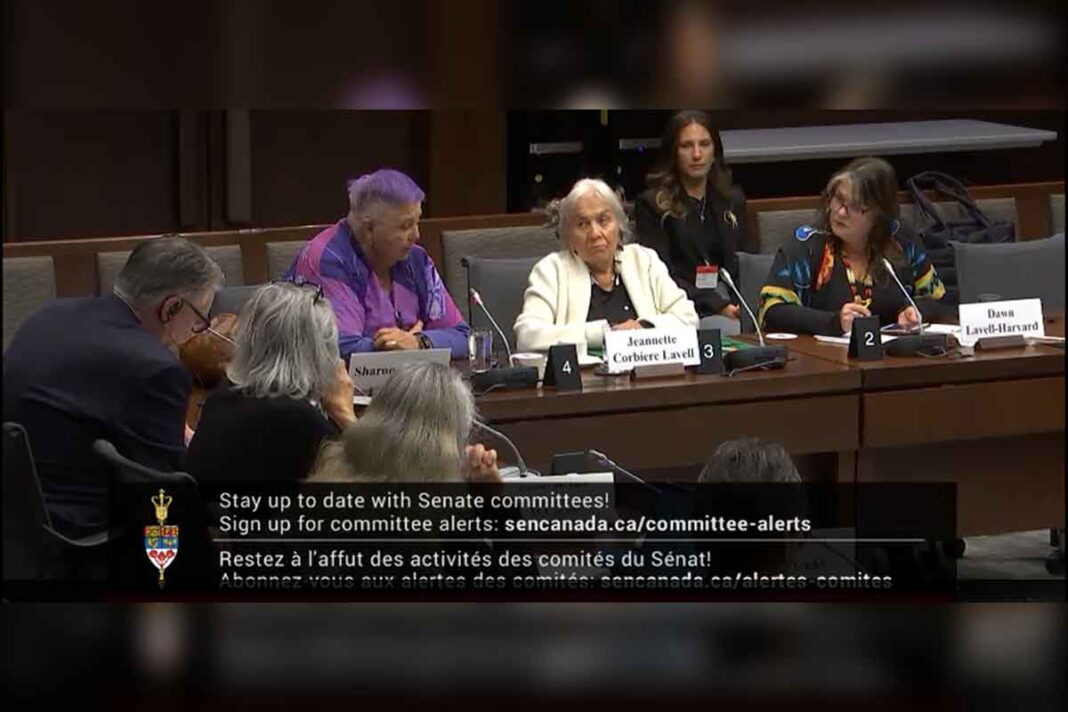
Island elder addresses Senate during review of Indian Act
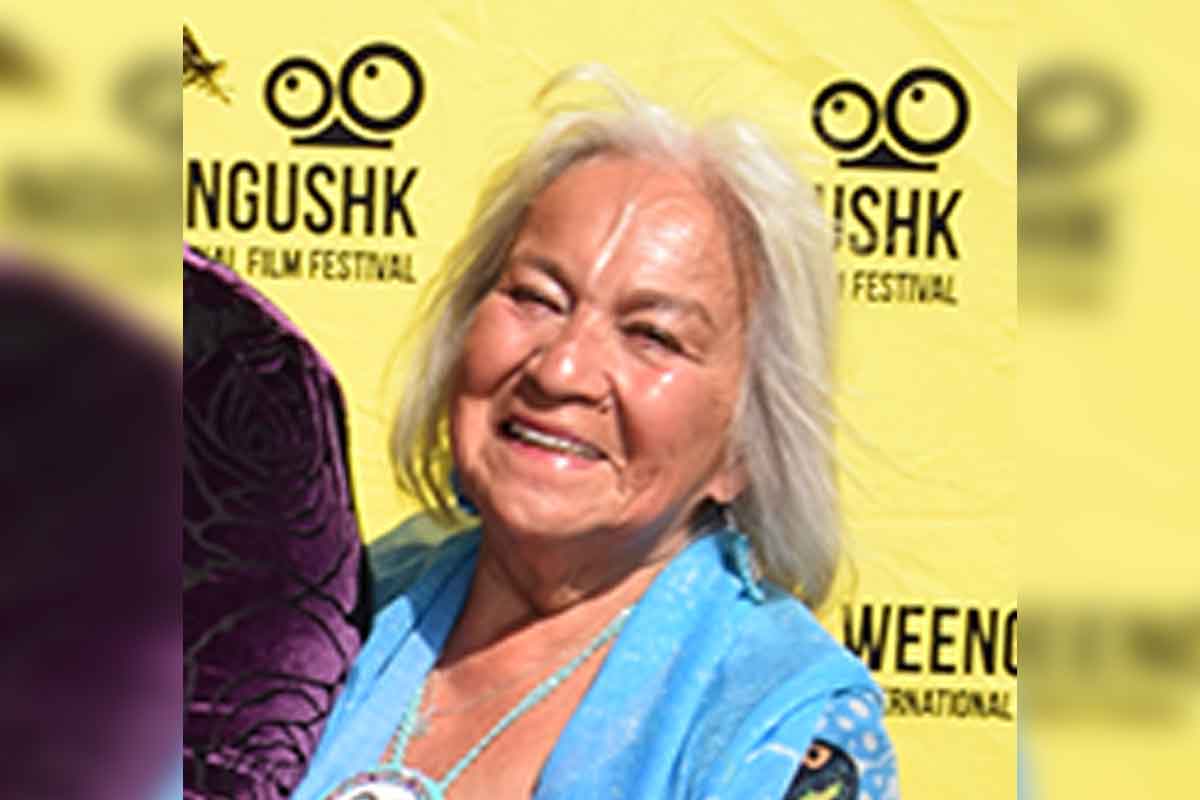
OTTAWA—Jeanette Corbiere Lavell, called Keewednanung, “North Star,” born June 21, 1942 in Wiikwemkoong, began a fight against the Indian Act — that culminated at the Supreme Court — more than 50 years. A woman of principles and extraordinary ethos, she has fought for the rights of her people and her descendants for more years than the author of this piece has lived.
The issues that first prompted her to take action remain today. The marginalization of Indigenous women, rooted in colonial policies, continues to affect diverse communities across the country. Her goal is to see justice reach all those who have suffered the most—Indigenous and non Indigenous alike—restoring humanity to those long denied them. When the tide rises, every canoe is lifted.
It has been 149 years since the Indian Act first carved the lives of First Nations people into legislation—since paper, pen, and Parliament decided who could be counted as “Indian”, who could belong and who could not. Nearly a century and a half later, the argument still echoes through the halls of power.
On October 1 of this year, National Chief Cindy Woodhouse Nepinak stood before the Senate Committee studying Bill S-2—a proposed set of amendments meant to “fix” the Act’s ongoing gender discrimination—and said plainly what many have been saying for generations: it cannot be fixed. That battle that began with Ms. Corbiere Lavell in 1970 endures.
The current attempt at amending the act is named Bill S-2, though there have been multiple iterations attempting to right this historical wrong.
Ms. Corbiere Lavell was the very first to challenge the state on human rights violations against women when, despite having two registered First Nations parents, received a shocking letter and a cheque for $35, telling her she was no longer, in her own words, “an Indian.” Her crime? Having fallen in love with and marrying a non-Native man. In the day, this was called “marrying out.”
When asked what it was like to take on the Canadian government in her late twenties, Ms. Corbiere Lavell had this to say:
“I guess it really started with the women I grew up around. My mom was one of the first teachers in Wiikwemkoong, and even she had to ask the Indian Agent for permission just to go into Manitowaning to sell a few piglets for Christmas money. She had a buyer that was willing to pay $25 per piglet. The Indian agent, he tried to give her $5 for each of them—$5. She just stood there, stunned, then said no and hauled them back home. That kind of control was normal back then, and that kind of strength from our women was, too.
“So, when I ended up in Toronto, meeting people through the Indian Eskimo Association, and this MP, Martin O’Connell, started talking about the Company of Young Canadians—this program meant to teach young people about our rights, about citizenship—it suddenly made sense. We’d never been taught any of that on reserve. But I’d watched my mother, my aunts, my grandmother—all these strong women—keeping our community going, keeping our culture alive. Seeing what was happening to our people in the cities, and remembering what I’d seen at home… that’s really what pulled me into all of this.”
After the 1885 Northwest Resistance, the federal government crafted the pass system — a slip of paper that let an Indian Agent decide whether an First Nations person could leave or return to their own reserve. Though most heavily enforced in the Prairie West, its shadow stretched into Ontario through the same machinery of control: the Indian Act, local Agents, and the constant surveillance of movement, labour and livelihood.
It was never a law, yet it carried the force of one, shrinking freedoms and interrupting the everyday rhythms of families and economies. The pass system became one more tool in a wider project of assimilation, and its effects still echo — a reminder of how quickly a colony can confine a people, not only with fences, but with the permission slips that governed their every step.
By restricting movement and preventing participation in ceremonies and cultural events, the system disrupted social and kinship networks and weakened communities
The current legal battle at the State Senate over the “two-generation cut off” began with Ms. Corbiere Lavell, a veritable trailblazer, who challenged Section 12(1)(b) of the Indian Act.
With a signature on a marriage line, she had been barred from her own reserve, cut off from treaty benefits and denied property rights. Her children were pushed out too, as if identity were something Ottawa could erase with a clerk’s pen. Meanwhile, a status Indian man who married a non-Indigenous woman lost nothing and the non-Indigenous woman gained the status that was stolen. The double standard was the point that Ms. Corbiere Lavell took contentiously.
“When that letter came, it hit me hard — realizing I had no say at all in whether I could belong to my own community. It felt automatic, like the decision had already been made for me. I talked to my friend, Clayton Ruby, who was a young lawyer then, and he looked at the date and said, ‘Well, you’ve got tonight to decide — tomorrow’s the last day to appeal.’ So, I said, ‘Alright, appeal it.’ And that’s what set everything in motion: the court challenge, the hearings, climbing all the way from county court to the Ontario Court of Appeal and finally the Supreme Court. Looking back, I can see how it ties into our teachings — how we’re born into clans with roles and responsibilities. I didn’t know all that then, but I can see now that stepping forward was part of mine.”
She continues, “I think that’s what pushed me — realizing I didn’t have to be afraid to speak up. I remember thinking, ‘No, I have a right to decide what happens to me. I’m part of this country too.’ Even if the Indian Act didn’t recognize me as a person, I knew I was still a human being, and I wasn’t going to let them tell me otherwise.”
She was the target for slights and resistance even by those who claimed to represent First Nations peoples interests, then called The National Indian Brotherhood, now called the Assembly of First Nations. The original naming is quite telling in how European Patriarchy had already insidiously crept into First Nations governance systems.
“It was very difficult, heartbreaking even. People from my own community pushed back. I remember a woman — a teacher from another reserve who’d married into Wiikwemkoong — writing in The Expositor, saying things like, ‘You made your bed, now lie in it.’ Imagine seeing that in print.
“But here we are, full circle, telling the story in a better way. And you’re right — even within that atmosphere, there were men who stood up. My own chief then, John Wasegiijig who supported me. He said, ‘No, you go ahead. Do what you need to do,’ because he was fighting for his own daughter in the same situation.”
But women, once they heard what she was challenging, formed their own grassroots organizations. Ms. Corbiere Lavell was one of the founding members of the Ontario Native Women’s Association, an organization whose roots are dug deep on this particular issue: “We got together, and then we — across Canada — other women did the same thing, so we did it on our own, with no government support at all, we just did it on our own,” she said when asked about the meaning of self-determination.
Her fight endured for another 15 years before her status was restored in 1985, after Lovelace vs. Canada was brought by Sandra Lovelace to the United Nations after her own uphill battle that began in 1980. However, the second generation cut-off was introduced to continue to control First Nations population increases now that women who “married out” were brought back into their nations.
After being unable to challenge the law in Canadian courts due to a prior Supreme Court precedent (Attorney General of Canada v. Lavell),Ms. Lovelace took her case to the United Nations Human Rights Committee (UNHRC). In 1981, the UNHRC ruled that Canada had breached the International Covenant on Civil and Political Rights (ICCPR), specifically Article 27, which protects the rights of minorities to enjoy their own culture.
She was the target for slights and resistance even by those who claimed to represent First Nations peoples interests, then called The National Indian Brotherhood, now called the Assembly of First Nations. The original naming is quite telling in how European Patriarchy had already insidiously crept into First Nations governance systems.
“It was very difficult, heartbreaking even. People from my own community pushed back. I remember a woman — a teacher from another reserve who’d married into Wiikwemkoong — writing in The Expositor, saying things like, ‘You made your bed, now lie in it.’ Imagine seeing that in print.
“But here we are, full circle, telling the story in a better way. And you’re right — even within that atmosphere, there were men who stood up. My own chief then, John Wasegiijig who supported me. He said, ‘No, you go ahead. Do what you need to do,’ because he was fighting for his own daughter in the same situation.”
But women, once they heard what she was challenging, formed their own grassroots organizations. Ms. Corbiere Lavell was one of the founding members of the Ontario Native Women’s Association, an organization whose roots are dug deep on this particular issue: “We got together, and then we — across Canada — other women did the same thing, so we did it on our own, with no government support at all, we just did it on our own,” she said when asked about the meaning of self-determination.
Bill S-2, according to the government, would restore Indian status to roughly 3,500 to 6,200 people who lost it through enfranchisement, fulfilling a court order in Nicholas v. Canada. But for the Assembly of First Nations — who first fought Ms. Corbiere Lavell — and many Indigenous leaders, it is another narrow amendment to a structure that should have been dismantled long ago.
“The Indian Act is inherently flawed,” Chief Woodhouse Nepinak said. “Since 1985, we have lived through amendments, litigation, and hollow consultation. None have brought justice.”
She called instead for First Nations to have full control over their own citizenship—something that should never have been taken from them.
A Clash in the Red Chamber
Just earlier this month, on November 5, those fractures widened into open confrontation.
Indigenous Services Minister Mandy Gull-Masty appeared before the same Senate committee to defend Bill S-2. What followed was an hour of tense exchanges that laid bare the deep mistrust between Parliament and Indigenous peoples over who holds the right to decide belonging.
When senators pressed her on the bill’s failure to address the “second-generation cut-off”—a rule that strips Indian status after two successive generations married outside of status—Minister Gull-Masty pushed back sharply.
“To predetermine a solution for a group if you do not live with the reality of that issue is racism itself,” she told the committee.
The remark came even as she faced Indigenous senators—Mi’kmaw, Cree and others—who argued that the second-generation rule has devastated families, cut people off from their nations, and left intergenerational trauma in its wake.
Senator Brian Francis, a Mi’kmaw former chief, spoke of that pain directly. “We’ve been consulted since 1985,” he said. “Let’s get this right and let’s do it now.”
But the minister would not yield. She told senators that formal consultations on the issue would not begin until 2026, once her department had co-developed a framework to guide the process.
“The duty to consult is not a checkbox,” she said. “It is the foundation of a solution.”
The Consult
For many senators, those words rang hollow. They pointed to the government’s recent passage of Bill C-5—the One Canadian Economy Act—which sped through Parliament in just two weeks without consultation and, critics say, poses far greater risks to Indigenous rights and sovereignty.
“You look at C-5,” said Senator Francis. “I don’t see any form of reasonable consultation that happened with that.”
Senator Kim Pate added that while consultation is important, “we also have a duty to end the discrimination—both the race and gender discrimination—that persists in the Indian Act.”
Senator Marilou McPhedran, who is not Indigenous, asked the question many have been waiting forty years to hear answered: “What justification can you and Canada offer for forcing these women and their descendants, whose rights are being violated now, to wait longer?”
The minister’s reply: “You yourself have not lived the reality as an Indigenous woman”—only deepened the divide.
Mi’kmaw Senator Paul Prosper, chairing the session, intervened gently but firmly. “When we talk about consultation,” he said, “the honour of the Crown is at stake.”
He reminded the minister that the second-generation cut-off has been studied, debated, and condemned for decades by courts, commissions, and communities. “Where is the value of that work,” he asked, “and does that not warrant the government to act honourably?”
A Century-Old Law, a Modern Reckoning
Since hearings began, the committee has heard from more than 60 witnesses—elders, lawyers, advocates, and survivors of the Act’s relentless arithmetic among them Ms. Corbiere Lavell and her daughter Dawn Lavell-Harvard, president of the Native Women’s Association of Canada. Nearly all called for the same amendment: remove the second-generation cut-off and restore the pre-1985 “one-parent rule,” where status passes through either parent, not just one side of the family tree.
The Union of BC Indian Chiefs submitted a brief reminding senators of its long-standing resolution: “The second-generation cut-off must be removed to prevent legislated extinction.”
Sharon McIvor, whose 2009 court victory restored status to hundreds of thousands, warned senators that the cut-off continues to “twist and damage” lives. “Young First Nations women and men are being governed by an unjust, sexist, and racist law,” she said. “The government is using up their lifetime.”
Senator Prosper has since indicated he will introduce an amendment to establish a permanent one-parent rule. But even if the Senate adopts it, few expect the House of Commons to let it stand.
The Long Wait
For now, Bill S-2 continues its slow crawl through Parliament—a law written to correct the sins of another law, while leaving the same architecture intact.
In her October testimony, National Chief Woodhouse Nepinak warned that Canada’s piecemeal fixes are not reconciliation, but repetition. “There is something wrong,” she said, “that it is 2025 and we are still having these same discussions.”
Still, she urged that the work continue—not through bureaucratic tinkering, but through true recognition of Indigenous sovereignty over identity.
First Nations people, she said, are the only people in the world legislated into existence by another government. The only people whose belonging has been written and rewritten by those who never had the right to hold the pen.
And until that pen is returned—until the stories of identity, kinship, and nationhood are written by the people themselves—the promise of justice will remain what it has always been under the Indian Act: deferred.
Ms. Corbiere Lavell closed the interview with the Expositor saying this:
“They should have let us govern ourselves. We’ve always known who we are. But the government stepped in, bound by their own laws and that so-called fiduciary duty — rules written long before 1967 and followed blindly ever since. Even now, this government would rather sidestep the real issues, push the second-generation cutoff down the road, hold another round of consultations.”
“So, what does real justice look like? For me, it comes back to our teachings. Justice is truth, honesty, love, respect — the simple principles of how human beings ought to live with one another. Our people have been on Turtle Island for more than 60,000 years; we had governance long before any Indian Act. Wisdom, truth, love, respect — those are the foundations of how we related to each other, and they should be the foundations of any justice system worthy of the name.
“And especially now, we need bravery — the courage to say what must be said, to name what needs to change, and to stand up not only for ourselves but for those who have no voice. That has always mattered to me.”
The State Senate is expected to deliver their recommendations later this week.
Editors Note: Several facts have been updated including clarification that the Pass System only affected First Nations people and not Canadian Indigenous peoples as a whole, as Inuit and Métis people do not have reservation lands.
Further, it was Lovelace vs. Canada which was brought to the UN — after being denied hearing at the Supreme Court on the precedent set by Lavell vs. Canada 12 years previously.
Thank you to leading Indigenous Law expert Pam Palmater for emailing her corrections.