
Features life and accomplishments of Dr. Jeanette Corbiere Lavell
MANITOULIN—For decades the friends and family of Canadian Indigenous rights icon Jeanette Corbiere Lavell of Manitowaning/Wiikwemkoong have been urging her to write a book about her life’s work—and what a life it has been. But the tireless ogichidaakwe (warrior woman) has never paused long enough to put pen to paper (or fingers to keys) to lay down her truth.
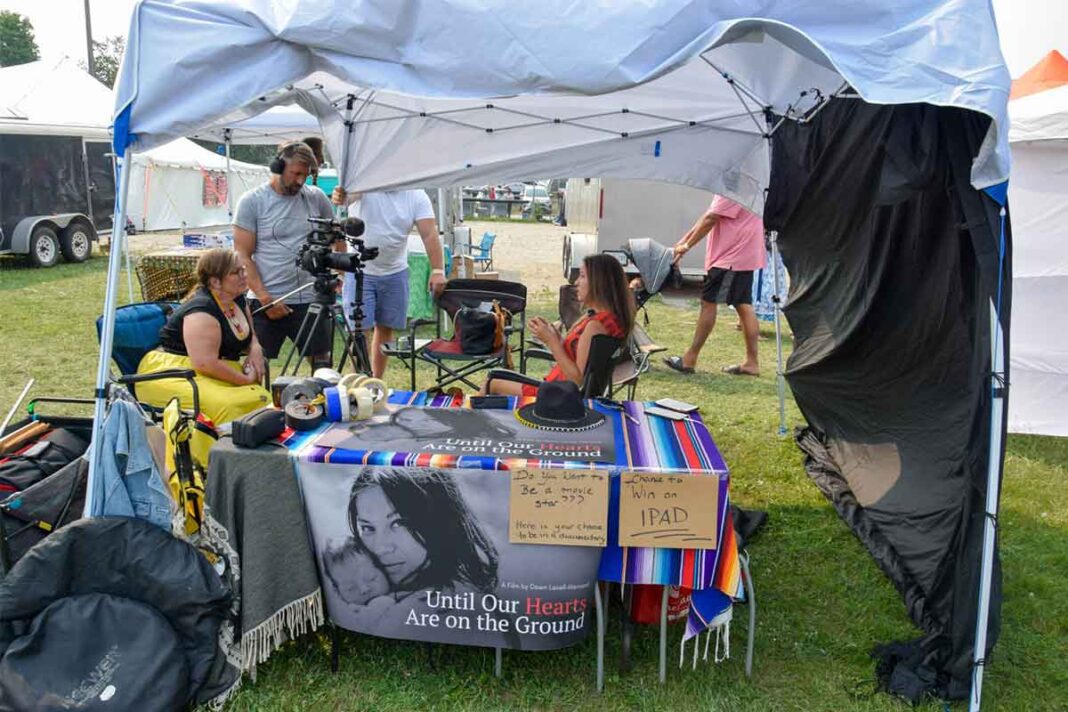
So it is that Ms. Corbiere Lavell’s daughter, Dawn (Memee) Lavell-Harvard has set about creating a documentary film based on her mother’s life’s work.
“I know my mum was never going to sit down and write a book,” said Ms. Lavell-Harvard when The Expositor caught up with her. The documentary producer/director minces no words. “She is my hero. If not for her standing up for women’s rights, we would not be where we are today.”
Ms. Corbiere Lavell may be diminutive in physical stature, but she would prove to be a giant in the battle for the rights of Indigenous women.
Jeannette Vivian Corbiere Lavell (Keewednanung, North Star in Anishinaabmowin), is a member of the Order of Canada, an activist, educator and community worker. She was born in 1942 in Wiikwemkoong Unceded Territory and was one of several Indigenous women who brought increased public awareness to the gendered discrimination that First Nations women faced because of status law, namely section 12(1)(b) of the Indian Act. Her efforts were central to revising patriarchal aspects of Canadian legal code.
Before her work (opposed somewhat oddly in retrospect by the male chiefs of her day) a woman would lose her status and rights as an Indigenous person when she married a non-Native man, yet a non-Native woman would gain status upon marrying a Native man. The inherent injustice of that fact fueled Ms. Corbiere Lavell’s activism over the course of many decades, with setbacks and defeats in the courts leaving her undaunted.
As the court cases played out, the National Indian Brotherhood (now the Assembly of First Nations) argued that women who challenged section 12(1)(b) of the Indian Act were selfish and “anti-Indian” because they fought against the very Indian Act they viewed as guaranteeing the right of Indigenous self-determination.
Little wonder that Ms. Corbiere Lavell’s image is one of the first you will see when entering the Canadian Museum for Human Rights in Winnipeg.
Ms. Corbiere Lavell began her education in the Wiikwemkoong Day School up until Grade 10 before going on to study in North Bay, at business college. She became an executive secretary in Toronto and engaged with the Native Canadian Centre as a youth and social services worker, assisting Indigenous people in the court system. As part of the Company of Young Canadians she travelled to Indigenous communities across the nation and was selected as Indian Princess Canada in 1965, providing her with an increased public profile she put to good use.
She eventually attended Western University, where she graduated from teacher’s college, going on to become a teacher and school principal.
Ms. Corbiere Lavell was a founding member of Ontario Native Women’s Association (ONWA), a non-profit organization established in 1971 that supports and empowers Indigenous women. From 1972 to 1973, she served as vice-chairwoman, and from 1974 to 1975 she was president.
In 1987, ONWA established an award in her honour, the Jeannette Corbiere Lavell Award, which is given to Indigenous women who demonstrate the same qualities and dedication to women’s causes as Ms. Corbiere Lavell.
She has also been involved in other Indigenous organizations, such as the Native Women’s Association of Canada (as president); Debajehmujig Storytellers, Nishnawbe Institute; Indian Rights for Indian Women (co-founder); Native Women’s Organization of Canada (founding member) and Anduhyaun Inc., a non-profit organization that creates safe spaces for Indigenous women and children (president).
As part of her documentary work, Ms. Lavell Harvard has been auditioning Anishinaabe-kwe in interviews aimed at uncovering how her mother’s life’s work has impacted their lives. “We talk about their status rights, how it impacts their lives,” she said, adding “I wouldn’t be here if not for their fight.”
She has had interest in the documentary about her mother’s inspirational life from Paramount, Netflix and APTN. Issues arose over some of the demands from Paramount, however.
“They wanted sole rights to my mother’s story,” said Ms. Corbiere Lavell. “I said, ‘no, no, you are not going to own my mother’.”
“Status is important,” said Ms. Corbiere Lavell, “but this is about more than that. It is about the right to belong to a community. It is about learning who you are.”
Ms. Corbiere Lavell is travelling across the country, from British Columbia to New Brunswick, gathering stories and insights, especially from young people.
Ms. Corbiere Lavell herself expressed some bemusement about the project, almost shy about it, but she could not hide the pride she feels towards the children she has raised and their accomplishments.
The documentary is anticipated to be completed sometime next year and will be making the rounds of film festivals when complete.