

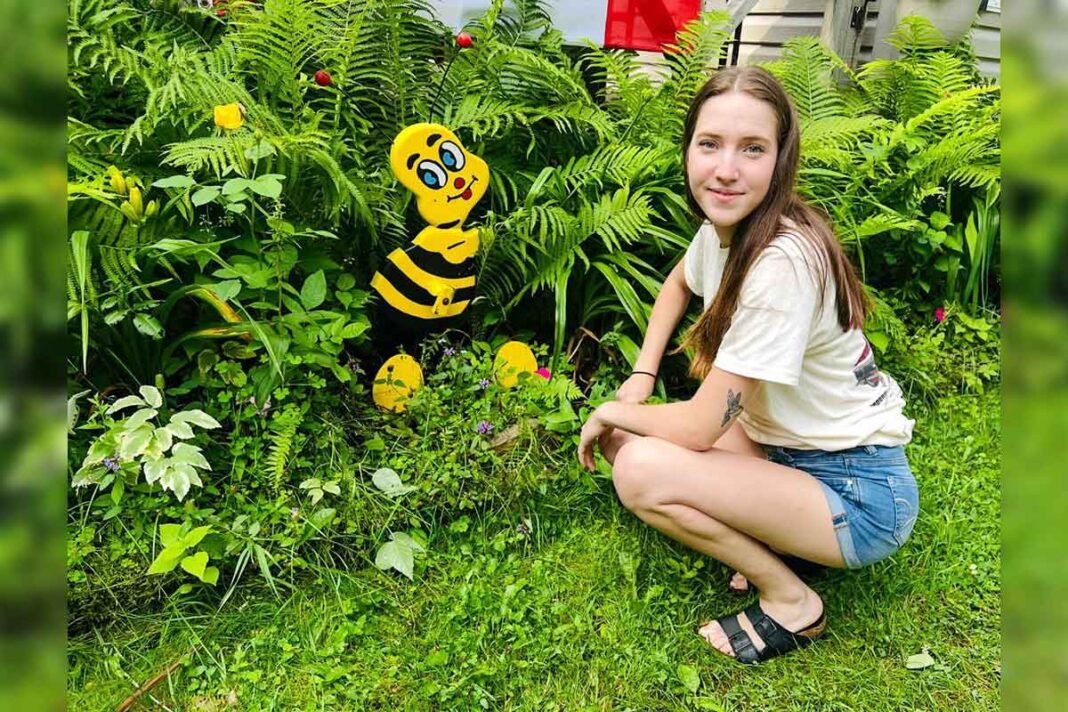
Many homeowners increase the attractiveness of their flower gardens by adding bird feeders, bird baths and ornaments. Ornaments depicting animals such as rabbits, birds, insects and turtles, and even cartoon characters, are especially enjoyed by children.
Ornaments intensify the experience children have when visiting gardens and help connect them to the natural world. Garden ornaments are sometimes left in place for so long they become a fixed memory of the garden that extends over several generations.
Such was the case with a wooden ornament of a happy honeybee my family purchased about 30 years ago from artisan Henri Malette who designed, built and painted lawn ornaments from his roadside home in Verner, Ontario, east of Sudbury.


Our honeybee was fondly named ‘Eric’ in reference to a song by British actor and comedian John Cleese of Monty Python fame.
Eric was firmly attached to the ground by two metal legs along a walkway at the top of hillside flower and vegetable beds in our Sudbury backyard.
For nearly three decades Eric was a sentinel overlooking our property. Each of our two children, then later five grandchildren, acknowledged Eric whenever they visited our gardens.
As a former professor of entomology, I always appreciated having a bee ornament in our yard and looked for ways in which Eric could make its way into my storytelling and lectures. Such an opportunity occurred on an international scale when I attended an entomology conference in Hungary in August of 1997.
As is common for scientists in all specialties, international conferences are held periodically so researchers can meet personally to share their views and new discoveries.
This is the case for biologists who study plant galls (odd growths on plants made by insects), so in 1997, I and about 60 other gall researchers gathered in a town east of Budapest for six days of meetings.
The organizer of the symposium, Dr. Gyuri Csóka of the Hungarian Forest Research Institute, had visited Sudbury a few years before to study our boreal and deciduous forests.
I took Dr. Csóka on excursions to Timmins and Niagara Falls to see our conifers and deciduous trees and we became close friends with our scientific interactions often laced with humour and kidding.
Dr. Csóka asked for volunteers to present entertaining stories at a social evening before the Hungarian conference began. Seeing this as an opportunity to practice one’s raconteur skills, I offered to contribute.
I fabricated a spoof on how Sudbury’s high levels of pollution at the time had altered the DNA of normally small adult gall wasps (5 mm in length) such that they became grossly enlarged and made galls the size of basketballs instead of small peas. Finding photographs to accompany the spoof was a challenge, but Eric became an ideal model.
Although the honeybees we see in our gardens are females while males or drones are rarely seen and do not participate in making honey, Eric was given a male name by John Cleese. For my story, the bee’s name should have been ‘Erica’ but in keeping with the Cleese connection, I left it as Eric.
Further, Eric was not a female honeybee in my story, but a female gall wasp of the type that lays eggs on rose bushes resulting in galls that house her larval offspring.
In preparation for the Hungarian skit and to embellish the story, I photographed Eric at a slag heap near the Copper Cliff smelter west of Sudbury to establish the illusion that pollution was genetically altering local insects.
I also photographed Eric in a field of wild roses north of the city where she laid giant eggs and made huge galls (simulated with green balloons).
The skit was well received, and Eric remained standing guard in our backyard for many years afterwards, where she continued to provide enjoyment for our family.
Eric was forgotten when we sold the house four years ago and moved into a retirement townhouse in south Sudbury, until one of our grandchildren asked about the beloved ornament.
The inquiry led to a visit to our former house asking the new owners if I could search for Eric. They not only agreed but suggested I take her if she was located.
By luck, Eric was still firmly attached to the ground but hidden in overgrown shrubbery. Incredibly, she was in excellent condition. Her wings had fallen off, but were located nearby.
Eric’s paint was still vibrant as was the cute smirk on her face, designed so many years ago by artisan Henri Malette.
I recently contacted Henri who still lives in his Verner home to tell him about his long-surviving ornament. He told me about using the same outdoor oil-based paint as did INCO for their signage.
Finding Eric with parts of her body missing reminded me of the 1972 Cleese song ‘Eric the Half a Bee’ where he mused philosophically as to whether or not a bee cut in two can still be considered a bee.
Cleese was part of the Monty Python troupe of actors known for their comedy sketches in a TV series called Monty Python’s Flying Circus which aired in Britain from 1969-1974. He was also the star in a 12-episode 1970s TV show ‘Fawlty Towers’ and appeared in Hollywood movies such as ‘A Fish Called Wanda.’
A song about Eric was part of an album following a routine called “Fish License” in which a character played by Cleese tried to obtain licences for his animal pets, one of which was a halibut.
Cleese’s character had named each of his pets ‘Eric’ much to the chagrin of the licence officer played by Michael Palin.
Eric the bee was also one of these pets and the song relates the tale of a bee that was accidentally ‘bisected’ one summer afternoon.
In Cleese’s mind, the lyrics raise philosophical questions as to the existence or not of half a bee. He wrote ‘half a bee, philosophically, must ipso facto half not be. But half the bee has got to be, vis-à-vis its entity-—do you see? But can a bee be said to be or not to be an entire bee when half the bee is not a bee, due to some ancient injury?”
I removed Eric from our former garden and had fun sharing her with neighbours at our new home in Sudbury. I then decided that she should retire in a flower garden at our permanent summer trailer near Sheguiandah on Manitoulin Island.
However, to everyone’s surprise, Eric somehow first visited her relatives in the apiary of Nancy and David Kains near Mindemoya, and then the sand dunes of Providence Bay.
In contrast to our former Sudbury garden, where Eric remained outside over the winter months, she will be stored in a shed come October. The local snowshoe hares will likely be disappointed as they would have enjoyed her brilliant colours against the white background.
As absurd as the Monty Python sketch about a bee missing body parts will be to many, there are serious aspects to finding and identifying small parts of insects. The body parts of insects are comprised of hard skeletons and they take years to disintegrate.
For example, mouthparts of the aquatic immatures of mosquito-like midges sink to the bottom of lakes when they moult. Each species has distinct mouthparts that can later be used to identify them.
The presence of mouthparts in cores of mud at the bottom of lakes allows scientists to reconstruct climates that occurred hundreds of years ago. Mouthparts of midges can also be used to monitor changes in aquatic ecosystems caused by pollutants.
Pieces of beetles found in post glacial deposits can be identified and used to describe the composition of past forests. Parts of insects found on deceased persons left in forests have been used by forensic experts to reconstruct crime scenes. But none of these uses can compare to the fun of using insects in storytelling.
Although the whimsical tale of Eric wasn’t included in the conference publication, it hopefully still brings a smile and a bit of philosophical pondering to the readers of The Manitoulin Expositor.
by Joe D. Shorthouse