

SHEGUIANDAH—The First World War battle for Vimy Ridge holds a hallowed place in the Canadian historical psyche, but for the people of Newfoundland that space in their national identity is occupied by the Battle for Beaumont Hamel and the larger Battle of the Somme—for good reason, most of an entire generation of Newfoundland youth fell within the first 20 minutes of that battle, as 800 members of the Royal Newfoundland Regiment went over the top. Only 68 men answered roll call the following morning.
In the years following the First World War, the government of Newfoundland purchased the land over which the members of the Newfoundland Regiment fought and died in major and significant battles. A sculptor, Captain Basil Grotto, created stunning statues of a caribou, the symbol which adorned the caps of the soldiers of the regiment, and a landscaper, RHK Cochius, created gardens of native Newfoundland plants and granite to mark the five principle sites, one in Belgium and four in France. These monuments at Beaumont Hamel, Gueudcourt, Monte-le-Preux, Courtrai and Masnières stand in silent tribute to the blood of a generation of Newfoundlanders spent during the war.
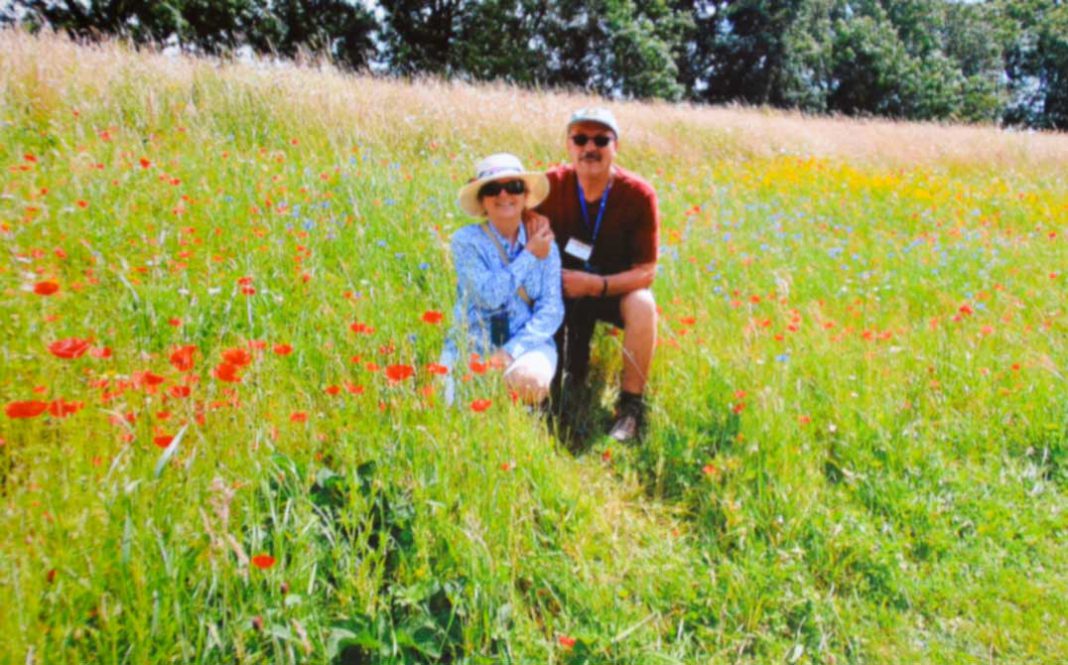
This past summer, Shegiuandah couple Cal and Diana Parrill joined a tour group that explored the site of those battles, following the famed Caribou Trail across Europe.
Mr. Parrill, now 65, joined the army himself at the age of 20. “I grew up in Newfoundland,” he said, just a few miles away from where his relatives that were lost in the First World War lived and were loved. His stint in the army was to last the standard three-year enlistment, for them, an even shorter period of time proved to be a lifetime.
“I always wanted to travel to visit the trail,” said Mr. Parrill. “All my life I had read quite a bit about the Royal Newfoundland Regiment.”
He followed in the footsteps of his great uncle, George Mitchell-Moore. Asked if his uncle had returned, Mr. Parrill quietly replies “no.”
“He had married my grandmother’s sister, but she died in childbirth,” he said. “He joined up right after. It was almost a year to the day that she died that he was killed.”
The people of the Labrador coast live in tight knit communities. Perhaps it is the isolation that builds upon the normal close relationships between the people of that land, it is a closeness that amplified the losses they suffered during the war.
“There were two nephews that joined up as well,” said Mr. Parrill. “All three of them died.”
It is little wonder that for Newfoundlanders, July 1 is a day of Remembrance. “It is important to every Newfoundlander,” he said.
The couple were at Beaumont-Hamel the day before the observance ceremonies marking the 100th anniversary of the battle. “The tour company had arranged it so that we would have time to walk around and visit the site before the crowds arrived,” noted Ms. Parrill.
“Of the 38 people on the tour, a lot of them were clergy,” she said. That included the archbishop of St. John. “When we stopped at a grave marker, he always seemed to know just what to say,” she recalled. “The tour was something of a pilgrimage.”
The ‘Ode to Newfoundland,’ the national anthem of Newfoundland and Labrador, was sung a lot on the tour.
The couple had a history of the Royal Newfoundland Regiment with them on the tour. The book had histories and biographies of many of those who were lost, including photographs of the young men in their uniforms.
“George and Isaac have no known graves,” said Mr. Parrill.
“Known only to God,” said Ms. Parrill.
“Samuel was the only one to be buried in a marked grave,” noted Ms. Parrill. “We found out where he was buried—our tour guide made it happen.”
Thanks to the book, the couple were able to put faces and stories to the names of the grave markers they encountered. “When we put a face to the name, we shared it with the rest of the tour,” said Ms. Parrill. “It was touching for Cal to find Samuel’s grave.”
Finding one grave amongst so many of the similar markers was not an easy task, but the tour guide accomplished it. “It was well off the beaten path,” noted Mr. Parrill.
The location was immensely poignant for a Newfoundlander.
“In the summer all across the Island along the highways are fields of potatoes,” he noted. “All you see for miles and miles are potatoes flowering in the fields.” The tiny graveyard where Samuel is buried is located in the midst of a potato field. “They are right at home, right in the middle of the potato field.”
We tend to think of those first war battles as being ancient history, as dusty and distant as Marathon or Persepolis, but for some on the tour that history was not so distant at all. “One lady on the tour, her father had been killed in the battle,” said Ms. Parrill.
The people of Beaumont Hamel remember as well. “For every year, starting in about 1925, the people have gathered each evening to listen to the Last Post. Everything stops in town,” said Mr. Parrill. “During World War II they left off, did it at another location, but once that war was over they began again.”
The government of Newfoundland did not turn the battle sites back into farms. “They left them as they were, with barbed wires and guns rusting away,” said Ms. Parrill. “You can see the topography as it was then.”
The war left an indelible mark on everyone. Mr. Parrill noted that the recruiter who had signed up the men of the Royal Newfoundland Regiment never returned home after the war. “He couldn’t face the Island,” he said. “He retired to South Africa and lived out the rest of his life there. He never went back home. He blamed himself for a lot of those young people dying.”
As they speak of their experiences, the couple flips through the pages of a large photo album.
“There is a story on every page,” said Ms. Parrill. She opens the history book to a letter sent by one Sergeant Archibald Ash he had written to Dr. Sir Wilfred Thomason Grenfell, the man who built the foundations of Newfoundland’s medical community, establishing hospitals and clinics all along the Labrador coast.
The young sergeant spoke of the horrors of the trenches and the spirit of the men, how they smiled even as they waded through hip deep water and huddled against the terror of incoming shrapnel and his uncommon luck in avoiding being hit. Four months after writing that letter the young man’s luck ran out.
“On the battle fields there is still so much shrapnel,” said Mr. Parrill. “You could fill your pockets with it within five minutes.”
The 10-day tour ended with a couple of days in Paris, but the memories of the Caribou Trail will remain with them for the rest of their lives.
The Parrills have made their home in Sheguiandah’s storied Bonnie Blink House, surrounded by pleasant and peaceful fields, a world and a lifetime away from the horrors of war that faced the men and boys of the Royal Newfoundland Regiment and the thousands of Canadians who joined them in the muddy trenches of Europe.
Lest we forget.