

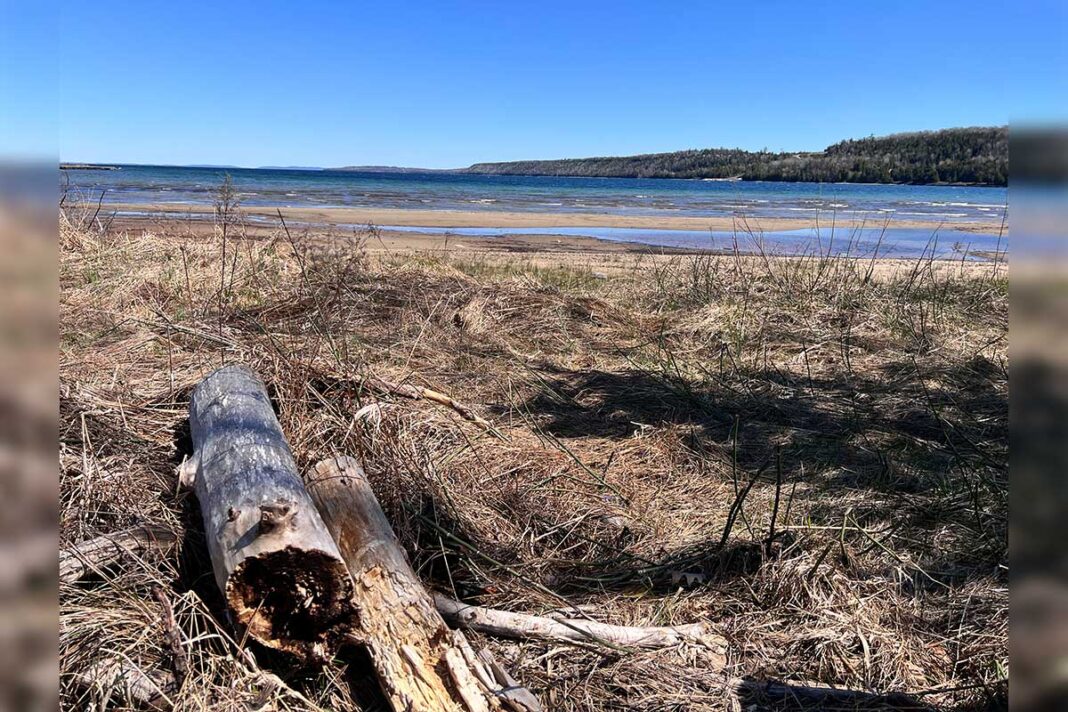
GEORGIAN BAY—Conveyance of water in the St. Clair River area continues and is contributing to lower water levels, says the chair of the Georgian Bay Great Lakes Foundation.
“In 2020, an Environment Canada Climate Change study predicted that by 2030 Lake Michigan/Huron water levels are to fall by one metre below the 2013 level’s record low,” said Mary Muter in a deputation she made to the Township of Archipelago at a workshop last Friday. “Since Michigan/Huron levels are already 0.5 metres lower than they should be, it means we will see levels down to 174.5 metres. This will devastate the Georgian Bay wetlands, make navigation hazardous and make it impossible to get to some cottages. It will be an economic and ecological disaster for Georgian Bay for the entire coastline including local municipalities.”
Ms. Muter told The Expositor, “We contracted the internationally respected coastal consulting engineering firm again, W.F. Baird and Associates this past fall to determine if conveyance increase in the St. Clair River has continued.”
“What was determined is the conveyance is continuing and is caused by US ships going through St. Clair (when the seaway is supposed to be closed),” said Ms. Muter. She explained there is one company that travels up the Mississippi River, and continues to Chicago, up Lakes Michigan/Huron and ice gets broken up and goes through Lake St. Clair on the Canadian side with an ice breaker to allow them through.”
“That water erodes the riverbeds,” said Ms. Muter. “Then in the spring the dredging is carried out. This is the only part of the Great Lakes that do not have control gates on them,” she said. “Because of all of this the water conveyance is continuing,” she said noting, “all kinds of people have already been relating concerns due to low water.”
“The water levels could be a lot lower this spring than they were last year,” stated Ms. Muter.
Ms. Muter explained when the original Seaway was designed around 1930 locks and control gates were designed for the St. Clair River. Of the five Great Lakes, Lakes Michigan, Huron and Georgian Bay act as a single lake hydraulically, due to the wide Straits of Mackinac connecting Lake Michigan to Lake Huron. It is known as Lakes Michigan-Huron and is the largest area of freshwater on the planet. On average, 2,100 cubic metres per second (a cubic metre is a ton of water) of water enters Lakes Michigan-Huron from Lake Superior via the St. Mary’s River; 32,000 cms enters as precipitation plus runoff less evaporation; and virtually all of the resulting 5,30 cms drains out via the St. Clair River (91 cms leaves via the Chicago diversion).
In 1909 the International Joint Commission (IJC) was established to prevent diversion of water out of or between the Great Lakes, said Ms. Muter. “While lake levels have irregular cycles, over a century Lakes M/H level has been dropping, while Lakes St. Clair and Erie have been rising.”
Since 1860 on the St. Clair River, sand and gravel was removed to build roads beginning in the late 1800s. It was dredged to deepen the navigation channel, first to 16 feet, then 20 feet, then 25 foot and finally in the early 1960s to 27 feet for St. Lawrence Seaway navigation. 30 million cubic metres of material was removed with no compensation. In addition, high flows and ice jams have caused erosion, increasing the outflow. This dredging and erosion increased the conveyance capacity of the St. Clair River causing the level of Lakes Michigan-Huron to drop by about 50 centimetres permanently, said Ms. Muter.
She showed a picture to the meeting attendees of the entrance to the St. Clair River at the Bluewater Bridge 2020, where ice booms could prevent ice jams (similar to the Niagara, St. Mary’s and St. Lawrence Rivers ice booms).
In February, during the years 2021-2023, major ice jams occurred in the St. Clair River with Canadian ice breakers needed to break up the ice. The ice layers were up to 8-16 feet thick and the force of the water eroded the sand and soft sediments on the riverbed, increasing the outflow during these ice jams, Ms. Muter explained. “The International Joint Commission confirmed this in their 2007 Upper Lakes Study, but nothing has been done to compensate for this loss. The United States Army Corps of Engineers (USACE) regularly dredge the lower riverbed to maintain navigation depth.
“Georgian Bay is a part of Lakes Michigan-Huron and according to McMaster University’s professor Pat Chow-Fraser its eastern northern shores contain the highest quality, most diverse and most extensive wetlands on all of the Great Lakes, but they are the most sensitive to extreme water levels since they are on glacial till sediments scattered among the Precambrian Shield granite shorelines including the 30,000 islands,” she explained.
These wetlands can only tolerate a range of five feet. Outside of that range they either dry up at low levels or are flooded out and trees take over with very significant loss of aquatic life habitat. GBGLF financially and logistically assist McMaster research, noted Ms. Muter. The coastline navigation channel is the route of thousands of recreational boats from May to October. That channel is maintained by the Coast Guard at a six foot or two-metre depth. A metre below record low will shut down the channel to all traffic except small boats.
“In 2003 Lake Michigan-Huron levels reached a low level of 176 metres. GBGLF was formed and retained an engineering team to investigate the cause. The levels stayed low for 15 years,” said Ms. Muter. “In 2004 GBGLF retained internationally respected coastal consulting engineering firm W.F. Baird and Associates to study the St. Clair River. The result was an additional erosion since the seaway project has caused Lakes Michigan-Huron to drop by a total of 50 centimetres.”
Ms. Muter continued that in 2007 the IJC funded the Upper Great Lakes Study to confirm the Baird study. “The result confirmed increased conveyance due to ongoing erosion. But no action was recommended.”
In 2013, the IJC commissioners recommended to governments that flexible structures in the St. Clair River be studied. These would be used only to raise low-water levels but not interfere with high-water levels. “To date, neither the Canadian government nor the US government has responded to the IJC advice to governments.”
Bill Bialkowski, a retired engineer at GBGLF designed a proposal for flexible structures in the St. Clair River, for hydrofoil gates in the upper St. Clair River, with gates that could be raised and lowered.
“In 2025, GBGLF again retained W.F. Baird and Associates to again model and study the St. Clari River conveyance since 2003,” said Ms. Muter. “The Baird modelling revealed a major discrepancy between the modelled St. Clair flows (5,00 cms under high flows) and the flows measured by the USGS flow meter at Port Huron (7,000 cps under high flows).”
She continued noting GBGLF interrogated USGS again in 2020 to check on the accuracy of this metre. “This was inconclusive. The metre does not read across the entire river, so USGS ‘extrapolates’ to estimate the full flow rates. Our Baird study showed that the St. Clair River conveyance capacity had increased by eight percent after 1930 and another eight percent after the Seaway project in 1962. It has not changed significantly since 2003 but continues to rise slowly.”
To prevent disastrous low waters after 2030, “a study is needed now to determine best methods to prove that flexible structures can be successfully deployed to alleviate low water levels but not interfere with high supplies. This is required under the 1909 Boundary Waters Treaty,” said Ms. Muter. “Once that is determined funds need to be put in place and the IJC could oversee the installation. GBGLF could undertake the work the IJC advised with new flow and bathymetric data collection contracted to W.F. Baird and Associates and to design the best option to prevent the impending decline to below 2013 record low.” “This will not happen on the other Great Lakes since they have control mechanisms and control boards that set monthly discharges,” said Ms. Muter. “The middle lakes deserve better than the crisis that is beginning to happen now.”
The GBGLF is requesting, “that the Canadian government respond to the IJC’s 2013 advice to governments, as soon as possible to prevent the economic and ecological disaster that will unfold on Georgian Bay if ECCC predictions happen that water levels on Georgian Bay will be one metre below 2013 record low by 2030. They are also asking the ECCC provide the $2 million funding requested by GBGLF to undertake the work the IJC requested of our government in 2013; That when the Seaway is shut down from January to March, the St. Clair and Detroit Rivers also be closed to navigation; that ice booms be placed at the outflow of Lake Huron into the St. Clair River (as is done in the St. Mary’s and Niagara rivers); that the Canadian Ice breaker not operate in winter months to maintain shipping in the St. Clair River.”
In early 2013, the IJC had provided more recommendations to the US and Canadian governments on how to improve management of water levels on the upper Great Lakes. She explained the IJC recommended that no action be taken by governments to promote full regulation of Lakes Michigan-Huron outflows through construction of extensive locks and dams in the St. Clair River. This solution could cost up to $20 billion and would have profound adverse affects on the environment and economy of the region.
The IJC recommended that a system-wide adaptive management program be implemented to promote resiliency across the region in face of significant climate change.
It was pointed out, the IJC has already modified its regulation plan for Lake Superior to better stabilize flows in the St. Mary’s River month to month. The IJC also recommended that work begin to assess how engineering structures could be installed in the St. Clair River to restore up to 10 inches of water levels on the upstream lakes.
Another recommendation of the IJC was to periodically monitor changes in the St. Clair River conveyance, including conducting bathymetric surveys on a frequent basis. Another significant recommendation by the IJC was for the governments to improve the monitoring and modeling of hydrologic and meteorologic conditions on the upper Great Lakes, including improving the prediction of evaporation rates. There have been significant improvements in this area already, Ms. Muter added.