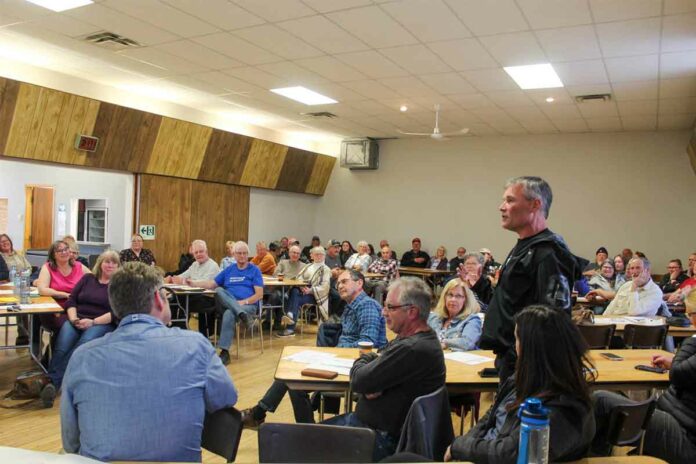

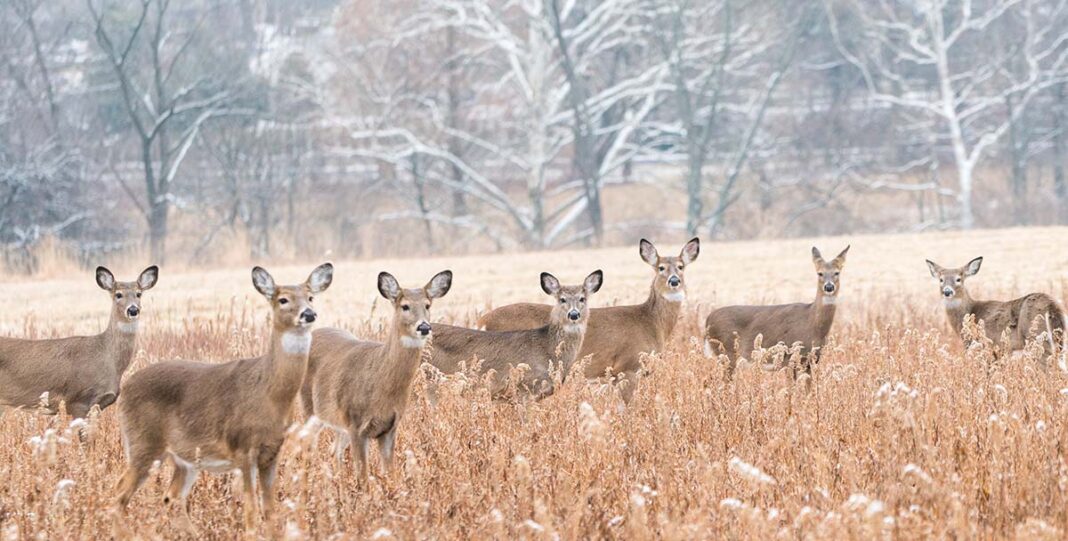
SUDBURY-MANITOULIN—Members of the Manitoulin deer management advisory group are requesting the Ministry of Natural Resources (MNR) increase the number of antlerless deer tags to close to 100 percent for all those applying for a tag, in wildlife management unit (WMU) 43B, to curb the increase in deer numbers.
“Coming home last night there were deer absolutely everywhere,” said Lee Hayden of Gordon/Barrie Island. “We’re going to have a problem real soon if we don’t get them (deer population) under control,” He advocated for increasing the deer tag quota applications for 43B from 5,500 to 6,000. I know that this isn’t the same all over the Island, but out here in Ice Lake, and then Burpee where we are, Gore Bay area, and around Gordon Township the deer numbers are extremely high.”
“From Billings township, which we kind of border with, Burpee and Mills, Gordon/Barrie Island, Gore Bay, Central Manitoulin, I can certainly add to that, there is a tremendous amount of deer,” said Bryan Barker, of Billings Township. “They are just starting to come out and I’ve seen 25-30 in fields. That’s a very dense population of deer. I can sit on my deer stand any morning or any night and see anywhere from six to eight underneath the stand.” He said has also noticed lots of twin and triple fawns and that the number of deer-vehicle collisions are high.
Denis Goupil said in Central Manitoulin, “I would echo a lot of the comments, that the deer population is high and over the last couple of years in particular, the number of predator animals is up significantly, which causes the deer to move around more to other areas.”
“If we don’t pay close attention here, over the next couple of years there will be an explosion in the deer population,” said one attendee. “I think it’s coming. I could see it there. Our winters have been nice and mild the last few years, although this winter has been a little bit more normal.”
Dennis Gendron, management biologist with the MNR Sudbury district office said, “some of the hunter data that we saw it looks as if the populations are staying kind of stable. But with the comments being made and anecdotal stuff, especially from those in very good deer areas, the numbers seem to be going up and is something we need to talk about.”
Stephanie Vanthof of the Ontario Federation of Agriculture (OFA) said, “Just echoing some of the comments from farmers that we’ve informally chatted with, they are also seeing increased deer pressure. I guess the agricultural land on the Island has changed a little bit over the last few years, so there’s increased deer pressure, also increased predator pressure aligned with that, and it’s causing some additional damage to crops.”
At the beginning of the meeting, Mr. Gendron presented data and charts on deer population objectives, revealing trends in deer sighting and hunter success rates in WMUs 43A and 43B during last year’s deer hunt on Manitoulin. He noted a slight increase in sightings for 43B and a decrease for 43A, while discussing the impact of winter severity on deer populations with mild conditions the past few years, although this past winter was a little more normal. The discussion included a breakdown of harvest data, indicating that the majority of deer were taken during the rifle season.
Mr. Gendron said that in looking at the deer population trends in the Manitoulin area, there is a stable overall population with slight fluctuations in specific regions. For 43B, there was a slight increase in deer seen per hunter day, while 43A experienced a slight decrease.
In providing a summary for each WMU, Mr. Gendron explained that for 43A, historical hunter demand has decreased over time and there was a habitat related population decline over a 15- to 20-year period through to 2010 (due to reduced timber harvest). However, the population has been shown to be stable to increasing for 2010-2018. The winter of 2019 was extremely severe with significant winter mortality and a very poor fawn crop. The winters of 2020-2024 were all favourable for deer, while 2025 appears to have been an average year. The deer tag allocation was increased from 300 to 400 in 2023. He said the goal for the 2025 hunt should be to maintain population levels.
In his summary for WMU 43B, Mr. Gendron said density of deer, hunting pressure and harvest are at the high end of the scale provincially. He explained there was an active effort to decrease the deer populations from 2003-2010, generally increasing from 2010-2017, and the 2017 harvest was the highest since 2007. A spike in predator populations in 2019 plus winter severity and deer mortality caused deer populations to decline. The impact of winter 2019 was significant, while the winters from 2020-2024 were all favourable and a tag increase from 4,000 to 5,500 was made in 2023. The goal for the 2025 hunt is to maintain population levels.
Mr. Gendron said in looking at the population trends and harvested data for Manitoulin, the deer population is stable, with slight fluctuations in specific regions. For 43B, there was a slight increase in deer seen per hunter day, while 43A experienced a slight decrease. He also mentioned the significance of winter habitat and severity in influencing deer populations and the potential need for adjusting hunting tags based on these trends.
For the winter severity analysis for deer management he said the winter severity for both WMUs was comparable to two years ago, suggesting an average winter.
Mr. Gendron highlighted the stable condition of the deer population, with reports of increased sightings in specific regions. He emphasized the difficulty of micro-managing deer distribution while managing the entire unit.
In the winter deer management overview, Ian Anderson said the winter conditions affecting deer management, highlighted that snow levels were not sufficient this winter to cause significant die-off of deer. He mentioned that predator control success is highly dependent on weather conditions, noting he trapped an average number of coyotes this season. The deer populations remain concentrated in a few townships, with some areas experiencing poor population numbers.
Mr. Anderson suggested that more hunting tags may be necessary to manage the numbers effectively. He also noted the complications of hunting on private land and the confusion surrounding tag applications.
“I think we’re fairly fortunate that things are stable and we haven’t had a really bad winter the last few years,” said Mr. Gendron. He acknowledged deer, “aren’t distributed evenly across the landscape. I know I’ve heard reports of quite a few deer being seen this spring out in fields. And I know from what some of our representatives here have said, like Lee’s area, some areas are loaded with deer.”
“I’m on Union Road (Burpee and Mills) and my uninformed eye tells me the deer population has definitely gone up, it’s on an upward trend. And the farmers that I rent to and talk to are telling me they are seeing more deer,” said Brian Ramakko.
Liam Campbell, of Manitoulin Streams Improvement Association (MSIA), told the meeting, “We have a deer save program that I’m pretty sure most of you guys should be familiar with. It’s just basically an agreement with landowners across the island that know they have wintering deer yards. We talk to them and basically get access. We cut down browse and stuff for them so that the deer have food. But we’ve been fortunate in the fact that we haven’t had to do it for I think three or four years. We haven’t really had to do anything. It’s been so long now that we actually have to start reaching out to landowners again, just to make sure that they’re still on board. And I know that quite a few of the lands have actually changed hands. So, we’re lucky we haven’t had to do it, but we’re going to be doing some updated reaching out this year.”
It was suggested at the meeting that the MNR could look at adding extra tags in the areas where there is a problem, although in the past this has been cumbersome, but can be looked at.
“In terms of where deer are, and nothing has changed, the deer are concentrated in three or four townships essentially on Manitoulin with reasonable populations in some other places and really poor populations in many places,” said Mr. Anderson. “I’ve been here over 50 years, and I had a vested interest in paying attention to deer (being a former conservation officer). And it really hasn’t changed much in the last 10 or 15 years. There are without question some places that we should have more tags. But I need to remind everyone that it’s entirely private land, and you can only hunt here with landowner consent.”
“Regardless, I agree with the observation that on some places on Manitoulin, we likely have too many deer right now,” said Mr. Anderson.
Mr. Gendron told the meeting he will follow up with provincial officials regarding the increase in deer tag allocations based on the feedback from the meeting.