
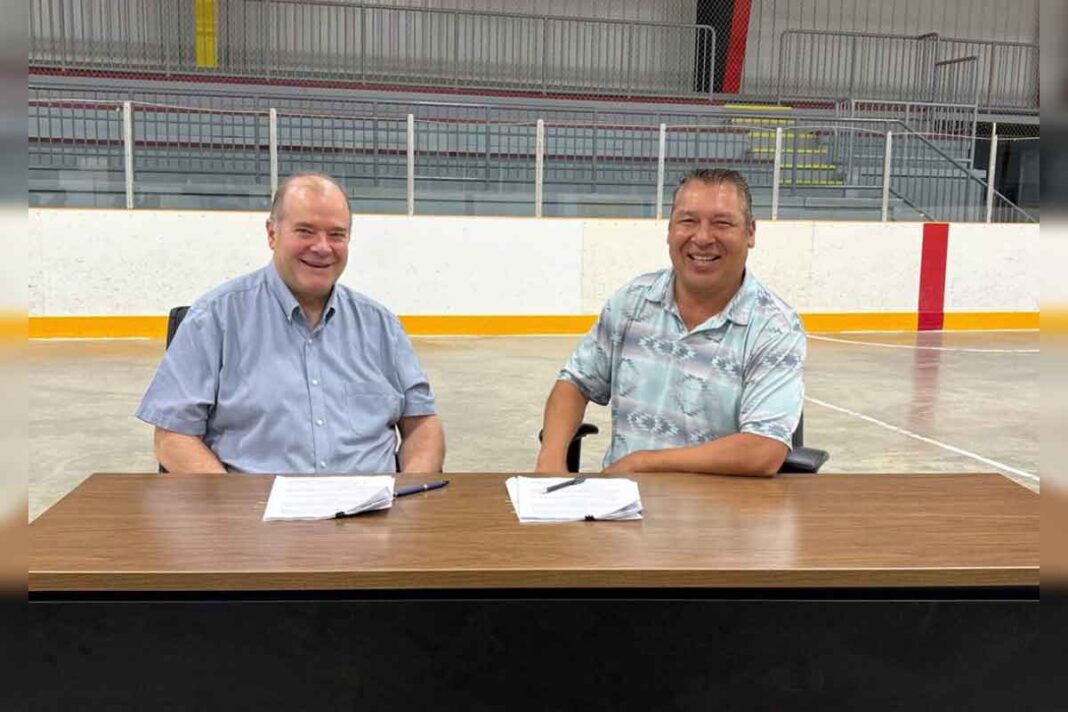
WIIKWEMKOONG—Where granite bluffs meet inland seas and the forest canopy closes overhead the paths walked by Anishinabek for millennia, the echo of a sacred vow some believed lost to time is once again enshrined by the people of Wiikwemkoong Unceded Territory.
Forty-two thousand hectares of forest—nearly two-thirds of the Nation’s land—will be stewarded by Wiikwemkoong within the scope of a 40-year carbon project that will restore right relations between the people and all beings upon whose lives depend upon the living web of soil, the quiet wisdom of rivers, the subtle council and networked voices of leaves, root and soil—the unseen pulse of a world held in balance by care, respect and remembrance.
Wiikwemkoong, in partnership with Finite Carbon Canada, has chosen to bind its economy to the Improved Forest Management for Canadian Forestlands protocol, a rigorous standard first published by the American Carbon Registry in September 2021.
“Our values as Anishinabek are central to this project, as stewards of the land, we see the benefits of this project – for not only the preservation of resources, but the other positive impacts to the environment,” stated Ogimaa Tim Ominika of Wiikwemkoong.
“Our team has done the research and due diligence needed, and we are pleased to begin this project with Finite Carbon Canada,” added Ogimaa Ominika.
Guided by the Improved Forest Management protocol for Canadian forestlands, first illuminated by the American Carbon Registry in 2021, this 40-year project enters into a covenant of care with the forest as a living ally— all within the recognition and protection of emerging legislation that acknowledges the authority and rights of the Nation to govern its land; in this sacred alignment of law, science, and ceremony, the forest becomes both teacher and partner, and every action taken resonates across generations, weaving a conciliatory story of reciprocity, responsibility and enduring balance into the fabric of the land itself.
The protocol is not a vague pledge. This is the practice of true guardianship, of deliberate governance. It requires transparent baselines, ongoing monitoring, independent verification, and permanence strategies. Every tonne of carbon saved must be proven and accounted for. Every credit issued must represent enduring forest still standing, verifiable emissions actualized sequestered.
This is the antithesis of greenwashing. This partnership is a deliberate, measured act of care that honours the spirit of conservationism in ways that governments past and present have too often promised, only to have those promises circumvented and waylaid by short-sighted policy that translates into harm
Through the Improved Forest Management protocol, the Nation’s stewardship becomes a covenant recognized not only by the pulse of the forest, but by the law itself. Each intentional act—selecting which trees to harvest, which groves to protect, which cycles to extend—is measured and witnessed by independent guardians, creating a record of care that is both scientifically rigorous and legally defensible.
This forest project generates tangible economic benefits that extend far beyond carbon credits. By increasing carbon sequestration through verified improved forest management, the Nation can generate a predictable, long-term revenue stream from the sale of carbon credits in regulated and voluntary markets. At the same time, careful stewardship maintains the value of timber and non-timber resources, protects watersheds and soils and avoids costly environmental degradation. Implementing these practices creates stable, skilled employment in monitoring, forest management, and carbon accounting, building local capacity while reinforcing the land’s long-term productivity. By combining legal recognition of the Nation’s authority with rigorous verification under the IFM protocol, the project secures both ecological and financial returns, making it a reliable, resilient, and high-value economic strategy, while participating in a framework that validates reciprocity between human hands, living ecosystems and emerging legal recognition.
The Quinte Conservation initiative in southern Ontario has already shown the economic potential of forest carbon projects, managing over 10,000 hectares of forest to generate carbon credits that provide hundreds of thousands of dollars in revenue while supporting watershed health, biodiversity, and sustainable management. The Wiikwemkoong forest carbon project, by contrast, spans 42,000 hectares—more than four times the size of Quinte’s initiative—and has the potential to vastly exceed it in both environmental impact and economic return.
Beyond the sale of carbon credits, the project will create skilled employment in monitoring and forest management, strengthen local capacity for stewardship, and provide a steady, long-term revenue stream that supports community programs, all while ensuring that the Nation retains legal and cultural authority over its land. In this way, the project demonstrates how careful stewardship, rigorous verification and Indigenous leadership can turn conservation into a financially viable, sustainable strategy for decades to come.
“Protecting 42,000 hectares of Manitoulin’s bioculturally diverse forests is the largest conservation commitment on the Island in decades,” said Kim Neale, an engineer and certified risk and sustainability professional (B.Sc Eng, CIP, CRMP, ISSPA) and nature-related finance specialist with over 15 years’ experience in carbon markets. “To put it in perspective, this project adds 40 times more protected land than Misery Bay Provincial Park.”
The Wiikwemkoong forest carbon project shows that Indigenous leadership over the land isn’t just a matter of justice—it’s smart economics for everyone. By keeping control of their forests, the Nation can manage them carefully, sell carbon credits and create jobs in monitoring, forestry, and conservation. That means steady income that supports schools, healthcare and community programs, while the forests themselves continue to clean the air, protect wildlife, and safeguard watersheds.
“This is the first voluntary carbon credit project on reserve lands in Canadian history Wiikwemkoong’s relational approach to buying and selling credits, and its emphasis on keeping revenue local, sets a new standard for First Nations-led innovation in carbon markets,” Ms. Neale told The Expositor, emphatic that the project is not only an historic one, but a boon for the Island. “By combining improved forest management with carbon credit generation, this project sequesters more carbon, reduces wildfire and climate risk, and creates long-term local jobs,” Ms. Neale says. “High-integrity initiatives like this make our local economy more resilient while protecting the lands and waters we all share.”
When Indigenous communities lead conservation projects like this, the benefits ripple outward: Canadians gain from cleaner air, healthier ecosystems, and more sustainable economic practices. It’s a model that proves economic growth and environmental stewardship don’t have to conflict—they can flourish together. Wiikwemkoong’s approach offers a blueprint for the whole country, showing that respecting Indigenous sovereignty can spark collective prosperity for generations to come.
The Forest That Counts
Forty-two thousand hectares. Forty years. Millions of tonnes of carbon. The numbers are colossal, yet their true story unfolds quietly, in the patient work of trees, roots, and soil. Picture it: a forest twice the size of Toronto, allowed to grow, breathe, and heal. Every tree a worker, every acre a sponge, every root a safeguard. It is scale made tangible, science made living.
Over the life of this project, the forest will hold between two and four million tonnes of CO2, carbon pulled from the sky and tucked into bark, leaf, and root. Each hectare draws down 30 to 100 tonnes per year, a silent labour, day by day, season by season. In human terms, the forest’s annual work is like taking 200,000 to 400,000 cars off the road—exhaust undone, atmosphere spared. Every acre is a sponge, every root a safeguard, every tree a worker in a vast, breathing system that stabilizes soil, purifies water, protects wildlife, and buffers against wildfire and extreme weather.
And it is here that Finite Carbon, North America’s largest developer of nature-based carbon solutions, enters the story. Specializing in Improved Forest Management, they bring decades of expertise and innovation to projects like Wiikwemkoong’s, ensuring that the Nation retains full control of its carbon credits while maximizing both ecological and economic impact. The approach is meticulous: feasibility studies, certified forest inventories, modeling CO2 sequestration, independent verification, registry submission, and marketing support for carbon credits.
Since 2009, Finite Carbon has developed over 60 projects across nearly four million acres and generated over 100 million offsets and more than $1 billion in carbon revenue, benefiting Indigenous communities, family landowners, and local economies. This is not theory—it is tangible, measurable impact. Jobs are created in forest management, monitoring, and conservation. Revenue flows into schools, health services and community programs. The forests remain vibrant, water flows clean, and biodiversity thrives.
The first carbon credits from Wiikwemkoong’s stewardship are expected in 2026, promising a long-term, locally controlled revenue stream. These forests do more than store carbon—they are investments in resilience: economic, ecological, and social. Companies, increasingly selective about high-integrity offsets, will find a proven solution here, where science, Indigenous knowledge, and careful forest management converge.
In Wiikwemkoong, the forest, the land and its people are aligned. Ecological stewardship and economic opportunity are inseparable.
The benefits ripple outward, far beyond the immediate boundary: soil held fast along riverbanks, water kept pure and steady, habitats for birds, mammals, insects, and pollinators secured. Wildfire risk diminishes, extreme weather finds a buffer and the forest hums with life—an invisible network, a planetary nervous system of roots, leaves and rivers.